 Semiahmoo Siding
 What LP SmartSide Actually Is
LP SmartSide is an engineered wood siding product made from wood strands bonded with resin and wax, then treated with LP's proprietary SmartGuard process and coated with a resin-saturated overlay before finishing. It's manufactured to look like traditional wood lap or panel siding, and it comes in trim, soffit, and panel configurations that make it a flexible option for a lot of home styles. It's a legitimate step up from the old OSB siding products of decades past, and LP has put real engineering into making it more moisture-resistant than its wood-composite predecessors.
We get asked about it often enough that it's worth a straight answer: it's not a bad product on paper. But after years of installing and repairing siding around Whatcom County, we made a decision to install only James Hardie fiber cement, and we think homeowners deserve to know why — not a sales pitch, just the honest reasoning.
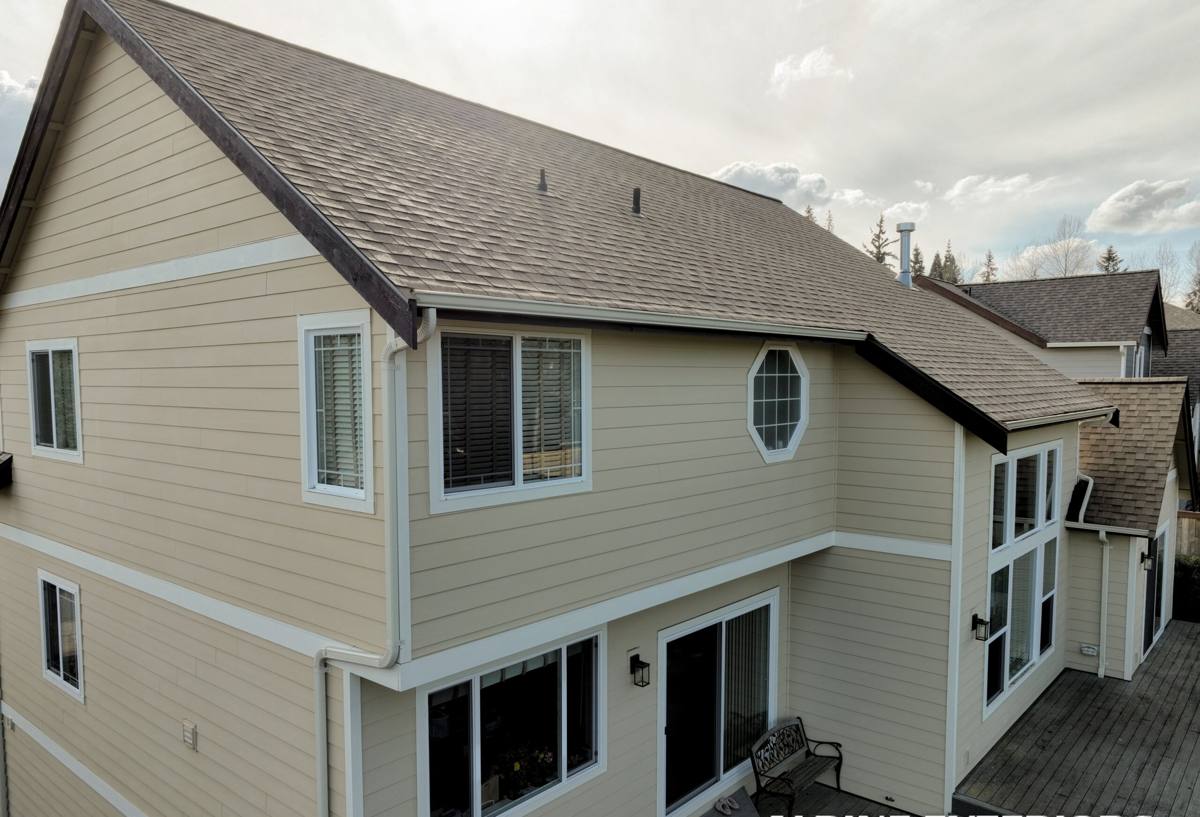
What LP SmartSide Gets Right
Fair is fair. LP SmartSide has real advantages that make it a reasonable choice for some contractors and some homes:
- It's lighter and easier to cut and nail than fiber cement, which can shave labor time on a job.
- It holds paint well when the finish is intact and maintained.
- It resists impact from hail and incidental bumps better than vinyl.
- It's generally less expensive than fiber cement, both in material cost and installation labor.
- It's widely available and most siding crews are comfortable working with it.
If cost were the only factor, or if this home were sitting somewhere dry and inland, SmartSide would be a defensible pick. That's not the situation most of our customers are in.
Why We Don't Install It
Our decision comes down to one core fact: LP SmartSide is still, at its core, a wood-based product. It's engineered, treated, and coated to resist moisture far better than raw lumber or old-style OSB siding — but wood strand substrate that gets wet and stays wet will swell, delaminate at the edges, and eventually rot. The entire performance of the product depends on the factory coating and the site finish remaining unbroken, forever, on every surface, cut, and seam.
The Field-Cut Problem
Every piece of SmartSide that gets cut on site — around windows, doors, corners, penetrations — exposes raw, uncoated substrate at that cut edge. The manufacturer's install instructions require field-applied primer or sealant on every one of those cuts before installation. It's a simple step, but it's also the single most common shortcut on real job sites, because it's slow, it's easy to miss on a piece nobody will see again once it's nailed up, and it doesn't show as a problem until years later when moisture has already worked its way in.
Our Regional Exposure
Semiahmoo sits right on the water, between Drayton Harbor and Boundary Bay, which means salt-laden air and driving rain off the Strait are just part of daily life here. Add in Whatcom County's long, damp moss season, and you've got siding that stays wet — or at least humid — for a large chunk of the year. That's a tough environment for any coated wood product. Salt air accelerates coating breakdown, wind-driven rain finds every gap in caulking and flashing, and prolonged moss and mildew growth traps moisture right against the wall surface. Fiber cement doesn't have a substrate that swells or rots when that happens; engineered wood does.
The Maintenance Isn't Optional
SmartSide's warranty and its actual field performance both depend on the homeowner keeping the factory or site finish intact — recaulking joints, repainting on the manufacturer's recommended schedule, and catching any coating failure before it becomes a moisture problem. That's a real, recurring obligation, and in our experience it's the exception rather than the rule for most homeowners to keep up with it precisely on schedule for 20+ years.
Engineered Wood vs. Fiber Cement: How They Handle Moisture
| Factor | LP SmartSide (Engineered Wood) | James Hardie (Fiber Cement) |
|---|---|---|
| Core material | Wood strands + resin, wax, and coating | Cement, sand, and cellulose fiber |
| Response to trapped moisture | Swells, can delaminate or rot at edges | Does not swell or rot; dimensionally stable |
| Combustibility | Combustible (wood-based) | Non-combustible |
| Field-cut edges | Must be primed/sealed on site per spec | No rot risk at cut edges; still should be primed for finish uniformity |
| Finish maintenance | Repainting/recaulking on a defined schedule required | ColorPlus factory finish is warrantied separately; less frequent repainting |
| Typical installed cost | Lower | Moderate to higher |
What This Means in Practice
The table isn't saying SmartSide is defective — it's saying the two products manage water differently, and one of those approaches gives you a much bigger margin for error over 20-30 years of Pacific Northwest weather, imperfect caulk joints, and homeowners who don't repaint on a strict schedule.
The Maintenance Commitment LP SmartSide Requires
If you already own SmartSide siding, or you're weighing it for a new install, here's what keeping it healthy actually looks like over time:
- Inspect caulking at all joints, trim, and penetrations at least once a year, and recaulk anywhere it's cracked or pulled away.
- Repaint on the schedule the manufacturer specifies for your climate zone — coastal, high-moisture areas like ours generally need more frequent attention, not less.
- Check for and remove moss, algae, and standing debris at seams and behind trim, since trapped organic matter holds moisture against the surface.
- Watch for soft spots, edge swelling, or bubbling paint, especially near ground level, roof lines, and deck ledger boards — early signs of moisture intrusion.
- Keep sprinklers and downspouts directed away from the siding; SmartSide doesn't tolerate repeated direct wetting well.
- Address any damage immediately rather than waiting for a broader repaint, since exposed substrate deteriorates faster than coated substrate.
None of that is unreasonable to ask of a homeowner. But it's a real, ongoing commitment, and it's very different from the maintenance profile of a non-combustible fiber cement product that doesn't have a wood core to protect.
Warranty Structure Worth Understanding
Like most engineered wood siding products, LP SmartSide's warranty coverage is conditioned on installation per the manufacturer's specifications and on the homeowner keeping up with recommended maintenance, including finish upkeep. That's a normal structure for the category — it's not unique to LP — but it means the warranty is only as strong as the weakest link in installation and upkeep over the decades the siding is on the wall. If a caulk joint fails and nobody notices for a year, the resulting damage may not be treated the same as a manufacturing defect.
We prefer to install a product where the substrate itself isn't the thing standing between a small maintenance lapse and a real repair bill.
Why We Standardized on James Hardie
After weighing the trade-offs across every product we could install, we made James Hardie fiber cement our only siding line. A few of the specific reasons:
- Non-combustible core — cement, sand, and cellulose fiber don't burn, swell, or rot the way an organic wood-strand substrate can.
- Climate-engineered product lines — Hardie's HZ10 line is formulated specifically for the wetter climate zones the Pacific Northwest falls into, including moisture and freeze-thaw behavior relevant to our winters.
- ColorPlus factory finish — baked-on color with its own separate finish warranty, which reduces (though doesn't eliminate) the repainting burden compared to field-finished siding.
- Strong transferable warranty — a long, non-prorated product warranty backed by a manufacturer with decades of fiber cement manufacturing behind it.
- Proven longevity when installed to spec — the material margin for installer error is wider, which matters when you're trusting a crew's caulk joints to hold for 30 years.
This isn't about chasing the most expensive option available. It's that after doing this work in Whatcom County's climate for years, we don't want to put a wood-based product on a home that's going to face salt air, driving rain, and months of moss season every single year, and then hope every field cut got sealed and every recaulk happened on schedule.
Cost Considerations
| Factor | LP SmartSide | James Hardie Fiber Cement |
|---|---|---|
| Material cost | Lower | Moderate to higher |
| Installation labor | Faster, generally lower labor cost | More labor-intensive, specialized tools and technique |
| Ongoing maintenance cost | Recurring repaint/recaulk cycles over the siding's life | Lower repaint frequency with ColorPlus finish; still needs periodic caulk inspection |
| Long-term cost picture | Lower upfront, higher lifetime maintenance investment | Higher upfront, lower lifetime maintenance investment |
Upfront price isn't the whole story on either product — it's worth thinking about what you're actually signing up to maintain for the next 20-30 years, not just what the estimate says on day one.
Questions Worth Asking Before You Choose a Siding Material
- What substrate is this siding made from, and how does it behave when it gets and stays wet?
- What does the manufacturer require at every field cut, and how is that enforced on the job site?
- What maintenance schedule does the warranty assume, and what happens to coverage if that schedule slips?
- How does this product perform specifically in coastal, high-moisture climates like ours — not just national averages?
- Is the installer specialized in this specific product, or is it one of many products they install without deep familiarity?
If you're weighing your options for a re-side or new build near Semiahmoo, we're happy to walk your home, talk through what we see, and give you a free, no-pressure estimate for a James Hardie install — no obligation either way.