 Semiahmoo Siding
 One Product, One Standard
Most siding contractors carry a little of everything — vinyl for the budget jobs, LP SmartSide for the middle tier, fiber cement for the higher end. We don't. We install James Hardie fiber cement siding, exclusively, on every home we side in Semiahmoo and the rest of Whatcom County. That's not a marketing gimmick. It's a decision we made after years of watching which siding systems actually held up on this stretch of coastline, and which ones created callbacks.
Semiahmoo sits right on the water, which means every home here deals with a combination that most siding products were never designed for: constant salt-laden air, driving wind-blown rain off the Strait, and long stretches of gray, damp weather that keep exterior surfaces wet for days at a time. Add in the moss and algae growth that thrives in that kind of shade and moisture, and you've got a climate that's genuinely hard on a house's exterior. We'd rather install one product well than juggle five products that all have different failure points.
What Fiber Cement Actually Is
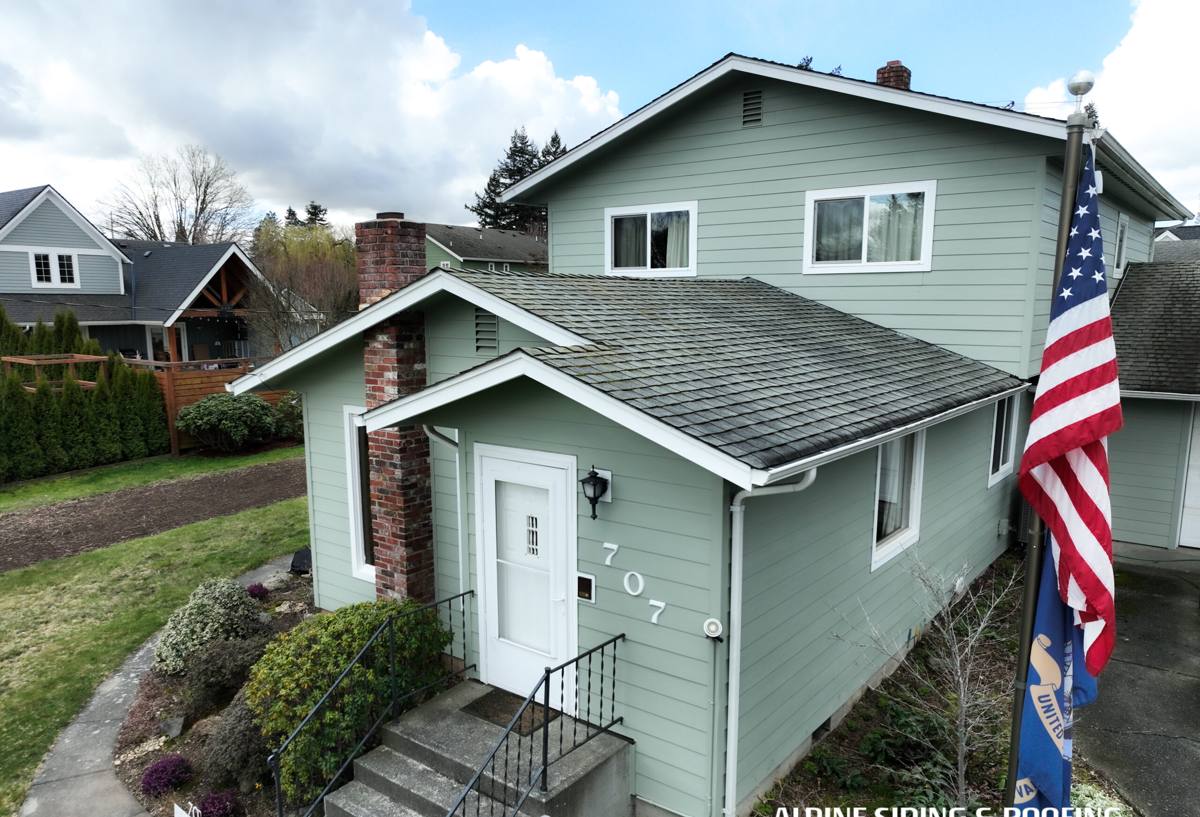
James Hardie siding is made from a mix of Portland cement, sand, and cellulose fiber, cured under pressure into dense, stable boards. It is not a plastic product like vinyl, and it is not a wood-and-resin composite like LP SmartSide. That distinction matters more than people expect:
- It doesn't expand and contract with temperature the way vinyl does, so it doesn't warp, buckle, or pull away from the house over time.
- It contains no wood fiber on the exposed face, which is the main thing that separates it from engineered wood siding products and their moisture-swelling risk.
- It's non-combustible, which matters to insurers and to homeowners who've watched wildfire coverage change in the Pacific Northwest over the past decade.
- It holds paint and factory finish differently than wood-based products, because it isn't absorbing and releasing moisture the same way.
None of that makes it magic. Fiber cement still has to be installed correctly, caulked correctly, and maintained. But it starts from a more stable, more water-resistant base material than the alternatives, and in a climate like ours that head start matters.
Why This Matters More Here Than Elsewhere
A siding product's weak points show up fastest in the conditions that stress them. In a dry inland climate, a mediocre siding choice might look fine for fifteen years. On the water in Whatcom County, with salt air accelerating corrosion of fasteners and finishes, and rain hitting the siding sideways for months of the year, weak points show up in five to seven. We've seen it. That's a big part of why we stopped installing anything else.
Built for Wet Climates: The HZ5 Product Line
James Hardie engineers its siding differently depending on the climate zone it's sold into. The HZ5 line is engineered specifically for wetter, harsher climates — the Pacific Northwest included — with formulations designed to resist moisture intrusion and hold up under sustained damp conditions better than the HZ10 line sold in drier regions of the country. When we order material for a Semiahmoo project, it's HZ5, full stop. There's no version of this job where installing the wrong climate zone product makes sense, even though it would be cheaper to just stock one nationwide SKU.
This is one of the quieter reasons homeowners should ask any contractor, for any fiber cement job, which climate zone product they're actually installing. Not all "James Hardie siding" quotes are apples to apples if the zone isn't specified.
ColorPlus Factory Finish vs. Field-Painted Siding
The other piece of the Hardie system we insist on is the ColorPlus finish — color that's baked onto the board at the factory under controlled conditions, rather than a house being primed at the factory and painted on-site after installation. A few reasons this matters:
- Factory-applied finish is more uniform and more resistant to fading than most field-applied paint jobs, especially in UV and salt exposure.
- It comes with its own dedicated finish warranty, separate from the substrate warranty, which most field-paint jobs simply don't offer.
- It eliminates a huge amount of the risk that comes from weather-dependent, crew-dependent field painting — a rushed paint job in damp Whatcom County conditions is one of the most common sources of early siding failure we've seen on other contractors' work.
We do install primed Hardie board in specific situations where a custom, non-standard color is required, but ColorPlus is the default and the strong recommendation for anyone on the water where UV and salt exposure are highest.
The Lines We Actually Install
| Product | Typical Use | Why We Use It Here |
|---|---|---|
| HardiePlank lap siding | Primary wall cladding, most homes | The workhorse; wide range of exposures and profiles, proven track record in wet coastal conditions |
| HardiePanel vertical siding | Modern/contemporary facades, accent walls | Clean lines, holds up well on gable ends exposed to driving rain |
| HardieShingle | Accent gables, Craftsman and cottage-style homes | Gives the staggered-shingle look without the maintenance burden of cedar shingle in a damp climate |
| HardieTrim | Corners, fascia, window and door trim | Matches expansion behavior of the field siding so trim doesn't move independently and open up joints |
We spec the product line to the house, not the other way around. A waterfront home with heavy wind exposure gets different fastening and flashing details than an inland Semiahmoo lot on a protected slope, even though both get the same underlying material.
What Correct Installation Actually Requires
Fiber cement's reputation problems almost never come from the material itself — they come from installation shortcuts. James Hardie publishes detailed installation specifications, and following them isn't optional if you want the warranty to mean anything. On a Whatcom County home, our installation checklist includes:
- Correct minimum clearance between siding and grade, decks, and roof lines to keep the bottom edge out of standing water and splash-back
- A proper weather-resistive barrier and rainscreen gap behind the siding, so any moisture that does get past the cladding can drain and dry rather than sitting against the sheathing
- Manufacturer-specified fastener type, spacing, and penetration depth — corrosion-resistant fasteners are non-negotiable this close to salt air
- Correct joint treatment and caulking at butt joints, corners, and penetrations, using products compatible with the ColorPlus finish
- Proper flashing at every window, door, and roof intersection, since most water intrusion problems start at a poorly flashed penetration, not through the field of the siding itself
- Field-touch-up paint matched and applied correctly at cut edges and fastener heads to preserve the finish warranty
Skip any one of these and you can install the best siding material on the market and still end up with moisture problems in a few years. This is also why we're skeptical of rock-bottom bids on fiber cement work — a proper installation takes more time and more material (starter strips, flashing tape, corrosion-resistant fasteners) than a corner-cut one.
The Warranty, in Plain Terms
James Hardie's product warranty on the fiber cement substrate is a long-term, non-prorated warranty, and the ColorPlus finish carries its own separate finish warranty covering fading and chipping. Warranties are also transferable to a subsequent owner within a defined window, which matters for resale — a documented, transferable warranty on the exterior cladding is a real selling point for a buyer, especially in a coastal market where buyers are already asking hard questions about moisture history.
What the warranty does not do is cover damage caused by improper installation. That's the other half of why we're strict about our own crews following the installation spec to the letter — a warranty claim that gets denied because of an installation error is a bad outcome for everyone, and it's entirely preventable.
What We Don't Install, and Why That's the Point
We get asked fairly often why we won't quote vinyl, LP SmartSide, or other fiber cement brands alongside Hardie. The honest answer is that carrying multiple product lines means carrying multiple sets of installation details, multiple warranty structures, and multiple sets of trade-offs to explain to homeowners — and it makes it easy for a crew to get sloppy on whichever product they install less often. Standardizing on one system that's engineered for wet coastal climates, backed by a factory finish, and installed the same correct way every time, is how we keep quality consistent from job to job. It also means when we tell a homeowner in Semiahmoo what to expect from their new siding in year ten and year twenty, we're speaking from direct, repeated experience with that exact product in that exact climate — not a general sense of how fiber cement behaves.
Is It Right for Your Home?
For the vast majority of homes we look at in Semiahmoo and greater Whatcom County, the answer is yes, with the specific product line and color chosen to match the home's exposure and style. There are edge cases — historic homes with strict material requirements, or specific architectural details — where a conversation about options makes sense. But for a standard re-side or new construction project on the coast, fiber cement with a factory finish, installed to spec, is the choice we can stand behind without hedging.
If you're weighing a siding replacement or new build in Semiahmoo, we're glad to walk your specific house, point out what the salt air and moss exposure have done to your current siding, and give you a straightforward, no-pressure estimate for what a correctly installed Hardie system would look like on your home.