 Semiahmoo Siding
 Siding Built for Cherry Point's Coastal Conditions
Cherry Point sits right up against the Salish Sea, and that location shapes everything about how a house ages here. Homes in this part of Whatcom County take on salt-laden air off the water, long stretches of driving rain through fall and winter, and a moss season that can run eight months or longer on north-facing walls and anything shaded by fir and cedar. It's a different set of stresses than you'd see on a home twenty miles inland, and the siding on a Cherry Point house needs to be chosen and installed with that in mind.
We're a local exterior contractor working throughout the Semiahmoo area, and Cherry Point is squarely in our service territory. We install siding, roofing, windows, and decks, and on every one of those trades the same regional reality applies: this is a marine climate, and materials that aren't suited to it fail faster than homeowners expect.
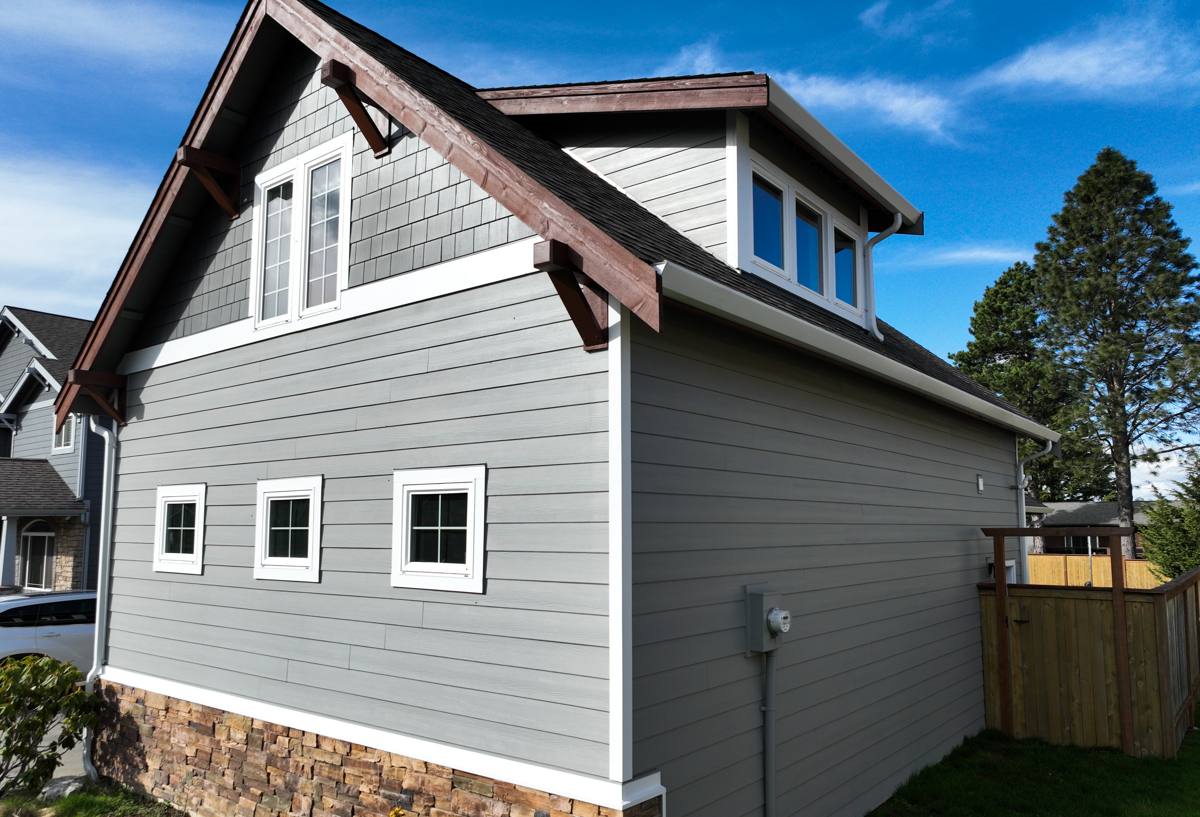
What Salt Air and Moisture Actually Do to a House
Salt air and fasteners
Airborne salt doesn't just sit on a wall — it works into seams, fastener heads, and any spot where two materials meet. Over years, that accelerates corrosion on lower-grade fasteners and trim hardware, and it can speed up the breakdown of paint films and caulk joints that weren't rated for a marine environment. It's a slow process, which is exactly why it gets overlooked until a wall is already showing damage.
Driving rain and wind-driven wetting
Storms coming off the water in this area tend to bring rain sideways, not straight down. That means siding laps, butt joints, and window and door flashing take on water that a calmer climate would never test. Any weak point in the water-management details — not just the siding material itself — becomes the place where a wall starts to fail.
Moss, algae, and shaded exposures
Cherry Point properties with mature tree cover or north- and east-facing walls stay damp for extended periods, especially through the wet season. That's ideal growing conditions for moss and algae, which hold moisture against the surface below them. Siding that absorbs water or swells when wet is far more vulnerable to this kind of sustained dampness than siding that's dimensionally stable and doesn't take on water in the first place.
Why We Install Only James Hardie Fiber Cement
We made a deliberate decision as a company to install one siding system — James Hardie fiber cement — and not offer vinyl, LP SmartSide, Cemplank, Allura, or unfinished wood species like primed spruce or cedar. That's not a marketing position, it's a standard we hold because of what we see on homes in this exact climate.
- Non-combustible core: Hardie's fiber cement is engineered from cement, sand, and cellulose fiber, giving it a non-combustible composition — a meaningful consideration anywhere in Whatcom County given regional wildfire risk in dry summer stretches.
- Won't swell, rot, or feed pests: Because it's cement-based rather than wood-based, it doesn't absorb water the way engineered wood or untreated wood siding can, and it isn't a food source for insects.
- Factory-applied ColorPlus finish: Rather than site-painted, Hardie's ColorPlus finish is baked on in a controlled factory process, which gives more consistent, longer-lasting color performance against UV and salt exposure than field-applied paint.
- HZ5 climate engineering: Hardie manufactures region-specific formulations, and the HZ5 product line is engineered for the freeze-thaw and moisture patterns of the Pacific Northwest — relevant for a coastal Whatcom County property.
- Transferable, substantial warranty: Hardie backs its siding with a strong product warranty that can transfer to a new owner, which matters if you plan to sell in Cherry Point's market.
We're upfront that other products have real strengths — vinyl is inexpensive, LP SmartSide is easy to install quickly, cedar looks beautiful when new. Our reason for not installing them comes down to what we've watched happen to those materials specifically in this marine, high-moisture climate over the long run: higher maintenance burden, moisture sensitivity, or installation tolerances that are easy to get wrong. We'd rather install one system correctly than offer five and let homeowners gamble on which one holds up.
How Fiber Cement Performs Against the Alternatives Here
| Factor | James Hardie Fiber Cement | Vinyl | Engineered Wood (LP SmartSide) | Untreated Wood/Cedar |
|---|---|---|---|---|
| Moisture absorption | Very low | Low, but seams/expansion can trap water | Moderate — vulnerable if edges aren't sealed | High — needs ongoing maintenance |
| Salt air resistance | Strong | Moderate — can chalk and become brittle | Moderate | Low without frequent refinishing |
| Fire classification | Non-combustible | Combustible (petroleum-based) | Combustible | Combustible |
| Finish longevity | Factory-baked ColorPlus, long-rated | Color molded in but can fade/chalk | Field or factory finish, varies | Needs repainting/staining cycles |
| Typical maintenance | Low — periodic wash and caulk check | Low, but repairs can be visible | Moderate — watch for edge swelling | High — recurring refinishing |
This isn't a knock on any one product line — it's a summary of the trade-offs that matter most in a coastal Whatcom County setting, where salt exposure and sustained moisture are constant rather than occasional.
Roofing, Windows, and Decks in the Same Climate
Siding doesn't work in isolation — the whole exterior envelope has to manage water and salt exposure together. A roofing system in poor condition sends water down behind siding at the eaves and valleys. Windows with failing seals let moisture into wall cavities behind even well-installed siding. Decks facing the water take the same driving rain and salt exposure as the siding above them, often with more direct sun and standing water at the surface.
Because we handle siding, roofing, windows, and decks as one contractor, we look at a Cherry Point property as a full system rather than four separate quotes. That matters most at the transitions — where a roofline meets a wall, where a window is flashed into siding, where a deck ledger attaches to the house — because that's where most real-world water intrusion starts.
What a Siding Project Looks Like in This Area
Assessment
We start by walking the exterior and looking specifically at the north and east elevations, anywhere with tree shade, and any area with visible moss, staining, or soft trim. On a coastal property this initial look often tells us more than the homeowner's stated concern does.
Removal and inspection
Once old siding comes off, we check the sheathing and framing underneath for hidden moisture damage. This is common enough on older coastal homes that we build time for it into the schedule rather than treating it as a surprise change order.
Water management details
Correct flashing, house wrap integration, and properly lapped joints matter more here than in a drier inland climate, because wind-driven rain will find any gap eventually. This is where installer experience with fiber cement specifically — not just siding in general — makes a measurable difference.
Installation to manufacturer spec
Hardie's warranty and performance depend on installation following the manufacturer's specifications — proper fastening, clearances, and caulking. We install to that spec as standard practice, not as an upsell.
A Practical Pre-Estimate Checklist
- Note which walls face north or east, or sit under heavy tree cover — these usually show moss and moisture wear first
- Look for soft spots, bubbling paint, or dark staining near the bottom of walls and around windows
- Check corners and butt joints for visible gaps or separated caulk
- Note the age of the current siding and whether it's been repainted or patched before
- Think about whether roofing, windows, or a deck also need attention — bundling can simplify scheduling and sequencing
Why a Local Crew Matters Here
A crew that works this stretch of Whatcom County regularly knows what Cherry Point's salt air and rain patterns do to a wall over time, because they've opened up enough old siding to see it firsthand. That's different from a crew that mostly works inland and treats every coastal job the same as a job in a drier microclimate. It shows up in the small decisions — how much clearance to leave at grade, how a joint gets sealed, which elevations get extra attention — that don't show up on a quote but do show up ten years later.
If you're weighing a siding project on a Cherry Point property, or want a second opinion on roofing, windows, or a deck, we're glad to come take a look. The estimate is free, there's no pressure, and we'll tell you honestly what we see.