 Semiahmoo Siding
 Roofing Built for Blaine Harbor's Waterfront Climate
Homes along Blaine Harbor sit in one of the more demanding roofing environments in Whatcom County. The harbor and the open water of Semiahmoo Bay send a steady drift of salt-laden air over every roof in the area, prevailing wind off the Strait of Georgia drives rain sideways into fascia and flashing details that a roof twenty miles inland never has to deal with, and the shade and dampness that come with a long Pacific Northwest wet season give moss and algae months at a time to get established. An asphalt shingle roof installed the same way it would be installed in a dry inland subdivision will show its age here faster than it should. One installed correctly, with the harbor climate in mind from the first course of underlayment to the last ridge cap, will hold up the way it's supposed to.
This page is about one thing: doing asphalt shingle roofing right for homes in and around Blaine Harbor. Not a generic overview of shingles in general, but what actually matters for a roof that has to shed driving rain, resist salt-air corrosion, and stay ahead of moss in a marine climate.
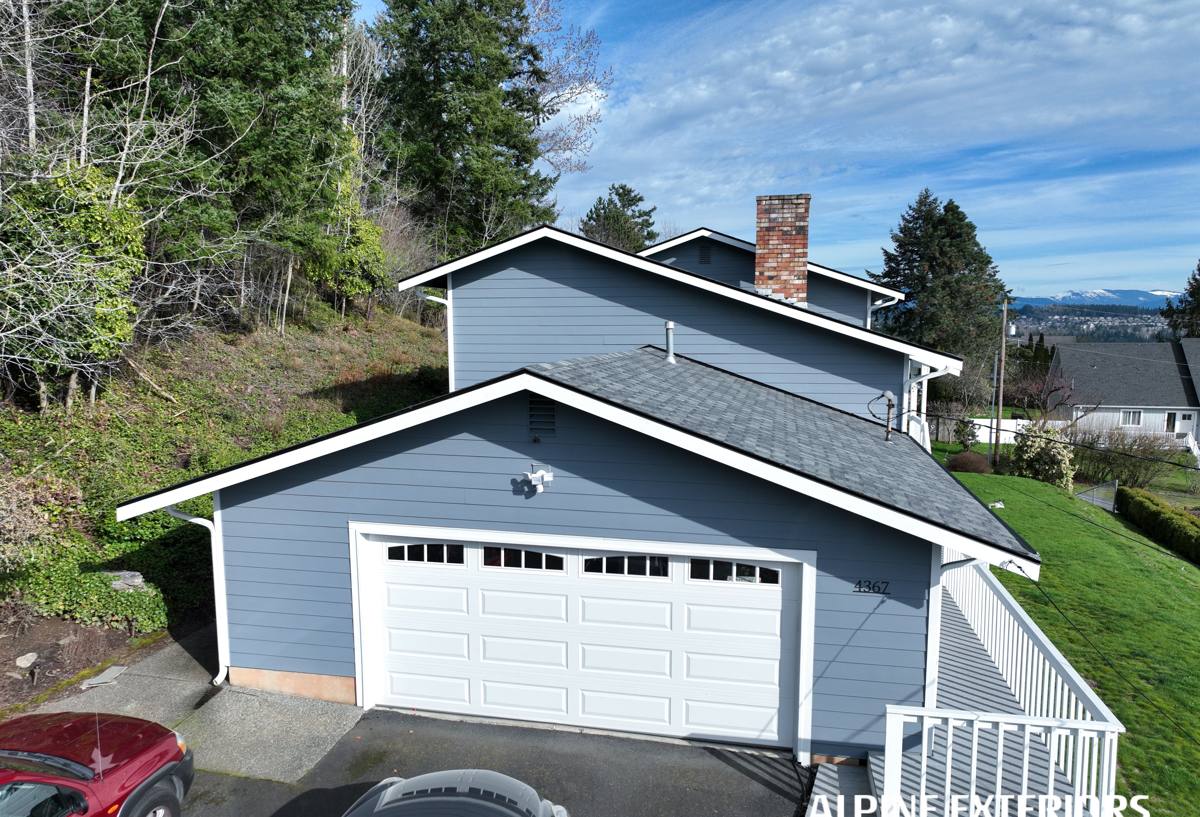
What Salt Air, Driving Rain, and Moss Actually Do to a Roof
Salt Air and Corrosion
Airborne salt from the harbor settles on every exposed surface, including metal. Roofing nails, flashing, drip edge, and vent stacks are all vulnerable if they're not rated for coastal exposure. Galvanized fasteners that would last decades in a dry inland climate can start showing rust streaks and weakening within a handful of years this close to the water. Once a fastener corrodes, it loses holding power, and a shingle that isn't fully secured is a shingle that's one windstorm away from lifting.
Driving Rain and Wind-Driven Water
Blaine Harbor gets wind off open water more consistently than most of the county, and wind-driven rain doesn't behave like rain falling straight down. It gets pushed up under shingle tabs, into exposed nail heads, and along valleys and flashing seams that would stay dry in calmer weather. A roof here needs tighter seal-down, more attention to flashing detail, and underlayment that's actually doing its job as a backup water barrier, not just a formality under the shingles.
Moss, Algae, and a Long Wet Season
Whatcom County's wet season runs long, and north-facing or shaded roof planes near mature trees can stay damp for weeks at a stretch. That's exactly the environment moss needs to take hold. Moss isn't just cosmetic — as it grows, it lifts shingle edges, holds moisture against the roof deck, and accelerates granule loss. Left unchecked over several seasons, it can shorten the useful life of an otherwise sound roof by years.
What a Correctly Installed Asphalt Shingle Roof Includes
A roof that's going to hold up on Blaine Harbor needs every layer working together, not just a good-looking shingle on top. Here's what we consider non-negotiable on a coastal Whatcom County installation:
- Starter strip at eaves and rakes — seals the vulnerable roof edges against wind-driven rain and uplift, which matters more here than in sheltered locations.
- Synthetic underlayment — a water-resistive barrier under the shingles that keeps the deck dry if wind pushes moisture past the shingle layer itself.
- Ice-and-water membrane at eaves, valleys, and penetrations — self-adhering membrane in the areas most exposed to standing water and wind-driven rain.
- Corrosion-resistant fasteners — nails and flashing specified for coastal/salt-air exposure, not standard-grade galvanized that will pit and weaken over time.
- Properly lapped step and counter-flashing — at chimneys, walls, and roof-to-roof transitions, where the majority of leaks actually originate.
- Balanced attic ventilation — intake at the eaves and exhaust at the ridge, sized to the attic volume, so moisture doesn't condense on the underside of the deck.
- Manufacturer-spec nailing pattern — correct nail count and placement per shingle, which is what actually determines wind rating, not the shingle product alone.
Skip any one of these and the roof is weaker than its warranty paperwork suggests. This is also why two roofs that look identical from the street can perform very differently five years in — the difference is almost always in the layers you can't see.
Choosing a Shingle for a Harbor-Exposed Roof
Not every asphalt shingle product is a good match for this climate. The table below covers the main factors we walk homeowners through when picking a shingle for a Blaine Harbor home.
| Factor | Why It Matters Here | What to Look For |
|---|---|---|
| Wind rating | Harbor-adjacent roofs see more sustained wind than sheltered inland lots | Shingles rated for higher wind speeds with a full manufacturer-spec nailing pattern |
| Algae resistance | Long wet season and shaded planes favor algae and moss growth | Shingles with copper- or zinc-infused granules built in for algae resistance |
| Granule quality | Driving rain and salt air both accelerate granule loss over time | Heavier, well-adhered granule coverage on a mid-to-upper-tier shingle line |
| Fastener compatibility | Standard fasteners corrode faster in salt air | Coastal-rated or stainless/coated nails, not builder-grade galvanized |
| Warranty structure | Coverage terms vary widely on wind and algae claims | Read the actual wind and algae clauses, not just the headline years |
Cost is a legitimate factor too, and it's fair to expect a range rather than a fixed number — the final price depends on roof size, pitch, number of layers being removed, deck condition once we open it up, and the shingle tier chosen. We'll walk through actual numbers for your roof during an on-site estimate rather than quoting blind.
How Our Process Works
Inspection and Estimate
We start by getting on the roof, not just looking at it from the driveway. That means checking the condition of the existing shingles, decking, flashing, and ventilation, and noting anything specific to your home's exposure — how much wind and salt drift it takes off the harbor, how much shade and moisture the north-facing planes hold onto, and where past repairs or patch jobs may have left weak points.
Tear-Off and Deck Assessment
For a full replacement, we remove old roofing down to the deck rather than layering over it. That lets us actually see the plywood or sheathing underneath and replace any sections that have soft spots or water staining before they're covered up and forgotten for another 20 years.
Installation
Underlayment, membrane, flashing, shingles, and ventilation go in as a system, following manufacturer specification for fastener count and placement — not a shortcut version of it. This is where the difference between a coastal-grade installation and a standard one actually shows up.
Final Walkthrough and Cleanup
We walk the finished roof with you, cover what maintenance to expect given your specific exposure, and make sure the property is cleared of debris and nails before we consider the job done.
Maintenance in a Moss-Heavy, Salt-Air Environment
A well-installed shingle roof still needs some seasonal attention here, more than it would inland. The goal is catching small issues — a lifted shingle edge, a patch of moss starting on a shaded plane, granules collecting in a gutter — before they turn into a leak.
- Keep gutters clear so wind-driven rain has somewhere to go besides under the shingles.
- Trim back overhanging branches to cut down on the shade and debris that feed moss growth.
- Have moss physically removed rather than left to spread — scraping and gentle treatment, not pressure washing, which strips granules.
- Check flashing and fasteners periodically for early corrosion, especially on roofs more than eight to ten years old.
- Schedule a walk-through after major windstorms to catch lifted or missing shingles early.
Signs Your Blaine Harbor Roof Needs Attention
Some warning signs are easy to miss from the ground, especially on a roof plane you don't see often. Use this list as a general guide for when to call someone out:
- Granules building up in gutters or at downspout outlets
- Shingle edges that look curled, cupped, or lifted, especially after a windy stretch
- Visible moss or dark streaking on shaded or north-facing roof planes
- Rust staining around flashing, vents, or exposed fastener heads
- Daylight or water staining visible in the attic near the roof deck
- Shingles noticeably thinner or more brittle than the surrounding field, a sign of granule and asphalt loss from age and weather exposure
Any one of these on its own might not mean an emergency, but on a harbor-exposed roof they tend to compound faster than homeowners expect. An honest inspection will tell you whether you're looking at a targeted repair or a roof that's genuinely at the end of its service life.
Why Local, Harbor-Familiar Experience Matters
A roofing crew that mainly works drier, more sheltered parts of Whatcom County can still put on a technically fine roof — but they may not default to coastal-rated fasteners, may under-spec the wind detailing, or may not flag the moss risk on a shaded north plane until it's already a problem. Working Blaine Harbor regularly means knowing which roof exposures on which streets tend to hold moisture longest, how much wind a given lot actually takes off the water, and which flashing details fail first in this specific climate. That familiarity shows up in fewer callbacks and a roof that performs the way it was supposed to, not just the way it looked on installation day.
Get a Straightforward Estimate for Your Roof
If your Blaine Harbor home needs a new asphalt shingle roof, a repair, or just an honest inspection to see where things stand, we're glad to take a look. Use the form below to request a free, no-pressure estimate — we'll assess your roof's actual condition and exposure and walk you through the options in plain terms, no obligation attached.