 Semiahmoo Siding
 Siding Repair in Blaine Harbor: A Different Job Than Inland
Blaine Harbor sits right on the water, along Drayton Harbor at the edge of Blaine in Whatcom County, and that location changes what "siding repair" actually means here. A repair estimate on a sheltered inland lot and one on a home a few hundred feet from moored boats and open water aren't the same job, even when the visible damage looks similar. Homes around the harbor take a steadier dose of salt air, more direct wind-driven rain, and a longer moss season than houses set back from the water, and all three of those conditions show up first, and worst, in the siding.
We install and repair James Hardie fiber cement siding exclusively, and Blaine Harbor is regular territory for our crew. This page covers what actually damages siding out here, how we tell a cosmetic repair from a structural one, what a correct repair job involves, and why hiring a crew that already knows this harbor beats hiring one that's learning it on your house. None of this is theoretical for us — it's the pattern we see call after call on homes within sight of the water.
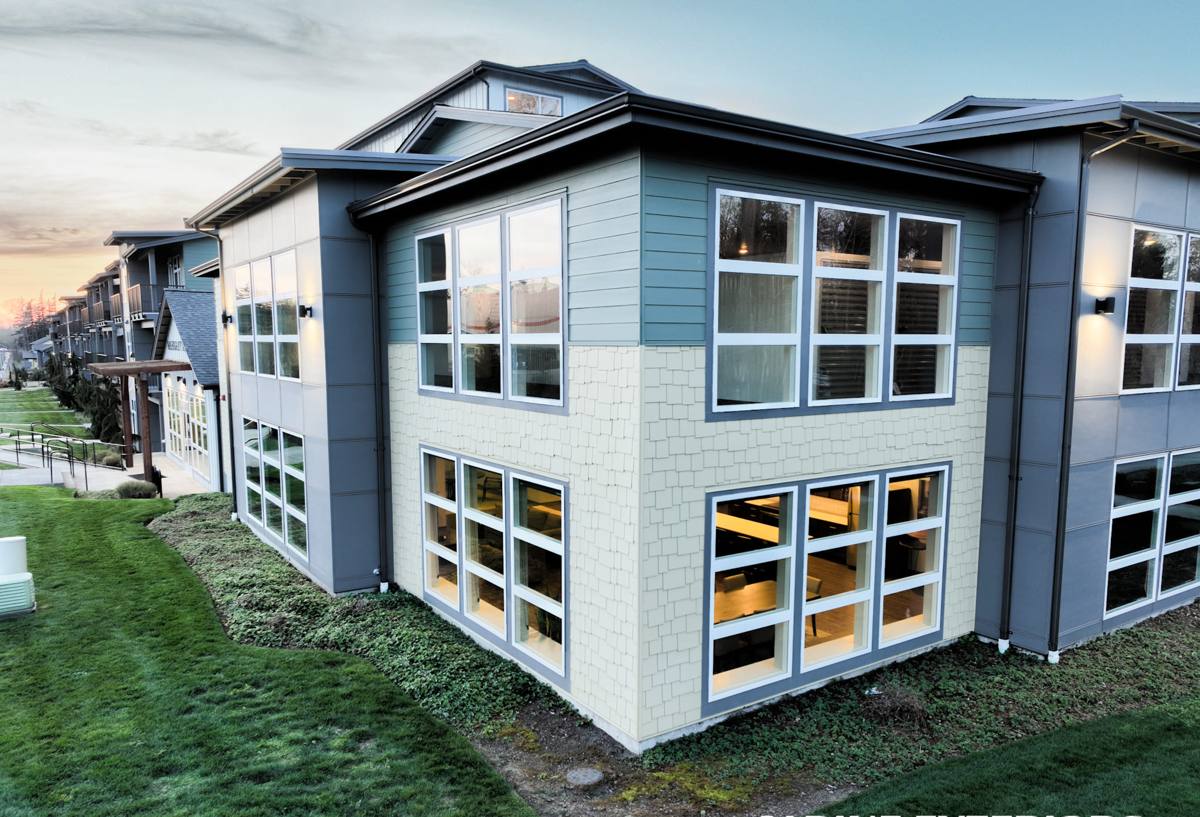
What the Harbor Climate Does to Siding
Salt Air Off the Water
Salt-laden air moves off the harbor and settles onto siding, trim, and fasteners continuously, not just during storms. Over time it accelerates corrosion in exposed hardware and breaks down lower-quality paints and finishes faster than a drier, more sheltered site would ever see. On a harbor-facing wall, that corrosion is often further along than it looks from the ground, because it starts at the fastener heads and joints before it shows as visible staining on the siding surface.
Driving Rain and Open Wind
With open water nearby and little to break the wind, rain around Blaine Harbor doesn't just fall — it gets pushed sideways into wall assemblies, seams, and trim joints with more force than the same storm would produce a few miles inland. That sideways-driven moisture finds gaps that a calmer site's rainfall never would, and it's a common reason we find water damage behind siding that still looks intact from the outside.
A Long Moss and Mildew Season
Mild temperatures and near-constant humidity give moss and mildew a growing season that runs most of the year in this part of Whatcom County, and homes close to the harbor don't get much of a break from it. Shaded, north-facing walls and anywhere water sits or drains slowly are usually the first places it takes hold, and it tends to come back quickly after a surface cleaning if the underlying moisture problem isn't addressed at the same time.
Common Siding Repair Issues We Find on Harbor-Area Homes
The repair calls we get around Blaine Harbor follow a pretty consistent pattern, shaped directly by the conditions above:
- Soft or spongy siding low on the wall or around window and door trim, usually a sign of moisture that's been getting in for a while
- Cracked or damaged panels near ground level, often from lawn equipment, moisture wicking from grade, or impact damage
- Corroded or failing fasteners and trim flashing, more common here than almost anywhere else in the county given the constant salt exposure
- Open or failed caulk joints at trim, window, and panel seams, which let wind-driven rain track behind the siding
- Moss and mildew staining that returns quickly after cleaning, pointing to a drainage or ventilation issue rather than just surface dirt
- Faded, chalking paint on older, non-Hardie siding that was never refinished with a factory-grade coating
- Panels that have separated, cupped, or pulled away from the wall at seams and corners
Individually, most of these look minor. Around the harbor, though, they tend to compound — a failed caulk joint feeds moisture to a fastener, the fastener corrodes and loses holding strength, and the panel it's holding starts to shift, which opens the joint further. Catching the problem at the caulk-joint stage is a much smaller job than catching it once a panel has actually started to move.
Repair or Replace? How We Make That Call
Not every siding problem on a harbor-area home means a full re-side, and not every "just a few boards" situation is actually a simple repair. The honest answer depends on what's happening behind the siding, not just what's visible on the surface.
| Condition | Usually a Repair | Often Points to Replacement |
|---|---|---|
| A handful of cracked or impact-damaged panels | Yes, if the wall behind them is dry | Only if damage is widespread across multiple elevations |
| Localized soft spots near grade or trim | Yes, once the moisture source is fixed | If probing finds soft sheathing over a large area |
| Corroded fasteners or flashing in a few spots | Yes — hardware swap during a panel repair | If corrosion is widespread across the whole wall system |
| Failed caulk joints and open seams | Yes — recaulk and reseal | Rarely on its own |
| Siding that's original, non-Hardie, and near end of life | Short term, as a stopgap | Usually, especially with recurring moisture issues |
We walk the exterior, probe suspect areas, and give a straight answer on which category a given wall falls into, including telling a homeowner when a repair is genuinely the right, cheaper call, rather than defaulting to whichever job is bigger.
What a Correct Siding Repair Actually Involves
Diagnosing the Cause, Not Just Patching the Symptom
A cracked panel or a soft spot is a symptom. Failed flashing, a clogged weep path, or a caulk joint that opened up a season ago is usually the cause. Replacing the visible damage without correcting what let moisture in behind it means the same repair shows up again in the same spot, often sooner the second time because the underlying problem was never actually fixed.
Matching Hardie Panels and ColorPlus Finish
Because we work exclusively in James Hardie fiber cement, repairs on homes we've already sided, or homes already carrying Hardie product, are straightforward to match: same panel profile, same factory ColorPlus finish, so a repair doesn't read as a visible patch job. On a home with older, non-Hardie siding, we'll be upfront that an exact match isn't possible and talk through whether a full re-side to Hardie makes more sense than chasing a mismatched patch for a few more years.
Hardware and Flashing Upgrades During the Repair
Any fastener, flashing, or trim piece we open up during a repair gets replaced with corrosion-resistant hardware suited to salt air exposure, not a like-for-like swap with standard-grade material that will fail on the same timeline. This is one of the more common places a repair either holds for years or needs redoing within a season, and it's not a detail we skip to save time.
Why Every Repair We Do Uses James Hardie Materials
We install and repair one siding system: James Hardie fiber cement. That's a professional standard, not a sales pitch, and it holds for repair work the same way it holds for new installations. Hardie's non-combustible core, factory-applied ColorPlus finish, and HZ5 formulation — engineered for regions with sustained moisture and freeze-thaw cycling — perform consistently in a harbor environment where a lot of other siding products show their weaknesses early. We won't install or patch in LP SmartSide, vinyl siding, Cemplank, Allura, primed spruce, or cedar. Each has homeowners who are satisfied with it elsewhere, but on a harbor-exposed wall, we'd rather repair a system we fully stand behind, backed by Hardie's transferable warranty when the original installation followed spec, than mix in something that quietly shifts maintenance risk back onto the homeowner within a few years.
Our Repair Process for Blaine Harbor Homes
- On-site inspection of the affected area and a walk of the full exterior, since harbor-facing walls often show problems that aren't visible from the damaged spot alone
- Probing soft or suspect areas to confirm whether the issue is surface-level or has reached the sheathing and framing behind it
- A straightforward assessment of repair versus replacement, explained in plain terms, along with what likely caused the damage in the first place
- Removing damaged panels, trim, and hardware, and checking house wrap and flashing underneath before anything new goes back on
- Repairing or replacing house wrap, flashing, and drainage details as needed, since a new panel over a bad moisture path just fails again
- Installing matched Hardie panels and trim with corrosion-resistant fasteners, sealed joints, and flashing that sheds water the way the original installation should have
- A final walk-through so the homeowner sees what was found and what was done, not just a wall that's been closed back up
Cost Factors for Blaine Harbor Siding Repair
| Factor | What Drives Cost | Harbor-Specific Consideration |
|---|---|---|
| Scope of damage | Number of panels, area affected, ground-level vs. upper-wall access | Salt exposure often means more corroded hardware than the visible damage suggests |
| Cause of the problem | Simple panel swap vs. flashing or drainage correction | Wind-driven rain damage often needs more than a like-for-like patch |
| Material match | Whether existing siding is Hardie or another product | Non-Hardie siding may need a broader repair or re-side to match properly |
| Access and site conditions | Landscaping, elevation, proximity to structures | Waterfront and harbor-adjacent lots can involve tighter access or setback considerations |
These are general drivers, not a quote. We walk the property and probe the actual damage before putting a number on the work, because two homes with similar-looking siding problems near the harbor can need very different scopes once we're up close and pulling boards.
Why Hiring a Crew That Already Works Blaine Harbor Matters
A contractor who mostly works inland can still do competent siding repair, but harbor-area homes carry variables that come up more often here than elsewhere in Whatcom County: corrosion patterns tied to near-constant salt exposure, moisture paths shaped by wind coming straight off open water, and, on some properties, waterfront setback or permitting considerations. A crew that already works Blaine Harbor regularly isn't learning those details mid-project. That familiarity shows up in a more accurate first inspection, fewer surprises once a wall is opened up, and repair decisions grounded in what actually happens to siding in this specific environment rather than a generic checklist applied the same way everywhere in the county.
If your Blaine Harbor home has damaged, soft, or failing siding, or you just want a straight opinion on whether it's a repair or something bigger, we're glad to take a look and walk you through what we find. Reach out using the form below to schedule a free, no-pressure estimate.