 Semiahmoo Siding
 Wiser Lake Roofs Face a Different Kind of Wear
Homes around Wiser Lake sit in a pocket of Whatcom County where tree cover, standing water, and near-constant moisture work against a roof year-round. It's not the same exposure as an open field or a dense subdivision. The tall conifers and mixed hardwoods ringing the lake keep large sections of roof deck shaded through most of the day, which means shingles and shakes dry out slower after every rain. Add in the driving rain that rolls through this part of the Pacific Northwest off the Salish Sea, and you get a roof that's rarely given a full chance to dry before the next system moves in.
That combination -- shade, moisture, and a long wet season -- is exactly what moss, algae, and slow-building rot need to get established. We've repaired enough roofs in this area to know the failures here don't usually start with a dramatic storm. They start small: a patch of moss holding water against the shingles, a valley that never quite sheds fast enough, a nail head that's been sitting under a wet mat of debris for two seasons. By the time a homeowner sees a stain on the ceiling, the roof has usually been losing ground for a while.
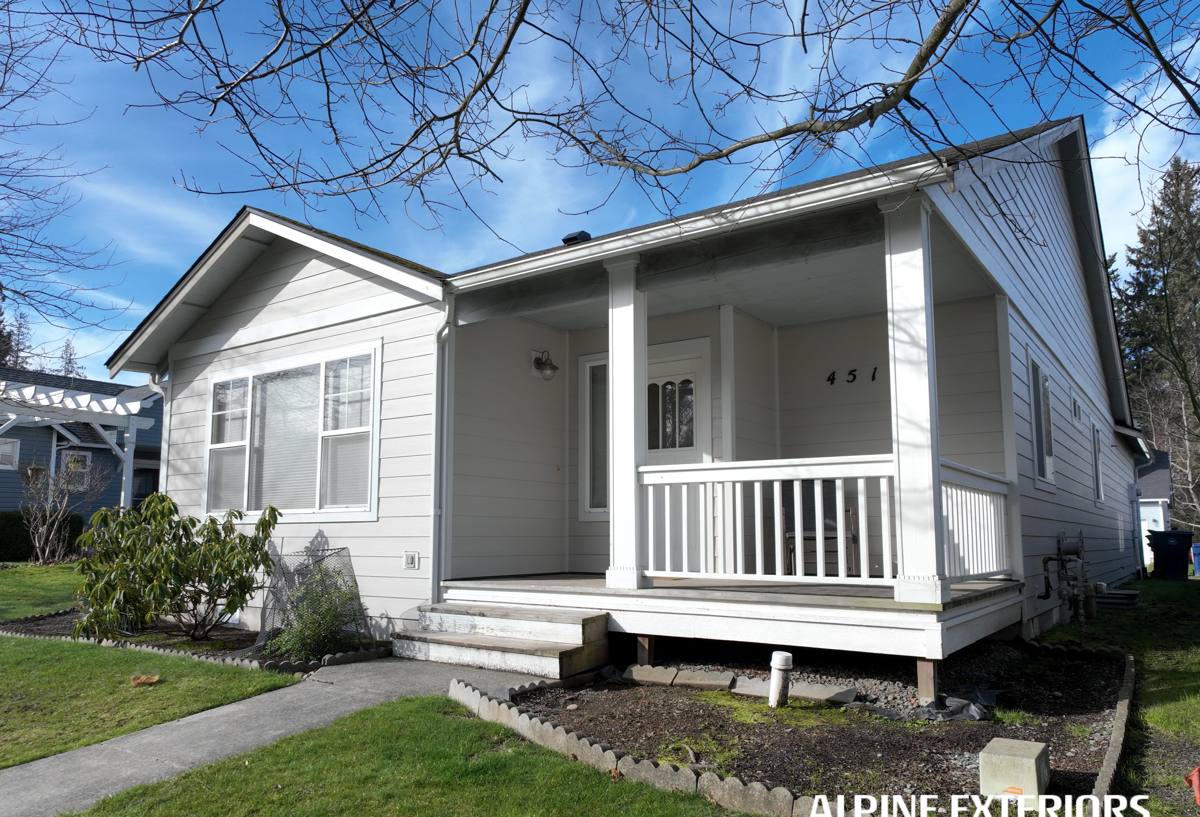
Common Roof Problems We See Around Wiser Lake
Moss and Organic Growth
Moss is the single biggest recurring issue on lake-adjacent and tree-shaded roofs in this region. It doesn't just sit on top of shingles -- it roots into the granule surface, lifts shingle edges, and holds water against the roof deck long after the rest of the neighborhood has dried out. Left alone through a full moss season, it can work its way under flashing and starter courses, which is where small problems turn into deck-level repairs.
Flashing, Valleys, and Penetrations
Valleys, chimney flashing, skylight curbs, and pipe boots are the parts of a roof doing the most work in heavy rain, and they're the parts most likely to fail first. Driving rain doesn't fall straight down -- it gets pushed sideways under shingle edges and around flashing laps that were installed a little loose. We see this constantly on repairs: the field of the roof looks fine, but a poorly lapped valley or a cracked pipe boot has been letting water in for months.
Wind and Storm Damage
Winter storm systems moving through Whatcom County bring gusts that can lift shingle tabs, especially on older roofs where the factory sealant strip has already weakened from age and repeated wet-dry cycling. A few missing or lifted shingles rarely cause an emergency on their own, but they're an open invitation for wind-driven rain to get underneath the surrounding courses.
What a Correct Repair Actually Involves
Diagnosing the Real Cause, Not Just the Symptom
An interior stain almost never sits directly below the actual entry point -- water travels along the deck and rafters before it shows up on drywall. A correct repair starts on the roof itself: checking the suspect area, then working outward to flashing, valleys, and any moss or debris buildup nearby. Patching drywall or caulking a visible gap without finding the actual entry point is the most common reason a "repaired" roof leaks again the next season.
Matching Materials and Technique
Repairs need to match the existing roof in more than just color. Shingle profile, exposure, and even the underlying felt or synthetic underlayment matter -- a mismatched patch can create a new weak point instead of fixing the old one. On older roofs where exact shingle matches aren't available, we talk through the trade-offs honestly rather than forcing a mismatch that will stand out and potentially shed water differently than the surrounding field.
Our Wiser Lake Roof Repair Process
- Inspection: We walk the roof (not just a ground-level look) to check field shingles, flashing, valleys, penetrations, and moss or debris accumulation.
- Diagnosis: We trace suspected leaks back to their actual source, checking the deck and structure where accessible.
- Written scope: You get a clear explanation of what's failing, what needs to be repaired versus monitored, and why.
- Repair: We remove and replace only the compromised materials, re-flash where needed, and reset any lifted or damaged shingles.
- Cleanup and moss treatment: Debris is cleared and, where appropriate, we address moss growth so the repaired area isn't immediately compromised again.
- Final check: We confirm proper water flow through valleys and around penetrations before calling the job done.
Repair vs. Replacement: How We Help You Decide
Not every roof problem calls for a full replacement, and not every leak can be responsibly patched. The table below outlines how we typically think through that decision -- final recommendations always depend on an actual inspection.
| Sign | What It Usually Means | Typical Approach |
|---|---|---|
| Isolated leak, one flashing point or valley | Localized failure, roof otherwise sound | Targeted repair |
| Heavy moss across multiple slopes | Moisture retention risk, but shingles may still be structurally fine | Moss removal/treatment plus spot repairs |
| Widespread granule loss, brittle shingles | Roof nearing the end of its service life | Repair now, plan for replacement |
| Soft or spongy deck sections | Water has reached the roof deck, not just the surface | Deck repair, often larger-scope work |
| Leaks in multiple, unrelated areas | Age-related failure rather than an isolated defect | Full replacement usually more cost-effective long term |
Repair costs vary a lot depending on how much decking is affected and how accessible the damaged area is -- a single valley or flashing repair is typically a modest cost, while deck-level repairs after prolonged moisture intrusion run higher. We give you real numbers after we've actually seen the roof, not before.
Roofing Materials We Work With in This Climate
Most homes around Wiser Lake are roofed in asphalt composition shingles, and for good reason -- they perform well in this climate when installed and maintained correctly, and replacement materials are widely available for future repairs. Architectural (dimensional) shingles hold up better against wind uplift than older three-tab styles, which matters given the storm patterns that move through this part of Whatcom County.
Metal roofing sheds moss and debris more readily and can be a strong option on steep, heavily shaded lots, though it comes with a higher upfront cost and requires correct fastening detail to avoid its own leak points. Cedar shake offers a traditional look but, in a shaded, high-moisture setting like the Wiser Lake area, it demands more frequent maintenance to manage moss and moisture retention than most homeowners want to take on -- we'll always walk you through that trade-off honestly rather than talk you into or out of a material based on looks alone.
A Homeowner's Moss and Moisture Checklist
Between professional inspections, there are a few things homeowners around Wiser Lake can watch for that often catch a problem before it becomes a repair:
- Visible moss patches, especially on north-facing or heavily shaded slopes
- Granules collecting in gutters or at the base of downspouts
- Shingle tabs that look lifted, curled, or cracked
- Dark streaking that could be algae rather than simple dirt
- Standing debris (needles, leaves, small branches) piling up in valleys
- Any new ceiling stain, even a small one that seems to come and go with the weather
- Gutters overflowing during heavy rain instead of draining cleanly
Catching any of these early usually means a smaller, less expensive fix.
Why a Crew That Already Works Wiser Lake Matters
Roof repair isn't just about swapping shingles -- it's about understanding how a specific roof, in a specific setting, is actually failing. A crew that regularly works the Wiser Lake area already knows how tree-shaded, moisture-heavy lots behave differently than open, sunnier roofs elsewhere in the region. That familiarity shows up in small but important ways: knowing which valleys tend to hold debris, how aggressively moss needs to be treated without damaging granules, and where driving rain off the Salish Sea tends to find its way in on homes with this kind of exposure.
It also means a contractor who isn't guessing at material availability or code requirements for Whatcom County, and who can speak plainly about what's actually wrong with your roof instead of upselling a replacement you don't need yet -- or leaving a repair too thin to actually hold through the next wet season.
If you're dealing with a leak, visible moss, or just want an honest read on where your roof stands, we're happy to take a look. Fill out the form below for a free, no-pressure estimate -- we'll tell you what we actually see, not what's easiest to sell.