 Semiahmoo Siding
 James Hardie Siding, Built for Birch Bay's Waterfront Exposure
Birch Bay sits directly on the water in northern Whatcom County, and that location puts more stress on an exterior wall than almost anywhere else in the region. Salt-laden air comes off the bay steadily, not occasionally. Rain arrives sideways more often than it falls straight down. And a moss and mildew season that stretches across most of the calendar year gives any organic or moisture-sensitive material a long window to fail in. This page is specifically about James Hardie fiber cement siding on Birch Bay homes — what the local exposure demands from it, what a correct installation actually involves here, and why we install this product exclusively rather than offering a menu of siding brands.
This isn't a general siding overview. If you're comparing materials broadly, that's a different conversation. Here, we're assuming James Hardie is the product on the table and walking through what it takes to get it right on a waterfront lot in this specific part of Whatcom County.
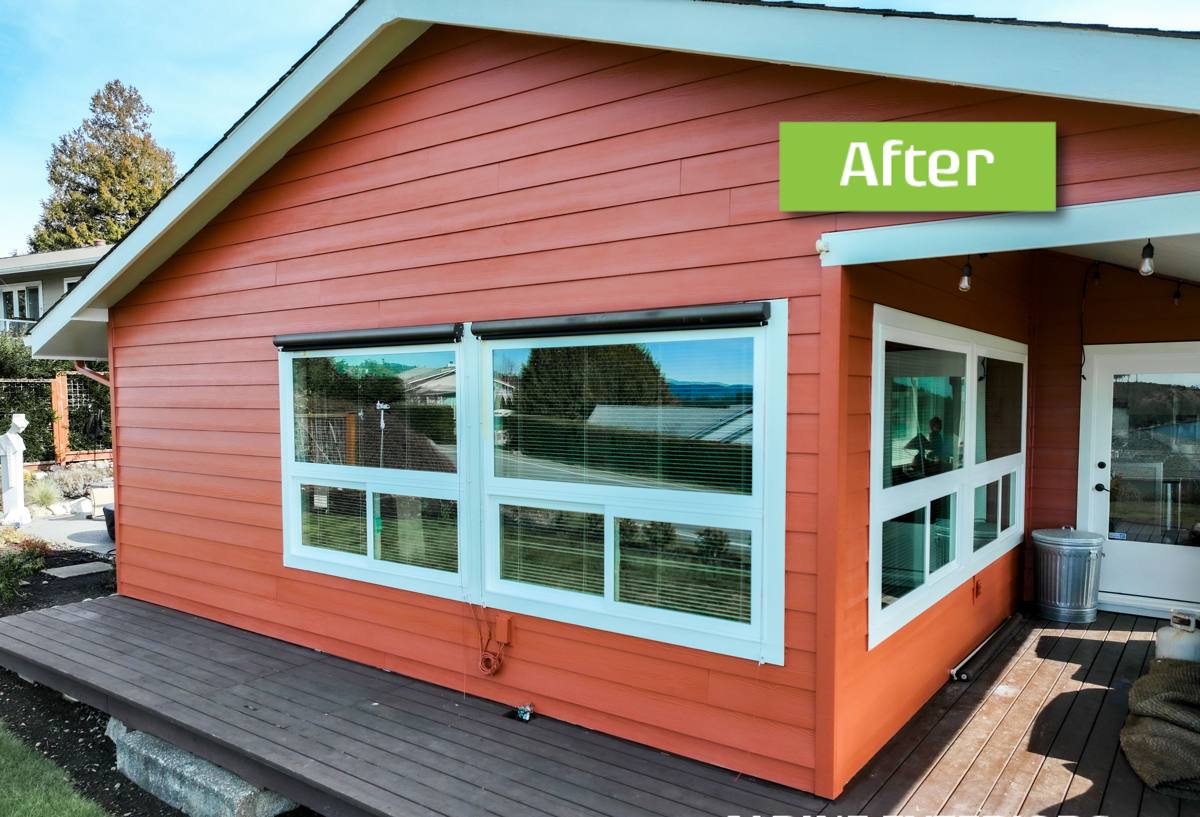
What Birch Bay's Climate Does to Siding
Salt Air, Not Just Rain
Homes set back from the water still deal with plenty of moisture, but Birch Bay properties get an added layer: salt carried on the wind off the bay settles on siding, trim, and fasteners continuously. Salt exposure accelerates corrosion in lower-grade hardware and can degrade a weak factory finish faster than a drier, inland location would ever test it. Any siding decision here has to account for that corrosion load, not just rainfall totals.
Wind-Driven Rain
Waterfront exposure means more sustained wind, and wind-driven rain doesn't behave like a calm, straight-down shower. It gets pushed into lap joints, under trim, and into any seam where the water-management detail isn't right. A siding system that performs fine in a sheltered yard a few miles inland can still leak on a Birch Bay property because the water is arriving from the side, not just from above.
A Long Moss and Mildew Season
Mild coastal temperatures combined with near-constant moisture keep moss and mildew active for most of the year, especially on shaded or north-facing walls and anywhere trees block direct sun. Organic growth on a siding surface holds moisture against the wall behind it, and that trapped moisture is where a lot of long-term siding problems actually start — not from a single storm, but from months of low-grade dampness sitting against the material.
Why James Hardie Fits This Exposure
We install James Hardie fiber cement exclusively, and on a property like this, the reasons are concrete rather than theoretical.
- Inorganic core: Fiber cement is made from Portland cement, sand, and cellulose fiber. It doesn't have a wood-based core that can absorb water, swell, or rot the way organic siding materials can, which matters directly in a climate where moisture exposure is nearly constant.
- Climate-engineered HZ5 formulation: Hardie engineers its products for specific climate zones, and the HZ5 line is built for regions with sustained moisture and freeze-thaw cycling — a closer match to waterfront Whatcom County than a product engineered for a hot, dry market.
- Factory-applied ColorPlus finish: Color is baked on in a controlled factory setting in multiple coats rather than brushed on in the field. That finish is built to resist fading and chalking under UV and salt exposure better than a site-applied paint job, and it carries its own warranty separate from the substrate.
- Dimensional stability: Fiber cement doesn't expand, contract, or cup the way some engineered wood products can after repeated wetting and drying over a wet season.
- Non-combustible: The material doesn't feed a fire, which is a genuine safety consideration and sometimes an insurance one as well.
We won't install LP SmartSide, vinyl, Cemplank, Allura, primed spruce, or cedar. Each has legitimate uses and satisfied owners elsewhere. On a shoreline exposure like this one, we've made a professional call to install one system we can fully stand behind rather than offer a lower-cost option that shifts more long-term maintenance risk onto the homeowner.
Choosing the Right Hardie Profile for a Birch Bay Home
James Hardie makes several siding profiles, and the right one depends on the home's style, exposure, and how much of the wall faces the water directly. This is worth talking through on-site rather than deciding from a brochure.
| Hardie Profile | Look | Where It Fits Well in Birch Bay |
|---|---|---|
| HardiePlank lap siding | Traditional horizontal lap, smooth or cedar-textured | Most common choice; performs consistently across full water exposure |
| HardieShingle | Staggered or straight-edge shingle look | Accent walls or gables where a traditional coastal look is wanted |
| HardiePanel | Vertical panel with battens | Modern facades and accent sections; needs careful seam detailing on wind-exposed walls |
| HardieTrim | Fascia, corner boards, window and door trim | Paired with any profile to seal transitions where wind-driven rain concentrates |
Whichever profile fits the home, the trim details around windows, doors, and corners matter as much as the field siding itself. Those transition points are where wind-driven rain concentrates, and they're often the first place a poorly detailed installation shows a problem.
What a Correct Installation Actually Involves
Fiber cement's real-world performance depends heavily on installation quality, and that's especially true on a waterfront lot where the material gets tested harder than it would inland. A rushed or off-spec install can undercut even the best siding product.
| Installation Detail | Why It Matters in Birch Bay |
|---|---|
| Manufacturer-specified clearances from grade, roofline, and deck | Keeps splash-back and standing moisture off the board edge on a wet, waterfront lot |
| Correct fastener type, spacing, and depth | Corrosion-resistant hardware matters more here given constant salt exposure |
| Proper flashing at windows, doors, and penetrations | Directs wind-driven rain away from seams instead of letting it collect there |
| Rain-screen or drainage plane behind the siding | Lets any moisture that gets past the surface drain and dry instead of sitting against the wall assembly |
| Factory-cut edges used wherever possible; field cuts sealed to spec | Preserves the ColorPlus finish's protection at every cut edge |
We send certified installers to every Hardie job rather than treating fiber cement as an interchangeable swap for whatever a crew is used to hanging. The material resists moisture and combustion on its own, but it still only performs as designed when the flashing, clearances, and fastener details around it are done correctly.
Our Process for a Birch Bay Siding Job
We start with an on-site walk of the existing siding, looking specifically for how it's handled moisture and salt exposure so far — where moss has taken hold, where trim has started to fail, and where the existing water-management detailing is weak. From there we put together a clear, written scope covering the Hardie profile, trim package, and color, along with a realistic timeline. During installation, the flashing, clearance, and fastener details covered above are standard practice on every job, not optional upgrades priced separately. Once the siding is up, we walk the finished job with the homeowner before calling it complete.
Cost Factors Worth Understanding
- Material and labor costs for James Hardie typically run higher upfront than vinyl and are comparable to or somewhat above engineered wood, reflecting the heavier material and more labor-intensive installation process.
- Waterfront exposure can add modest cost for corrosion-resistant fastener grades and additional flashing detail, which is money spent up front instead of on repairs later.
- Maintenance cost over time runs lower than wood or engineered wood siding, since there's no repainting or recaulking schedule tied to a wood-based core.
- Hardie's transferable, non-prorated limited warranty on the substrate, plus a separate ColorPlus finish warranty, is a real factor in resale value on a coastal property where buyers increasingly ask about exterior condition and moisture history.
Why a Local Crew Matters on a Waterfront Lot
A contractor who works this stretch of Whatcom County regularly already knows how salt air, wind exposure, and prolonged dampness behave differently here than a few miles inland. That shows up in specific decisions — which fastener grade to use, how much clearance to leave at grade, where extra flashing gets added — and those decisions are what determine whether a siding job holds up for one wet season or several decades.
Before You Hire Anyone for Hardie Siding in Birch Bay
- Ask whether the crew is certified to install James Hardie products and how many Hardie jobs they've done in this specific climate
- Confirm current Washington contractor licensing and active liability insurance
- Ask specifically how they detail flashing at windows, doors, and corners for wind-driven rain, not just general workmanship
- Ask what fastener grade they use given direct salt exposure
- Get a written scope specifying the Hardie profile, trim package, color, and warranty coverage before signing anything
If you're weighing siding options for a Birch Bay property, we're glad to walk the exterior with you and give an honest read on what it needs. Reach out below for a free, no-pressure estimate.