 Semiahmoo Siding
 Why Birch Bay Siding Wears Differently Than Siding Inland
Birch Bay sits right on the water, and that changes what siding has to survive. Homes a few miles inland in Whatcom County deal with rain and cold. Homes in Birch Bay deal with all of that plus salt-laden air blowing straight off the bay, wind-driven rain that hits walls sideways instead of falling straight down, and a shoulder season that stays damp long enough for moss and algae to get established on north-facing walls and anything shaded by trees. Siding that's rated "fine for the Pacific Northwest" in a catalog isn't automatically fine for a lot four blocks from the beach.
Salt air is corrosive to fasteners and trim hardware, and it accelerates the breakdown of paint films on wood and some engineered wood products. Driving rain finds every gap in flashing, caulk, and lap overlaps that would never get tested on a more sheltered wall. And moss doesn't just look bad — it holds moisture against the siding surface for weeks at a time, which is exactly the condition that rots wood substrates and delaminates poorly sealed engineered wood siding from the inside out.
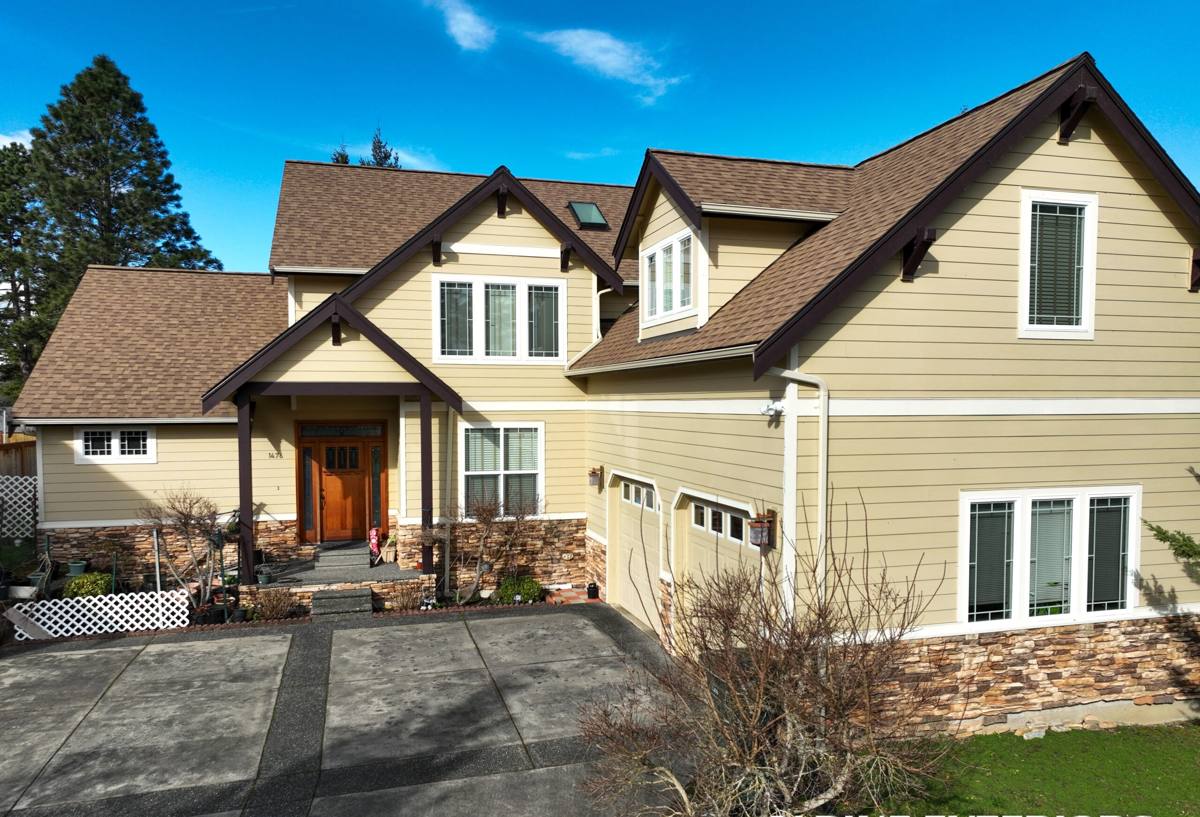
What This Means for a Siding Replacement Decision
If you're replacing siding on a Birch Bay home, the material choice matters more here than it would on a sheltered inland lot. We install James Hardie fiber cement siding exclusively — we don't install LP SmartSide, vinyl, Cemplank, Allura, primed spruce, or cedar, and on a coastal property like this, the reasons matter even more than usual.
Fiber Cement vs. Moisture-Sensitive Materials
Fiber cement is cement, sand, and cellulose fiber — it doesn't rot, it isn't a food source for moss or algae to feed on the way wood-based products can be, and it holds its shape and paint adhesion in damp conditions far better than engineered wood siding, whose long-term performance depends heavily on edges and cut ends staying properly sealed. On a lot exposed to onshore wind and salt spray, that difference shows up over years, not days — which is exactly the timeframe that matters for a siding investment.
Vinyl's Coastal Limitations
Vinyl siding is a common budget choice, but it has real limits on an exposed coastal property: it can distort or warp under sustained heat and wind stress, its seams and J-channels are a common entry point for driving rain, and it doesn't offer the same fire performance as fiber cement. We don't install it, and on a bay-front or near-bay lot we think that trade-off is even less favorable than usual.
What a Correct Siding Replacement Involves Here
Replacing siding isn't just swapping old boards for new ones. On a Birch Bay home, the work underneath the siding is what determines whether the new job actually holds up to salt air and driving rain.
- Full removal of the old siding down to the sheathing, so we can actually see what's underneath instead of guessing
- Inspection of the sheathing and framing for moisture damage, especially around window and door openings and any area that's been shaded or moss-covered
- Repair or replacement of any rotted or compromised sheathing before anything new goes up
- Installation of a weather-resistive barrier suited to a high wind-driven-rain exposure, lapped and taped correctly at every seam
- Correct flashing at windows, doors, and all penetrations — this is the single most common failure point on coastal homes we open up
- Proper rainscreen or ventilation gap behind the siding where conditions call for it, so any moisture that does get behind the cladding can dry out instead of sitting against the wall
- James Hardie panel or lap installation per manufacturer fastening and clearance specs, including correct ground clearance to keep the bottom edge away from splash-back and standing moisture
- Factory-finished ColorPlus trim and caulking at seams, corners, and transitions
Skip any one of those steps and you can end up with siding that looks new for a couple of years and then starts showing the same problems the old siding had — just on a newer timeline.
Moss and Algae: Prevention Built Into the Job
Moss season in this part of Whatcom County runs long, and Birch Bay's damp, shaded, salt-humid air makes it worse than most inland neighborhoods. You can't eliminate moss exposure on a wooded or shaded lot, but you can control how much it matters:
- James Hardie's factory-applied ColorPlus finish resists the surface staining that bare or field-painted wood siding is prone to
- Correct rainscreen ventilation keeps the back side of the siding drying out instead of staying damp, which slows moss and mildew growth on the surface too
- Proper flashing and drip edges keep water moving off the wall instead of sheeting down it, which is what lets moss colonies establish in the first place
- Fiber cement doesn't provide the organic substrate that wood-based sidings do, so surface growth stays a cleaning issue rather than a structural one
James Hardie Product Lines That Fit This Location
James Hardie makes climate-engineered HZ product lines, and for a bay-exposed home the coastal-rated formulation is the right call, not an upsell. Beyond that, the practical choice is usually between lap siding and panel siding, and sometimes a mix of the two with shake or board-and-batten accents.
| Option | Best Fit For | Consideration on a Coastal Lot |
|---|---|---|
| HardiePlank lap siding | Traditional home profiles, most common choice | Widely used look; correct overlap and fastening critical near driving rain |
| HardiePanel vertical siding | Modern facades, accent walls, gable ends | Fewer horizontal laps means fewer potential water entry seams |
| HardieShingle | Cottage or shingle-style coastal homes | More detail work at joints; needs careful flashing |
| ColorPlus factory finish | Any of the above | Reduces field-painting need and resists coastal UV and salt fading |
Cost Factors Specific to a Birch Bay Job
Every replacement is priced on its own specifics, but a few things move the number on a coastal Whatcom County property more than they would inland:
| Factor | Why It Affects Cost Here |
|---|---|
| Sheathing condition | Salt air and long moss exposure raise the odds of hidden moisture damage found once old siding comes off |
| Wind/rain exposure of the elevation | Bay-facing walls often warrant upgraded flashing detail and rainscreen assemblies |
| Access and site conditions | Waterfront and bluff-adjacent lots can have tighter or steeper access than a standard inland lot |
| Trim and accent complexity | Coastal cottage and shingle-style detailing adds labor versus a simple lap job |
| Existing siding removal | Multiple layers or extensively rotted material take longer to strip and dispose of |
Why a Crew That Already Works Birch Bay Matters
Siding installation is detail-sensitive work, and the details that matter change with the site. A crew that installs siding across a wide mix of climates might get the panel install right and still miss the coastal-specific calls — how much rainscreen gap is enough for this exposure, where flashing needs to be upgraded beyond code minimum, which walls actually take the worst of the wind-driven rain based on the lot's orientation to the bay. That's not a guess you want made on your house.
Working this area regularly also means we're not learning Whatcom County's inspection standards, permitting process, or typical soil and drainage quirks on your project. We show up already knowing what a Birch Bay lot tends to throw at a crew, and we plan the job around it instead of reacting to surprises mid-install.
Signs Your Birch Bay Home's Siding Needs Replacing, Not Patching
- Soft, spongy, or visibly rotted sections when pressed, especially near the bottom courses or window sills
- Persistent moss or dark staining that comes back within weeks of cleaning
- Paint that's bubbling, peeling, or chalking heavily, particularly on the sides facing the water
- Visible gaps, warping, or cupping in lap boards
- Interior signs like musty smells, peeling interior trim paint, or damp drywall near exterior walls
- Siding that's original to a home built more than 20-25 years ago and has never been fully inspected behind the surface
A few of these can sometimes be addressed with repair. Several together, especially with any sign of sheathing damage, usually mean full replacement is the more honest recommendation — and it's cheaper in the long run than repeatedly patching a wall that's failing from the inside.
What to Expect From Our Process
We start with an on-site look at the home, not a phone-based guess, because exposure and condition vary block to block along the bay. From there we walk you through what we find once old siding starts coming off, what (if anything) needs repair before new siding goes on, and which James Hardie product and finish fits the home's style and the wall's actual exposure. You get a clear, written scope before work starts — no surprise change orders for things we could have identified up front by doing the inspection properly.
If you're planning a siding replacement on a Birch Bay home, we're happy to take a look and give you a straight assessment of what your walls actually need. Reach out for a free, no-pressure estimate using the form below.