 Semiahmoo Siding
 Blaine's Siding Has a Harder Job Than Most
Blaine sits right where Semiahmoo Bay, the Strait of Georgia, and the open marine air meet the edge of Whatcom County. That location is beautiful, but it's rough on a house exterior. Salt-laden air moves inland on a regular basis, driving rain comes in sideways off the water during fall and winter storms, and the shaded, damp lots common in this area keep moss and algae growing on north-facing walls for most of the year. Siding here isn't just cosmetic — it's the first line of defense against a climate that never really lets up.
We work on homes throughout Blaine and the surrounding Semiahmoo area, and the same pattern shows up again and again: siding that looked fine from the street was quietly failing at the seams, behind the trim, or at the bottom courses closest to grade. A siding job done right for this specific location looks different than a siding job done for a dry inland town, and that difference is the whole point of this page.
What Salt Air, Rain, and Moss Actually Do to Siding
Salt Air
Airborne salt is corrosive to fasteners, flashing, and any metal trim components on a house. It also accelerates the breakdown of coatings that aren't formulated to resist it. Over years, homes closer to the water show faster paint failure and more surface chalking than homes just a few miles inland — even on the same street, orientation and exposure to prevailing wind off the water make a measurable difference.
Driving Rain
Blaine gets weather that comes in horizontally, not just straight down. That means water gets pushed up under laps, into butt joints, and behind poorly sealed trim in a way that a calmer climate never tests. Siding systems that rely on face-sealing (caulk alone, without proper flashing and drainage behind the cladding) tend to fail here faster than they would in a drier region, because the water finds every gap the wind can push it into.
Moss and Sustained Moisture
Shaded lots, tree cover, and long stretches of overcast, damp weather mean moss and algae get a real foothold on north- and east-facing walls. Moss itself doesn't destroy siding, but it holds moisture against the surface for extended periods, which is exactly the condition that causes rot in wood-based products and accelerates coating breakdown on anything not built to handle sustained dampness.
Why We Only Install James Hardie Fiber Cement in This Area
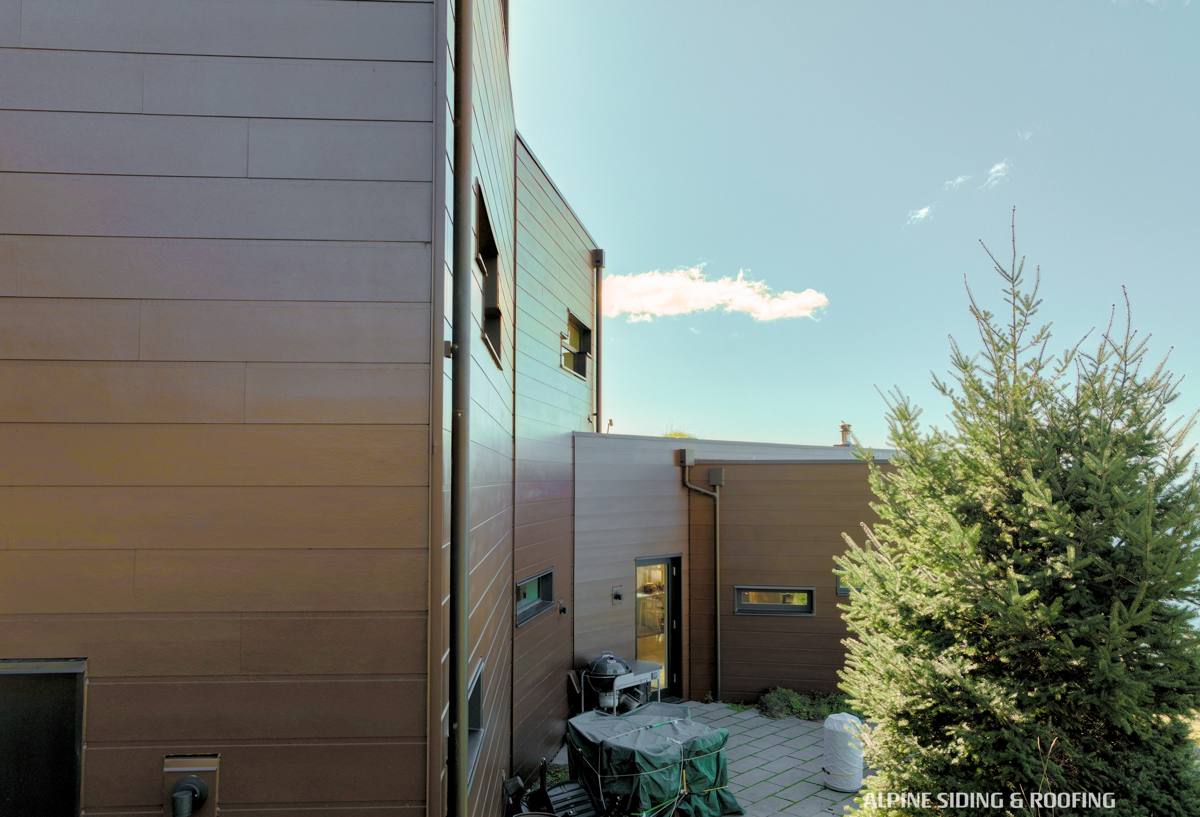
We install one siding system on Blaine homes: James Hardie fiber cement, factory-finished with ColorPlus Technology. We don't install vinyl, LP SmartSide, primed wood, or other fiber cement brands — not because those products can't work anywhere, but because we've standardized on the one system that holds up consistently to this exact combination of salt air, wind-driven rain, and year-round moisture.
Fiber cement is non-combustible and dimensionally stable, meaning it doesn't expand and contract with moisture the way wood-based products do. That matters directly in Blaine: a product that swells and shrinks with every wet-dry cycle eventually works its fasteners loose and opens gaps at the joints — exactly the entry points that driving rain is looking for. James Hardie's HZ5 product line is engineered specifically for climates with high moisture exposure, which describes this stretch of Whatcom County well.
The factory-applied ColorPlus finish is also relevant here, not just for looks. Field-applied paint is only as good as the prep and the paint itself, and it's the first thing that shows wear in salt air. A factory finish baked on under controlled conditions resists fading and chalking longer, and it comes with its own finish warranty — separate from the product warranty — so the color performance isn't left to chance.
What a Correct Fiber Cement Install Involves
Fiber cement siding is only as good as the installation behind it. A huge share of the siding failures we get called out to inspect in this area trace back to installation shortcuts, not the material itself. A correct install for a Blaine home includes:
- A drainage plane (weather-resistive barrier) installed correctly behind the siding, not just tucked in around openings
- Proper flashing at every window, door, and roof-to-wall intersection — the details that stop driving rain from getting behind the cladding
- Correct fastener type and placement per the manufacturer's install manual, since the wrong fastener corrodes faster in salt-air exposure and can void the warranty
- Proper clearance between the bottom of the siding and grade, decks, and roof lines, so water can't wick up into the board
- Caulking only where the manufacturer specifies it — over-caulking traps moisture rather than shedding it
- Factory-cut, factory-primed edges wherever field cuts are unavoidable, with cut edges properly sealed
Any one of these done wrong doesn't necessarily show up as a problem in year one. It shows up in year five or eight, as rot behind a window, a soft spot near a deck ledger, or moss holding moisture against a joint that was never properly flashed. That's the gap between siding that's installed and siding that's installed correctly for this climate.
How We Approach a Blaine Siding Job
Every home is different, but the process we follow on Blaine projects stays consistent because the climate risks stay consistent.
| Step | What Happens | Why It Matters Here |
|---|---|---|
| Exterior assessment | Inspect current siding, trim, flashing, and any moisture or moss patterns on the home | Identifies existing water intrusion before it's covered up by new siding |
| Moisture check | Check sheathing and framing at vulnerable points — window sills, bottom plates, deck ledgers | Blaine's driving rain finds these spots first; we don't side over hidden rot |
| Weather barrier and flashing | Install or verify drainage plane and flashing details at every penetration | This is the layer that actually stops wind-driven rain, not the siding face |
| Hardie installation | Install James Hardie panels or lap siding per manufacturer specification | Correct fastening and clearances prevent the early failures we see with rushed installs |
| Trim and detail work | Finish corners, transitions, and joints with proper sealant and reveal | Reduces the joints where moisture and moss can take hold |
| Final walkthrough | Review the finished exterior with the homeowner | Confirms the details before we consider the job done |
Fiber Cement vs. Other Siding in a Salt-Air, High-Rain Climate
Homeowners in Blaine often ask how James Hardie fiber cement really compares to the alternatives once you account for the local weather, not just the brochure specs.
| Factor | James Hardie Fiber Cement | Vinyl | Wood / LP-Style Products |
|---|---|---|---|
| Moisture response | Dimensionally stable; engineered HZ5 line for wet climates | Doesn't absorb water, but can warp and gap in temperature swings | Absorbs moisture; prone to swelling and rot without diligent maintenance |
| Salt air / coastal exposure | Non-combustible, factory finish holds up well to coastal exposure | Can become brittle and discolor faster near salt air over time | Finish and fasteners degrade faster; needs more frequent recoating |
| Moss and algae resistance | Hard, dense surface resists moisture retention better than wood-based cores | Sheds moss fairly well but joints can trap debris | Textured/wood-grain surfaces hold moisture, feeding moss growth |
| Fire resistance | Non-combustible material | Combustible; can melt or deform near heat sources | Combustible |
| Long-term maintenance | Factory finish reduces repainting frequency | Low maintenance but limited repair/color options once faded | Regular painting/sealing required to prevent moisture damage |
Maintenance That Actually Matters in This Climate
Fiber cement is low-maintenance, not no-maintenance. In a marine climate like Blaine's, a short annual routine catches problems early and keeps the siding performing the way it's designed to.
- Rinse salt residue and grime off the siding once or twice a year, especially on sides facing the water or prevailing wind
- Gently remove moss and algae buildup on shaded or north-facing walls before it spreads — avoid high-pressure washing directly into joints
- Check caulking at trim, window, and door intersections annually; failed caulk is an early warning sign, not a cosmetic issue
- Keep gutters clear and downspouts directed away from the wall so runoff isn't sheeting down the siding face
- Trim back vegetation and tree cover that keeps a wall section shaded and damp longer than the rest of the house
- Watch bottom courses near grade, decks, and patios — these are the first places moisture damage shows up
Signs Your Current Siding Needs Attention
A few warning signs are worth acting on before they become bigger repairs: soft or spongy spots when you press on the siding, visible gaps or separation at joints and corners, paint that's bubbling or peeling rather than just fading, persistent moss that keeps returning to the same spot even after cleaning, and any staining or discoloration around window and door trim. Any of these can point to moisture getting behind the cladding rather than just sitting on the surface.
Why It Matters That We Already Work in Blaine
Siding installation is a set of details — flashing sequence, fastener choice, clearance at grade, how a corner is finished — and those details change based on what the house actually has to withstand. A crew that works Blaine and the broader Semiahmoo area regularly already knows which walls take the worst of the wind-driven rain, which lots hold moisture and moss longest, and where salt exposure tends to hit hardest. That local pattern recognition is part of what keeps a siding job from becoming a callback five years later.
We stand behind James Hardie fiber cement because we've seen how it performs against this specific climate when it's installed to spec — not as a sales position, but as the product we're comfortable putting our own installation standards behind on a coastline like this one.
Get a Straight Answer About Your Siding
If you're dealing with aging siding, ongoing moss problems, or you're just planning ahead for a Blaine home, we're happy to take a look and give you an honest read on what your exterior actually needs. Fill out the form below for a free, no-pressure estimate.