 Semiahmoo Siding
 Why Blaine Harbor Decks Wear Out Faster Than You'd Expect
A deck built two blocks from the water lives a harder life than one built inland, even a few miles inland in Whatcom County. Blaine Harbor sits right on that exposure line — open to wind off the bay, salt-laden air, and the kind of driving rain that comes sideways off the water instead of straight down. That combination doesn't just wear paint and stain faster. It gets into places a normal deck inspection misses: under flashing, inside fastener holes, and along the ledger board where the deck ties into the house.
We also get a long moss season here — often eight months or more where surfaces stay damp enough for moss and algae to take hold. On a deck, that's not cosmetic. Moss holds moisture against the boards, and moisture held against wood or even composite decking for months at a time is what actually breaks decks down, not any single storm.
None of this means a deck at Blaine Harbor can't last. It means it has to be built and maintained with the exposure in mind from day one, and that a deck that "looks fine" from ten feet away can still be structurally compromised underneath.
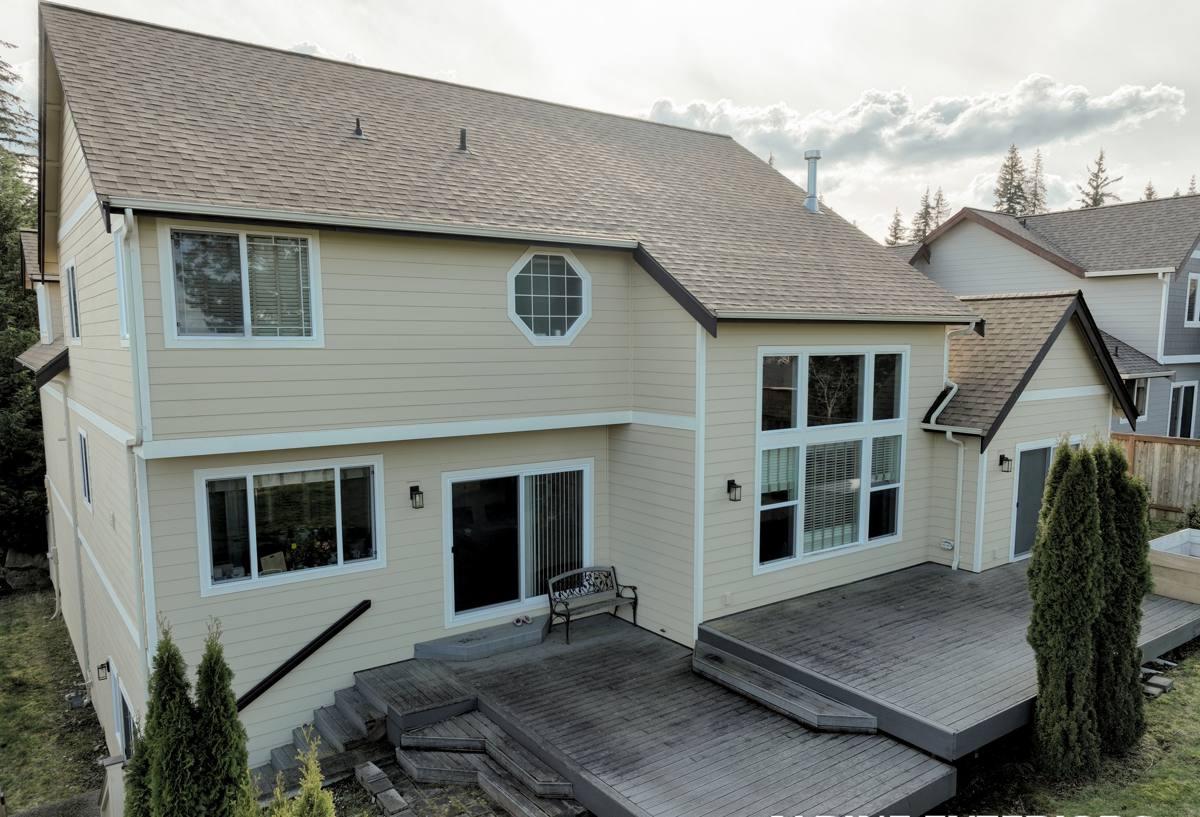
Repair or Replace? Reading the Real Signs
Homeowners often call us thinking they need a few boards swapped, and sometimes that's true. But a few warning signs mean the deck needs a full replacement rather than a patch:
- Soft, spongy spots in the decking surface — usually means the boards or the framing underneath have absorbed water and started to break down
- Rust streaking around fasteners or visible corrosion on brackets and hangers
- Gaps or separation where the ledger board meets the house — a common failure point in wet coastal climates and a safety issue, not a cosmetic one
- Posts that feel loose or that show soft wood near the base, where they sit closest to ground moisture
- Persistent moss or dark staining that comes back within weeks of cleaning, which usually means water is getting trapped rather than draining
- A deck older than 15-20 years that has never had the substructure inspected, only the surface refinished
If it's just a handful of boards and the frame underneath is sound, repair makes sense. If the framing, ledger connection, or footings are compromised, patching the surface just hides the problem for another season.
Choosing Materials for a Marine Climate
There's no single "best" decking material — there's a best fit for how the deck will be used and how much upkeep the homeowner wants to take on. In a salt-air, high-moisture environment like Blaine Harbor, the trade-offs matter more than they would somewhere drier.
| Material | How it holds up here | Maintenance burden |
|---|---|---|
| Pressure-treated fir/pine | Affordable, but needs consistent sealing to resist moisture and moss in a long wet season | Annual cleaning and re-sealing |
| Cedar | Naturally moisture- and insect-resistant, ages to a silver-gray patina if left unfinished | Periodic cleaning; optional refinishing |
| Composite decking | Resists rot and moss staining well, but still needs cleaning — moss will grow on any surface that stays damp | Low; occasional wash-down |
| PVC/capped decking | Best moisture resistance of the common options, holds up well to salt air over time | Lowest; wash-down only |
We'll talk through your budget and how the deck gets used before recommending a material — a rarely-used side deck doesn't need the same spec as a main entertaining deck that faces the water and takes the brunt of the weather.
Why We're Careful With Certain Products
Some lower-tier composite products on the market are more sensitive to installation technique than solid wood — improper spacing or fastening can trap moisture and void the manufacturer's warranty. That's a product-handling issue, not a reason to avoid composite decking altogether. It's why we follow manufacturer spec sheets exactly, use the specified fasteners and clips, and won't cut corners on gapping just to save time.
What a Correct Deck Replacement Actually Involves
A deck replacement is more than pulling up old boards and screwing down new ones. Done right, in this climate, it includes:
Ledger and Flashing
The ledger board — where the deck attaches to the house — is the single most common failure point on coastal decks. We install proper flashing, ideally with a self-adhering waterproof membrane behind it, so wind-driven rain can't work its way behind the ledger and into the house rim joist. This is the detail most likely to get skipped on a fast, cheap rebuild, and the one most likely to cause hidden rot years later.
Framing and Footings
We inspect and typically replace the substructure — joists, beams, and posts — rather than reusing old framing under new decking. Footings get checked for frost depth and drainage; standing water around a post base is one of the fastest ways to rot a deck from the ground up in a wet climate.
Fasteners and Hardware
Salt air accelerates corrosion on standard hardware. We spec stainless steel or coated, corrosion-resistant fasteners and structural connectors rated for coastal or wet-service use, not general-purpose hardware that's cheaper but starts rusting within a couple of seasons this close to the water.
Drainage and Airflow
Proper board spacing and under-deck ventilation matter more here than in a dry climate — trapped moisture under a low deck is a common source of the soft-spot and rot problems we get called out for on older builds.
How We Work in Blaine Harbor
We're based in Semiahmoo and work this stretch of Whatcom County regularly, which matters for a few practical reasons. We already know how the local weather patterns behave through the wet season and plan our schedules around it, rather than losing days guessing. We're familiar with typical lot conditions in waterfront and near-waterfront neighborhoods, including drainage and grade issues that come up often around Blaine Harbor properties. And because we're local, warranty and service calls aren't a long drive for us — if something needs a look after the job is done, we're close by.
Our process on a deck replacement generally runs:
- On-site assessment of the existing deck, including a look at the framing and ledger connection, not just the surface
- A written scope and estimate that separates structural work from surface material choices, so you know exactly what you're paying for
- Permit handling where required (see below)
- Demolition and disposal of the old deck
- Framing, flashing, and structural work first, inspected before decking goes down
- Decking, railing, and stair installation to manufacturer spec
- Final walkthrough
Permits and Local Requirements
Deck replacement projects in Whatcom County — particularly on or near waterfront and shoreline-adjacent lots — can involve setback rules and permitting that a standard inland deck job wouldn't trigger. Requirements vary depending on deck height, footprint, and proximity to the water, so we check what applies to your specific property before work starts rather than assuming a past project's rules still apply. We handle the permit process as part of the job so you're not navigating it alone.
Maintenance Through Moss Season
Whatever material you choose, a little seasonal upkeep goes a long way in this climate:
- Sweep debris and standing leaves off the deck regularly through fall — trapped organic matter feeds moss growth
- Rinse or wash down the surface a couple of times during the wet season, not just once a year in spring
- Keep gutters and downspouts clear so runoff isn't dumping extra water directly onto or under the deck
- Check railings and stair connections annually for movement — hardware loosens faster with repeated wet-dry cycling
- Re-seal wood decking on the manufacturer's recommended schedule, not just when it starts looking gray
A deck built correctly for this environment, with the right flashing, hardware, and material choice, needs far less fighting against moss and moisture than one built to a generic inland spec.
Before You Hire Anyone for This Job
A deck replacement is a structural project attached to your house, not just an outdoor furniture upgrade. Before hiring, it's worth confirming a few basics with any contractor you're considering:
- They carry current Washington contractor licensing and liability insurance
- They'll put ledger flashing and fastener specs in writing, not just "we'll handle it"
- They pull permits themselves when the project requires one, rather than leaving that on you
- They can explain why they're recommending a specific material for your deck's exposure, not just upselling the most expensive option
- They have experience with waterfront or near-waterfront properties specifically, since the failure points are different than an inland build
If you're weighing a deck replacement for a Blaine Harbor property, we're happy to take a look and give you a straight assessment — what's actually wrong, what it'll take to fix it right, and what that costs. Reach out for a free, no-pressure estimate using the form below.