 Semiahmoo Siding
 Building New at Cherry Point Means Building for the Weather First
Cherry Point sits right on the Salish Sea, exposed to wind coming off open water with very little to break it up. If you're framing a new home here, the window package isn't just a design decision — it's one of the first lines of defense the house will have for the next 30-plus years. Salt-laden air, driving rain that comes in sideways more often than straight down, and a moss season that can stretch from October through May all put steady stress on window units and the assemblies around them. New construction gives you one real chance to get the window-to-wall connection right before the siding goes on and covers it up.
We've installed new-construction windows on homes throughout Whatcom County, including a number of projects on the Semiahmoo peninsula and the rural, shoreline-adjacent lots around Cherry Point. The framing details, drainage planes, and flashing sequences that work fine on an inland lot in a milder microclimate often aren't enough out here. This page is about what actually needs to happen differently for a Cherry Point build.
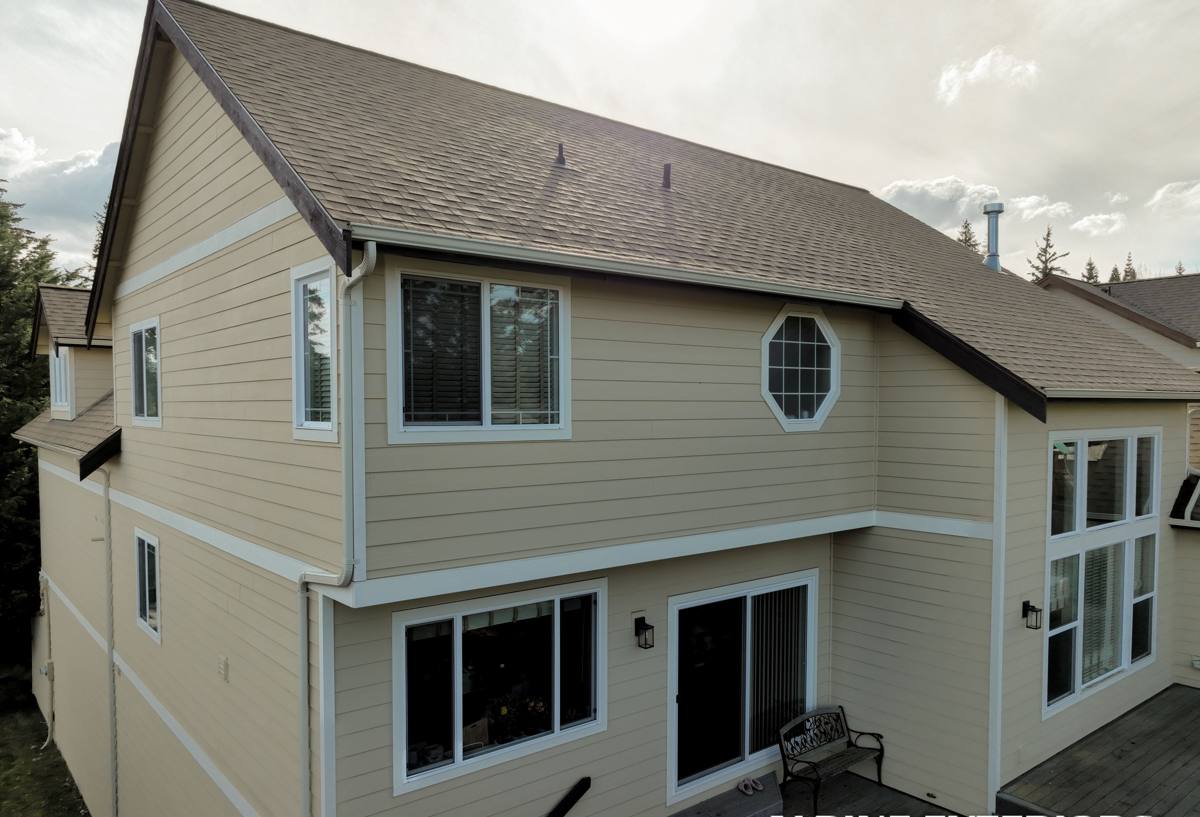
New-Construction Windows vs. Replacement Windows — Not the Same Job
It's worth being clear about terminology, because the two products and the two installation methods are genuinely different animals.
- New-construction windows have a nailing fin (also called a nail flange) around the perimeter of the frame. They get installed into an open, unfinished rough opening before the weather-resistive barrier (WRB) and siding go on, so the fin can be integrated directly into the wall's drainage plane.
- Replacement (retrofit) windows have no nailing fin and are built to fit inside an existing frame, with the surrounding siding and trim left in place. They rely on the old opening's flashing, which may or may not still be sound.
On a new build at Cherry Point, you have the far better option available: full nailing-fin integration with the WRB, done in the correct shingle-lap order so water is always directed outward and downward, never trapped behind the cladding. This is the install method we build our process around for new-construction work, and it's the reason getting the sequence right during framing matters more here than almost anywhere else in the region.
What a Correct New-Construction Install Actually Involves
A window that looks fine from the outside can still be set up to fail years down the road if a few unglamorous steps get rushed. For a Cherry Point exposure, we treat these as non-negotiable:
Sill Pan Flashing
Every rough opening gets a sloped, sealed sill pan before the window ever goes in. This is the single most important detail on a coastal build — it gives any water that gets past the window a dedicated path back out to the exterior instead of into the framing. A flat or missing sill pan is the most common failure point we find when we're called in to diagnose rot in homes that are only a few years old.
Jamb and Head Flashing in Proper Shingle-Lap Order
Flashing tape and the WRB have to be layered so each piece overlaps the one below it, the same way roof shingles do. Reverse the order even at the head of the window, and wind-driven rain off the water will find the seam.
Nailing Fin Integration
The fin gets fastened per the manufacturer's schedule and fully integrated into the drainage plane — not just tucked behind the WRB and taped on top, which is a shortcut that shows up as leaks within a few winters.
Backer Rod and Sealant at the Interior and Exterior
A continuous air seal on the interior side (not just caulk on the exterior) controls condensation inside the wall cavity — a real concern given how much moisture-laden air sits around Whatcom County homes for much of the year.
Corrosion-Resistant Fasteners and Hardware
Salt air accelerates corrosion on standard fasteners and hinge hardware faster than most builders expect. We spec fastener and hardware materials rated for coastal exposure on every Cherry Point job.
Material and Glass Choices That Actually Hold Up Here
There's no single "best" window for every house, but for a Cherry Point lot we walk clients through the same real trade-offs every time.
| Frame Material | How It Handles Salt Air & Moisture | Maintenance Reality |
|---|---|---|
| Vinyl | Doesn't corrode; performs well against salt exposure | Low maintenance; color/finish options more limited |
| Fiberglass | Very stable in temperature swings and moisture; strong coastal track record | Low maintenance; higher upfront cost |
| Aluminum-clad wood | Attractive, but the wood interior needs the cladding and seals to stay perfect over time | Higher maintenance sensitivity — any seal failure exposes wood to moisture |
| Bare aluminum | Prone to corrosion and condensation in this climate unless thermally broken | We steer clients away from this for direct coastal exposure |
On glass, we default clients toward dual-pane, low-E units with warm-edge spacers as a baseline for this area, moving to triple-pane where noise from wind or road exposure is a bigger concern than the added cost. The bigger performance difference usually comes down to installation quality and flashing, not glass upgrades — a premium window installed with a flat sill pan will underperform a mid-grade window installed correctly.
Moss Season and Long-Term Window Health
Whatcom County's extended damp season doesn't just grow moss on roofs — it keeps humidity elevated around window openings for months at a time. Two details matter more here than in drier parts of the state: making sure the WRB drainage plane actually drains (not just sheds surface water) and keeping weep holes and drainage gaps in the window frame itself clear and unobstructed during and after install. We check both on every job, since a blocked weep path turns a well-built window into a place where moisture sits.
Our Process for a Cherry Point New-Construction Job
- Plan review: we look at the rough opening schedule and elevations before the walls are even framed, flagging any window sizes or placements that need extra flashing detail given wind exposure on that specific lot.
- Coordination with the framer and WRB installer: timing matters — the WRB needs to be run and the sill pans set before we install, and we coordinate directly rather than working around whatever's already up.
- Install: sill pan, window set plumb and square, fin integration, flashing tape in proper lap order, interior air seal.
- Documentation: photos of the flashing and sill pan detail before the WRB and siding cover it, so there's a record of what's behind the wall.
- Final check: operation, seal continuity, and weep path clearance confirmed before we sign off.
Cost Factors on a New-Construction Window Package
Pricing on a Cherry Point new-construction window package depends on a handful of factors more than any single line item:
| Factor | Why It Moves the Price |
|---|---|
| Frame material | Fiberglass and aluminum-clad wood run higher than vinyl |
| Window count and size | Larger openings and picture/specialty windows cost more per unit |
| Glass package | Triple-pane and upgraded low-E coatings add cost over standard dual-pane |
| Exposure of the specific elevation | Sides facing open water or prevailing wind sometimes warrant extra flashing detail or upgraded sealants |
| Coordination complexity | Jobs where we're brought in early and coordinate directly with the framer typically avoid rework costs |
We give a written, itemized estimate before work starts — no vague allowances that turn into surprises at the end of the project.
Why Hiring a Crew That Already Works Cherry Point Matters
New-construction window work isn't a solo trade — it touches framing, the WRB installer, and siding all in sequence. A crew that's already done this coordination on other Cherry Point and Semiahmoo-area lots knows the timing that keeps a job moving instead of waiting on trades, and knows which elevations on a given lot typically take the worst of the wind and rain based on how the property sits relative to the water. That's not something you can fully substitute with a generic install checklist — it comes from having actually stood on lots in this specific stretch of Whatcom County.
Questions Worth Asking Any Crew Before You Sign a Contract
- Do you install a sloped sill pan on every opening, or only "if needed"?
- Can you show me flashing photos from a recent job before the siding went on?
- What fastener and hardware materials do you use for coastal exposure?
- How do you coordinate timing with my framer and WRB installer?
- What's your warranty on the installation itself, separate from the manufacturer's window warranty?
If you're framing a new home at Cherry Point or elsewhere on the Semiahmoo peninsula, we're happy to walk your plans and talk through the window package before the rough openings are even framed. Reach out for a free, no-pressure estimate — the form below gets you straight to us.