 Semiahmoo Siding
 Building Decks for California Creek's Marine Climate
California Creek sits close enough to Semiahmoo Bay and Drayton Harbor that salt-laden air, wind-driven rain, and long stretches of overcast, moisture-holding weather are just part of owning property here. That combination is hard on outdoor structures in ways that inland decks never have to deal with. Salt air accelerates corrosion on anything metal — fasteners, brackets, railing hardware — and it settles into porous surfaces over time. Driving rain off the water doesn't just fall straight down; it gets pushed sideways under railings and into board gaps, which means drainage and flashing details matter more here than in a sheltered backyard a few miles inland.
Then there's moss. Whatcom County's damp season runs long, and any deck surface that stays shaded or doesn't shed water quickly will grow moss and algae. On wood decking that means soft, slippery boards and repeated pressure washing that wears the surface down year after year. Composite decking doesn't solve moss growth on its own — nothing fully does in this climate — but the right composite product, installed correctly, resists moisture absorption and gives moss less to hold onto than raw wood does.
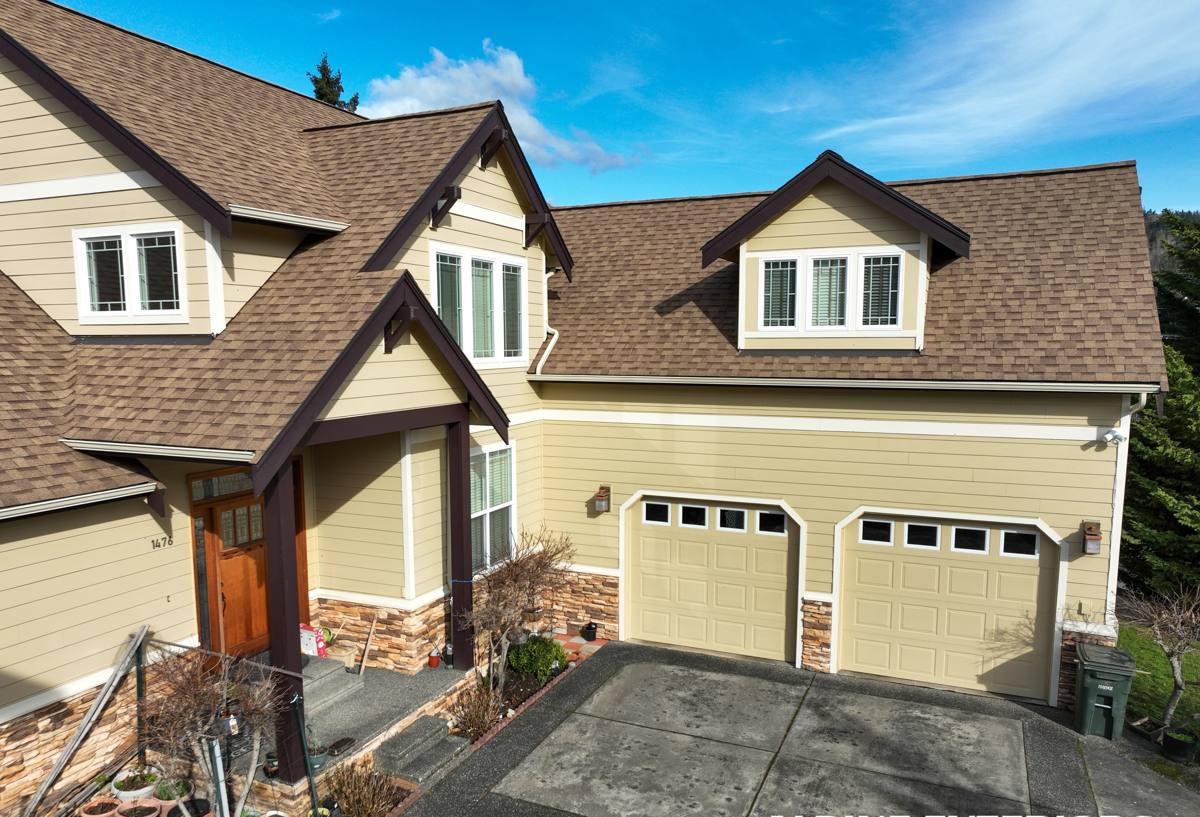
What Correct Composite Decking Looks Like in This Area
A composite deck built for California Creek isn't just "any composite deck." The board itself is only part of the system. What actually determines whether the deck holds up through a decade of Whatcom County winters is what's underneath and around it: the substructure, the fastening method, the drainage path, and the hardware. We treat all four as part of the job, not optional upgrades.
The Substructure Has to Handle Moisture, Not Just Weight
Framing lumber under a composite deck still gets wet — composite boards don't stop rain from reaching the joists below, they just don't rot the way wood decking does. If the framing isn't protected, you end up with a deck surface that looks fine while the structure underneath is quietly deteriorating. We use joist tape or an equivalent protective barrier on the tops of joists and beams, and we make sure ledger board connections are properly flashed where the deck meets the house, since that's one of the most common places water finds its way into a wall assembly.
Fasteners and Hardware Matter More Near the Water
Standard hot-dip galvanized hardware can start showing corrosion faster in a salt-air environment than most homeowners expect. We spec stainless steel or coastal-rated fasteners and structural hardware for decks in this area, and we pay attention to any place where two dissimilar metals might be in contact, since that speeds up corrosion too.
Choosing a Composite Board for Salt Air, Rain, and Moss
Not all composite decking performs the same way once it's exposed to a marine climate. The main differences that matter for a property like yours in California Creek come down to how the board handles moisture at the cut edges and surface, and how much grip and cleanability it holds onto over time.
| Material | Moisture Behavior | Moss/Algae Resistance | Maintenance |
|---|---|---|---|
| Capped composite | Cap layer sheds water; core resists swelling if cut edges are sealed | Good — smooth cap sheds debris, slows moss establishment | Periodic wash; no staining or sealing needed |
| Uncapped composite | More prone to surface moisture absorption and fading | Fair — more texture for moss and algae to grip | More frequent cleaning to prevent buildup |
| PVC decking | Fully synthetic, essentially moisture-proof | Good, though very smooth surfaces can be slippery when mossy film forms | Low; wash to keep surface clean |
| Pressure-treated wood | Absorbs water readily; prone to cupping and splitting over time | Poor — porous surface holds moisture and organic growth | Regular pressure washing, staining, and sealing |
For most California Creek properties we lean toward capped composite as the practical middle ground — strong moisture resistance without the premium cost of full PVC, and far less upkeep than wood in a climate that punishes untreated surfaces. That said, the right choice depends on your budget, how much sun or shade the deck gets, and how the deck connects to the rest of your home's exterior. We'll walk through the actual boards and give you honest trade-offs rather than pushing whatever has the best margin.
How Our Installation Process Works
- Site assessment — we look at drainage, sun/shade exposure, wind direction, and how close the deck sits to salt-influenced air, since all of that affects material choice and detailing.
- Structural plan — footings, beams, and joist spacing sized for the board you choose and the loads you actually need (furniture, hot tub, foot traffic).
- Moisture protection — joist tape, proper ledger flashing, and a drainage path that gets water away from the house rather than trapping it against framing.
- Framing — built square, level, and fastened with corrosion-resistant hardware suited to a marine environment.
- Decking installation — hidden fastener systems where the product allows, correct board spacing for expansion, and clean edge and picture-frame details.
- Railings and finishing — stairs, railings, and any post connections sealed and flashed so water doesn't collect at penetration points.
- Final walkthrough — we go over care basics with you before we consider the job done.
Drainage: The Detail That Decides How Long a Deck Lasts
Composite decking gets marketed on how little maintenance it needs, but that promise only holds if water isn't sitting where it shouldn't be. On a property like yours, with sustained wet weather for months at a stretch, we pay close attention to a few things most homeowners never think about until there's a problem: proper slope away from the house on any ledger-attached deck, gaps and spacing that let water drain between and under boards instead of pooling, and clear paths for water to exit from underneath the deck rather than sitting against the framing. A deck that traps water — even composite decking — will develop mold, staining, and eventually structural issues in the framing below, regardless of how good the surface material is.
Living With a Composite Deck in a Moss-Prone Climate
Composite decking cuts down on maintenance significantly compared to wood, but "low maintenance" in Whatcom County still means some regular attention, especially in shaded areas or under trees where moisture and organic debris collect.
- Sweep leaves, needles, and debris off the deck regularly, especially heading into fall and winter — trapped organic matter is what moss and algae feed on.
- Rinse the deck periodically with plain water to keep salt residue and grime from building up on the surface.
- For moss or algae film, a soft-bristle broom with mild soap and water is usually enough; avoid pressure washing directly into board seams, which can force water into the substructure.
- Check railing posts, stair connections, and any metal hardware once or twice a year for early signs of corrosion or loosening.
- Keep gutters and downspouts near the deck clear so roof runoff isn't dumping extra water onto the deck surface or framing below.
- Trim back overhanging vegetation where practical — more sun exposure on the deck surface means faster drying and less moss.
What Affects the Cost of a Composite Deck Here
| Factor | Why It Matters in This Area |
|---|---|
| Board tier (capped vs. PVC vs. entry composite) | Higher-grade caps resist salt air and fading longer, which affects long-term value more than upfront price |
| Substructure condition or replacement | Existing framing near the water often needs closer inspection for moisture damage before new decking goes on |
| Hardware and fastener spec | Coastal-rated stainless hardware costs more than standard galvanized but avoids early corrosion |
| Deck size, height, and layout | Stairs, multiple levels, and railings add labor and material beyond flat square footage |
| Drainage and flashing details | Proper ledger flashing and under-deck drainage add some cost but prevent the most common failure points |
We don't quote composite decking off a flat per-square-foot number, because a deck ten feet from the water with full wind exposure needs different detailing than one tucked against a sheltered side of the house. We'll give you a real number based on your site, not a generic estimate that changes once we see the property.
Why It Matters That We Already Work in California Creek
A lot of what makes a deck last in this specific area isn't in a manufacturer's install manual — it's knowing how wind off the water tends to drive rain up under railings on certain exposures, which yards hold moisture longer into spring, and how salt air affects hardware choices differently than it would twenty miles inland. Crews that mostly work drier, more sheltered parts of Whatcom County don't always build in that margin, because they haven't had to. We have, and we plan for it as a matter of course rather than as an upsell.
There's also a practical side to hiring local: permitting familiarity with Whatcom County requirements, knowing which suppliers actually stock the composite lines that hold up here, and being available for a warranty check or a quick question after the job is done, not just during the sale.
Get an Honest Look at Your Deck Project
If you're planning a new composite deck in California Creek or replacing an aging wood deck that's finally lost the fight with moss and moisture, we're happy to come take a look and give you a straightforward assessment — no pressure, no inflated scope. Use the form below to request a free estimate, and we'll walk the site with your specific exposure, drainage, and budget in mind.