 Semiahmoo Siding
 Why Lynden Windows Take a Different Approach Than Windows Inland or Farther South
Lynden sits close enough to the Semiahmoo shoreline and the Strait of Georgia that homes here deal with a mix of weather most window installers never have to plan around: long stretches of driving rain pushed in on wind, salt-tinged air that speeds up corrosion on hardware and fasteners, and a moss and algae season that can run most of the year on north-facing walls. None of that is exotic or rare — it's just the normal climate pattern for this part of Whatcom County. But it does mean a window that performs fine in a drier, more sheltered part of the state can struggle here within a few seasons if it wasn't specified and installed with this environment in mind.
Custom windows aren't about upgrading for the sake of it. They're about matching frame material, glass package, and installation detailing to what a specific house actually faces — its orientation, its wall assembly, its exposure to weather — rather than defaulting to whatever's cheapest to stock.
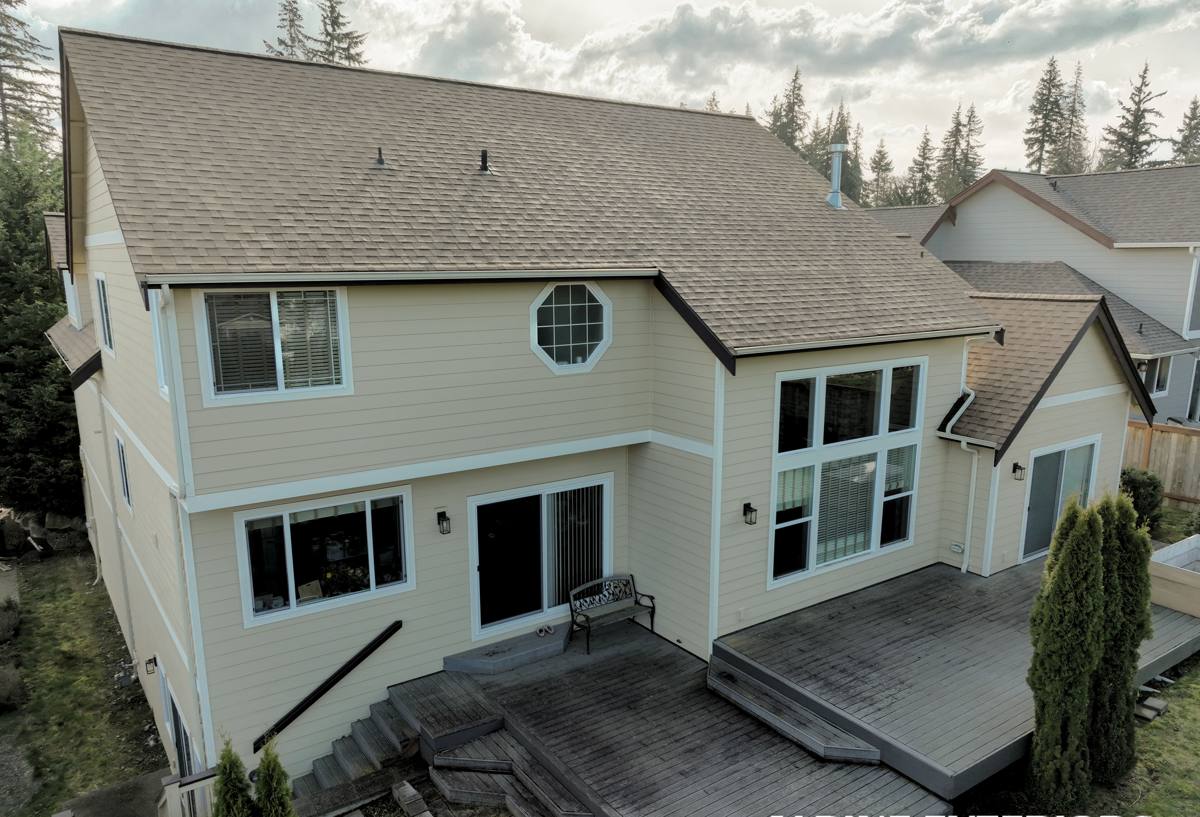
What "Custom" Actually Means on a Window Job
"Custom" gets used loosely in this trade. On a real job it covers a few distinct decisions, and getting them right up front is most of what separates a window that lasts from one that doesn't.
Retrofit (Pocket) Replacement vs. Full-Frame Replacement
Retrofit windows install into the existing frame and are faster and less disruptive, but they only make sense when the existing frame is still sound — no rot, no water staining, no soft wood at the sill. Full-frame replacement removes everything down to the rough opening, which costs more and takes longer but is the only correct option once there's any moisture damage behind the old frame. On a lot of Lynden homes built before modern flashing details were standard, we find that damage more often than homeowners expect, especially on windows that face prevailing weather.
Matching Existing Openings vs. Resizing
Most replacements keep the same rough opening size, which keeps cost and disruption down. Resizing — to add a window, change a fixed unit to operable, or correct a poorly proportioned original opening — is a bigger job involving siding, trim, and sometimes structural framing around the opening. Either way, "custom" means the window is built to the actual opening, not the opening forced to fit a stock size.
Frame Material: What Holds Up Here and What Doesn't
Frame material is the single biggest factor in how a window ages in this climate. Salt air and constant moisture cycling are hard on anything that corrodes or absorbs water, so this is where we spend the most time with homeowners before ordering anything.
| Material | Performance in This Climate | Maintenance |
|---|---|---|
| Vinyl | Good moisture resistance, no corrosion; quality varies a lot by manufacturer | Low — occasional cleaning |
| Fiberglass | Excellent — dimensionally stable, resists moisture and salt air well | Low |
| Wood-clad | Good if cladding and flashing details are correct; exposed wood interior needs protection from interior moisture | Moderate |
| Aluminum | Prone to condensation and corrosion near salt air unless thermally broken | Moderate to high |
We don't push one brand or material on every job. The right call depends on the wall's exposure, the home's style, and the homeowner's budget and maintenance appetite — but we'll tell you plainly if a product isn't a good match for a south- or west-facing wall that takes direct weather.
Glass Packages That Actually Matter in Whatcom County
The glass package affects comfort and condensation more than most homeowners expect. In a climate with this much sustained humidity and temperature swing between day and night, the wrong glass spec shows up as fogged windows, interior condensation, and cold spots near the frame.
- Low-E coatings: reduce heat loss and help control condensation on the interior pane — standard on nearly every job we do here.
- Argon or krypton fill: improves insulation between panes; argon is the practical standard, krypton is a step up for narrow-gap or triple-pane units.
- Dual-pane vs. triple-pane: dual-pane is adequate for most Lynden homes; triple-pane earns its extra cost on north- and west-facing rooms, or homes with persistent condensation history.
- Warm-edge spacers: the material separating the panes at the edge of the glass — matters more than people assume, since a poor spacer creates a cold edge where condensation forms first.
What a Correct Installation Involves
More window failures we see locally trace back to installation, not the window itself. A quality unit installed with poor flashing or sealant will fail anyway — usually as water intrusion into the wall cavity, which is a far more expensive problem than the window.
Flashing and Water Management
Every opening needs a sill pan and properly lapped flashing tape that integrates with the home's weather-resistive barrier — installed so water is directed out and down, never trapped behind the window. On driving-rain days, this detail is what actually keeps water out, not caulk.
Sealing and Insulation
The gap between the window frame and rough opening needs to be insulated and air-sealed correctly — not overpacked with expanding foam, which can bow the frame and cause the window to operate poorly. Exterior sealant needs to be compatible with the siding material and applied at the right joints, not everywhere.
Signs Your Current Windows Are Already Struggling
A lot of homeowners call us after noticing one of these, not realizing how long the underlying problem may have been developing:
- Fogging or moisture between panes (failed seal — the glass unit itself needs replacing)
- Soft or discolored wood or trim at the sill or corners
- Visible gaps or daylight around the frame
- Difficulty opening, closing, or locking
- Persistent condensation on the interior glass, especially in colder months
- Moss or algae growth on the frame or sill that won't clean off and keeps returning
- A noticeable draft near the window even with it closed
Our Process for a Lynden Window Job
- On-site assessment: we look at every opening being replaced, checking for existing moisture damage, not just measuring for new units.
- Product selection: we walk through frame material, glass package, and options based on that specific wall's exposure and your budget — no default upsell.
- Precise measurement and ordering: custom units are built to the actual opening, which takes lead time — we'll give you a realistic timeline up front.
- Removal and inspection: once the old window is out, we check the framing and sheathing before anything new goes in. If there's rot, we address it before installing — not after.
- Installation with proper flashing: sill pan, flashing integration, insulation, and sealant done to the standard that actually keeps water out long-term.
- Final walkthrough: we check operation, sealing, and finish work with you before calling the job done.
What Affects Cost
Every job is different, but the main cost drivers on a custom window project are consistent enough to plan around:
| Factor | Why It Matters |
|---|---|
| Retrofit vs. full-frame | Full-frame costs more but is required once there's frame damage |
| Frame material | Fiberglass and quality wood-clad cost more than vinyl; performance trade-offs differ by wall exposure |
| Glass package | Triple-pane and upgraded coatings add cost but pay off on exposed or problem-prone walls |
| Number and size of openings | Larger or non-standard sizes take longer to source and install |
| Existing damage | Rot repair, resized openings, or structural work add time and material |
As a broad rule of thumb, a straightforward retrofit replacement runs less than a full-frame job with rot repair or resizing involved. We'll always give you a specific number for your home rather than a generic estimate that doesn't account for your actual openings.
Why It Matters That This Crew Already Works in Lynden
A crew that already works this specific stretch of Whatcom County isn't guessing at what the weather here does to a window installation over time — we've seen which flashing details hold up through a wet winter, which frame materials handle the salt air without early corrosion, and which walls in this area take the worst of the driving rain. That local track record matters more on window work than almost any other exterior trade, because the mistakes don't show up on day one. They show up two or three winters later as rot, air leaks, or a fogged pane, and by then the fix is a lot bigger than it would have been to do right the first time.
If you're weighing whether your current windows need attention or you're planning a replacement project for a Lynden-area home, we're glad to come take a look. The estimate is free, there's no pressure, and you'll get a straight answer about what your windows actually need — use the form below to get started.