 Semiahmoo Siding
 Why Drayton Harbor's Climate Is Hard on a Deck
Drayton Harbor sits right where Semiahmoo's marine air meets the mainland, and that combination is rougher on outdoor building materials than most people expect. Salt carried in on the wind off the harbor settles on every exposed surface over time, and it doesn't take a direct water view for it to matter — salt air travels well past the shoreline. Add Whatcom County's wet season, where rain comes in sideways off the water for days at a stretch, and a stretch of the year where a deck rarely gets a full day to dry out, and you have a climate that's genuinely tougher on outdoor decking than the regional average.
None of this means composite decking is a poor choice here — it's usually the better one. But it does mean the details of the build matter more in Drayton Harbor than they would forty miles inland. A deck assembled the same way you'd build one in a dry climate tends to show problems here years earlier than it should: hardware that corrodes, boards that stay damp on the underside, and moss that gets a foothold in shaded, low-airflow spots and never really lets go.
The moss season around the harbor also runs longer than it does even a short distance inland, since the water keeps humidity higher through stretches when an inland yard would already be drying out. A deck sitting a block from the water can show the same moss and staining patterns as one right on the shoreline, so this isn't only a concern for waterfront lots.
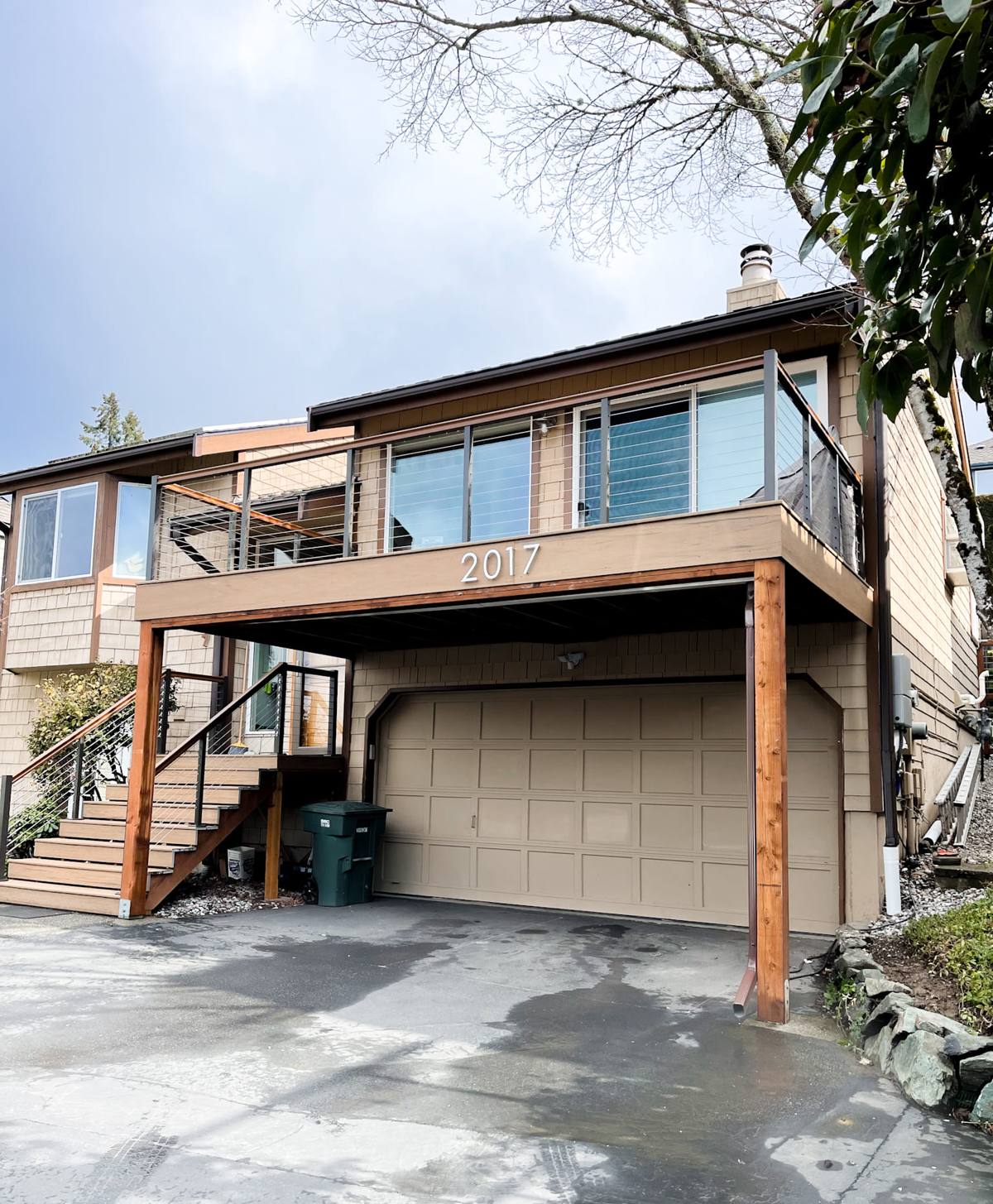
Picking a Composite Board That Actually Holds Up
Not all composite decking is built the same, and the differences matter more in a damp, salt-air environment than most manufacturer literature lets on.
Capped vs. Uncapped Composite
We only install fully capped composite boards on decks near Drayton Harbor — meaning the wood-plastic core is wrapped on all sides in a protective polymer shell. Uncapped or lightly capped composite can absorb moisture at cut ends and around fastener holes, and in a climate this damp that moisture doesn't get much chance to fully dry before the next system rolls in. A full cap keeps the harbor's humidity out of the board's core, which is where long-term swelling and staining problems start.
Color and Moss Visibility
Board color matters more here than in a drier market. Very light boards show green and black staining from moss and algae growth faster than mid-tone or darker colors, especially on the shaded side of a house or under an overhang where direct sun rarely reaches. We walk your site with you and talk through which areas get real sun exposure and which stay damp and shaded most of the year, because that changes which color and finish will actually still look good in year three — not just on install day.
Surface Texture and Grip
A wet deck near the water gets walked on wet more often than a dry-climate deck ever does, so surface texture is worth thinking about up front. Boards with a deeper wood-grain texture or a brushed finish tend to hold footing better when they're damp than a smooth, glossy board. It's a small detail, but it's the kind of thing that matters on a rainy Drayton Harbor evening and gets overlooked when a board is chosen from a sample chip in dry weather.
The Substructure Most People Never Think About
Composite boards get most of the attention, but the framing underneath them is what actually determines whether a deck holds up in this climate.
Framing and Ledger Attachment
If your deck attaches to the house with a ledger board, that connection has to be flashed correctly so wind-driven rain off the harbor can't work its way behind the siding and into the wall assembly. This is one of the most common failure points we find on older decks in the area — a ledger that was fastened solidly but never properly flashed, quietly feeding moisture into the rim joist for years before anyone notices. We flash every ledger connection and run joist tape across the top of every joist before decking goes down, which keeps standing water off bare framing lumber even though the composite boards themselves won't rot.
Footings in Wet, Low-Lying Ground
Ground near Drayton Harbor tends to hold moisture longer than well-drained upland soil, and footings that aren't set to the correct depth and bearing can shift after a few wet seasons. We size and place footings based on what we actually find on your site — soil condition, drainage, and frost depth — not a generic number pulled from a different job, and we won't pour footings on ground that hasn't been properly evaluated first.
Fasteners, Flashing, and Hardware
Standard galvanized hardware corrodes noticeably faster in salt-laden coastal air than it does even a short distance inland. We use stainless steel or coated fasteners rated for coastal exposure on every composite deck we build in this area — structural screws, joist hangers, hidden fastener clips, and railing hardware included. It costs more upfront than standard-grade hardware, but replacing corroded fasteners on a deck that's otherwise sound is an avoidable expense, and it's one of the first things we check when a homeowner asks us to look at an existing deck that's started showing problems.
Hidden fastener systems matter here for a second reason: face-screwed boards create thousands of extra puncture points where moisture can work into the board core over repeated wet-dry cycles. Hidden clips leave the board face uninterrupted, which holds up better through a long, wet Whatcom County winter. Railing posts get the same attention — post-to-frame connections take the most stress on a deck, and a poorly fastened or corroding post connection is a safety issue long before it's a cosmetic one.
What Drives the Cost of a Composite Deck Project
Every deck is priced around its own footprint and site conditions, but a few factors move the number more than others in this particular area.
| Factor | Why It Matters Here | Typical Cost Impact |
|---|---|---|
| Deck size and footprint | More boards, joists, and footings across a larger area | High |
| Substructure condition | Coastal moisture often means hidden framing repair on a rebuild | Medium to High |
| Board tier selected | Higher-tier capped composite resists moss and staining longer | Medium |
| Railing style | Code-compliant guardrails add material and labor over open decks | Medium |
| Fastener and hardware spec | Marine-grade hardware costs more but avoids corrosion callbacks | Low to Medium |
| Site access and grade | Low-lying or sloped lots near the harbor affect footing work and equipment access | Medium |
Our Process, Start to Finish
- On-site assessment — we walk the property, check sun and shade patterns, drainage, and the condition of any existing deck, ledger connection, or framing before we talk numbers.
- Design and material selection — board tier and color matched to your site's actual sun exposure, plus layout, border, and railing options that fit the house.
- Permitting — we confirm what's required for your parcel before any work starts, so there are no surprises partway through the build.
- Framing and substructure — footings, joists, ledger flashing, joist tape, and marine-grade hardware go in first, before a single composite board is placed.
- Decking, fascia, and railing installation — hidden fasteners where possible, code-compliant guardrails throughout, clean board layout and border work.
- Final walkthrough — we check level, fastening, railing security, and drainage together with you before we call the job finished.
Why Hiring a Crew That Already Works Drayton Harbor Matters
A composite deck built to a spec sheet from a dry inland market and a composite deck built for Drayton Harbor's actual conditions can look identical on install day and age very differently five years later. A crew that already works this stretch of Whatcom County knows which lots sit low and hold water longer after a storm, which yards catch the harder wind off the harbor, and roughly what to expect from the permitting process on parcels close to the shoreline. That's not something you can fully substitute with a spec sheet or a manufacturer's install guide written for a national audience.
It also matters after the job is done. If a question comes up about a fastener, a railing connection, or how a section is draining a year or two in, you're calling a crew that is still working in your neighborhood and knows the site — not chasing down a company that only passed through once for a single job.
Living With a Composite Deck Through a Long Moss Season
Composite decking needs far less upkeep than wood, but "low maintenance" does not mean "no maintenance" — especially with a moss season as long as this one. A little regular attention keeps a good deck looking good instead of needing a hard scrub-down every spring.
- Sweep or rinse debris off the deck surface regularly so wet leaves and organic matter don't sit for weeks at a time
- Keep gutters and downspouts clear so roof runoff isn't sheeting directly onto the deck surface
- Trim back vegetation that's shading the deck and keeping it damp longer than it needs to be
- Clean with a soft-bristle brush and a composite-safe cleaner rather than a pressure washer on a high setting
- Check railing hardware and fastener points once a year for early signs of corrosion, especially closer to the water
- Address any moss as soon as you see it rather than letting it establish — it comes off far easier early than after it's taken hold
If you're weighing a new composite deck or replacing one that's struggling with the salt air and moss around Drayton Harbor, we're happy to take a look and talk through what your specific site actually needs. The estimate is free, there's no pressure, and you can use the form below to get started.