 Semiahmoo Siding
 Storm Damage in Laurel Isn't Like Storm Damage Inland
Laurel sits close enough to the water that homes here take a different kind of beating than a roof twenty miles inland. It's not usually one dramatic event that does the damage — it's the combination. Winter windstorms off the Strait push driving rain sideways under shingles and flashing that would stay dry in a straight-down rain. Salt-laden air accelerates corrosion on nails, flashing, and vent boots faster than most manufacturers' warranty literature accounts for. And the long wet season here — often eight or nine months of the year with meaningful moisture — gives moss and moisture a head start that homes in drier parts of the state simply don't deal with.
When we get called out to a storm-damaged roof in this area, we're rarely looking at a single clean problem. It's usually a wind event that found a weak spot the salt air and moss had already been working on for a year or two. Repairing it right means treating both the immediate damage and the conditions that made the roof vulnerable in the first place.
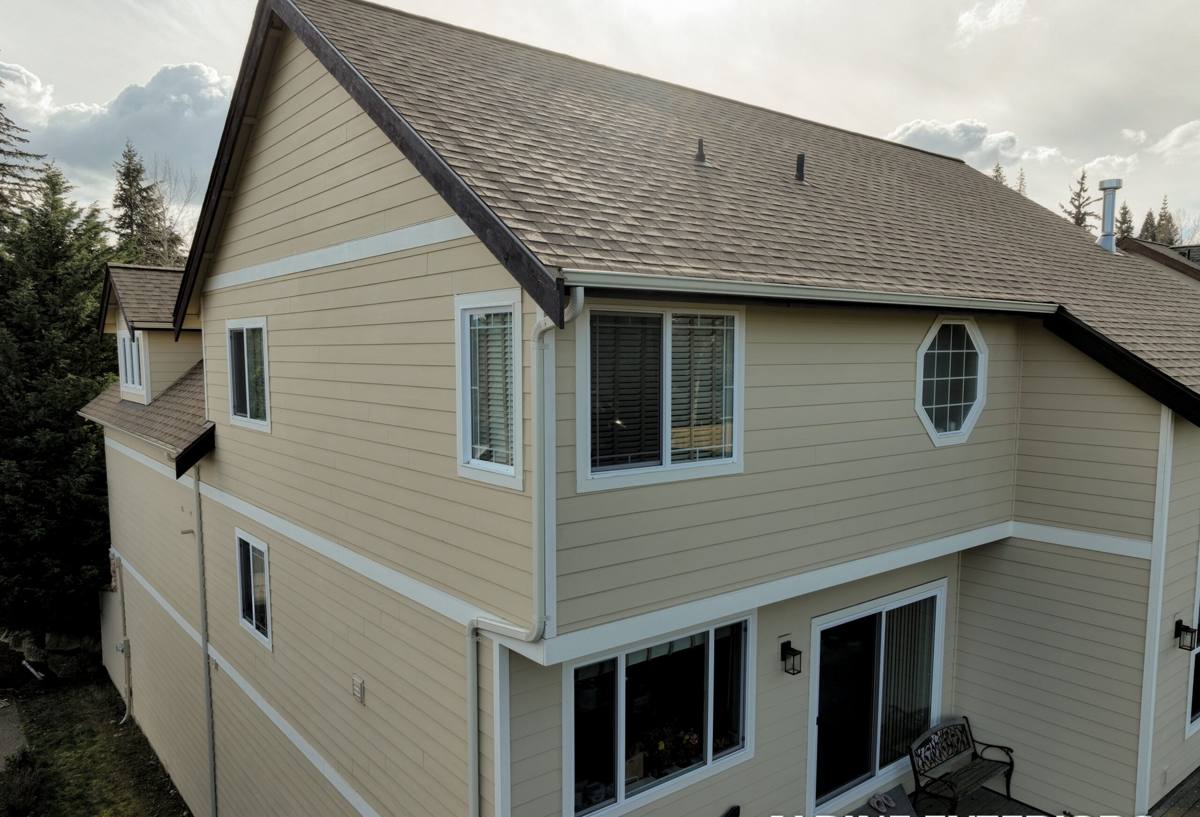
What Actually Causes Storm Damage Here
Wind and Driving Rain
Whatcom County storms coming off the water tend to bring sustained wind rather than short gusts, and that matters. Sustained wind pressure works shingle edges loose gradually, lifts ridge caps, and drives rain horizontally under laps that were never designed to shed water sideways. A roof that looks fine from the ground can have dozens of lifted or cracked shingles after one bad night.
Salt Air Corrosion
Proximity to the water means airborne salt settles on every exposed metal component — flashing, drip edge, nail heads, vent stacks. Corroded fasteners back out over time, and corroded flashing seams open up just enough to let water in during the next storm, even if the flashing looks intact from a distance.
Moss and Trapped Moisture
The long moss season here does two things: it holds moisture against the shingle surface for weeks at a time, and it grows under the shingle tabs and lifts them slightly, which is exactly the gap a windstorm needs to finish the job. A roof with heavy moss growth going into storm season is already primed for damage.
Signs of Storm Damage Worth Checking
- Shingles that are cracked, curled at the edges, or missing entirely after a windstorm
- Granules collecting in gutters or downspouts — a sign of shingle wear accelerated by wind and rain
- Water stains on interior ceilings or walls, especially near chimneys, skylights, or where two roof planes meet
- Flashing that looks bent, lifted, or separated from the roof deck around vents and valleys
- Soft or spongy spots on the roof surface, which usually mean the decking underneath has taken on water
- Heavy moss growth combined with any of the above — moss alone isn't storm damage, but it's often hiding it
Not every one of these means a full roof replacement. Some are a straightforward repair. But every one of them is worth a proper look, because water that gets past the surface layer doesn't stop at the shingle — it keeps going until something stops it, usually the decking or the framing underneath.
What a Correct Storm Damage Repair Actually Involves
A repair that just covers the visible damage and leaves everything else alone tends to fail again in the next storm. Here's what we consider a complete job:
1. Full Roof Assessment, Not Just the Obvious Spot
Wind damage is rarely isolated to one area. We check the whole roof plane, not just where the homeowner saw a shingle come loose, because the same wind that tore off one shingle almost always loosened several others nearby that haven't failed yet.
2. Deck Inspection Where Water Got In
If there's any sign water reached the decking, we check it before covering it back up. Wet decking that gets sealed over without being addressed is one of the most common reasons a "repaired" roof develops a soft spot or a leak a year later.
3. Flashing and Fastener Correction, Not Just Replacement
Given how salt air treats metal in this area, we don't just swap a damaged flashing piece for an identical one and call it done. We look at whether the fastening and sealing approach actually holds up to this coastal exposure, and adjust where it doesn't.
4. Matching Materials Properly
Shingle color and profile matching matters more on a repair than most homeowners expect — mismatched patches are one of the most common complaints we hear about other contractors' storm repairs. We source materials that blend with the existing roof wherever the manufacturer and age of the roof make that possible.
5. Moss and Debris Clearing as Part of the Job
Since moss is part of what set the roof up for damage, a repair that doesn't address existing moss growth is leaving the same vulnerability in place for the next storm season.
Repair vs. Replacement: How We Make That Call
| Factor | Points Toward Repair | Points Toward Replacement |
|---|---|---|
| Extent of damage | Isolated to one section or slope | Spread across most of the roof |
| Roof age | Under roughly 10-12 years | Nearing or past typical service life for the material |
| Decking condition | Dry, sound plywood or sheathing | Soft, delaminated, or repeatedly wet decking |
| Moss/algae history | Light, surface-level growth | Heavy, recurring growth lifting shingles broadly |
| Prior repair history | First significant storm damage | Multiple past patches in different spots |
We'll always give you the honest read on which side of that table your roof falls on, and we won't push a replacement when a proper repair will hold. We also won't tell you a patch is fine when the underlying roof is clearly at the end of its service life — that just means you're paying for the repair twice.
Our Process for Laurel Storm Damage Calls
- Inspection. We walk the roof (weather permitting) and check the interior for water intrusion signs, not just the exterior.
- Written scope. You get a clear explanation of what's damaged, what's causing it, and what we recommend — repair or replacement — with reasoning, not just a number.
- Temporary protection if needed. If there's active leaking and the full repair can't happen immediately, we can address the exposure first so it doesn't get worse while materials are sourced.
- The repair itself. Deck check, flashing correction, matched materials, moss clearing where relevant, and a clean tie-in with the surrounding roof.
- Walkthrough. We show you what was done and what to keep an eye on, particularly if there are other areas of the roof approaching the end of their service life.
Why Local Storm Experience Matters
A roofing crew that mostly works drier, inland parts of Washington will approach a Laurel storm repair the same way they'd approach one anywhere else — replace the obviously broken piece and move on. That's not enough here. A crew that regularly works this stretch of Whatcom County knows to check for salt corrosion on fasteners that look fine to the eye, knows how fast moss re-establishes itself in this climate, and knows which flashing details actually hold up to sustained coastal wind rather than just meeting code on paper.
That local pattern recognition is the difference between a repair that lasts through the next several storm seasons and one that reopens the first time the wind picks up again.
What Homeowners Can Do Between Storms
- Clear moss buildup before it spreads across a full roof plane, not after
- Keep gutters and downspouts clear so storm water has somewhere to go besides under the shingles
- After any significant windstorm, do a visual check from the ground for missing or lifted shingles
- Watch for granule buildup in gutters, which signals accelerated shingle wear
- Get a roof inspected before storm season if it's due for one anyway — catching a weak spot before a storm is cheaper than repairing after
None of this replaces a professional inspection after real damage, but it does reduce how often you need one.
Get an Honest Look at Your Roof
If a recent storm left you with missing shingles, a new leak, or just a nagging feeling something's not right up there, we're glad to come take an honest look. We'll tell you straight whether it's a repair or something bigger, and why — no pressure either direction. Reach out for a free estimate using the form below.