 Semiahmoo Siding
 Deck Repair Built Around Lynden's Weather, Not a National Checklist
Lynden sits inland from Semiahmoo Bay but still lives inside the same weather pattern that defines this whole corner of Whatcom County: long wet winters, a short dry window in summer, and a moss season that can stretch from October well into April. Decks here don't fail because the wood was bad or the builder was careless. They fail because Pacific Northwest moisture finds every seam, fastener hole, and end-grain cut over enough winters, and most decks were never detailed to shed water as aggressively as this climate demands. We repair decks in Lynden and the surrounding Semiahmoo-area communities with that reality in mind, not a generic checklist written for a drier region.
A deck repair done right here has to account for driving rain that hits at an angle instead of falling straight down, salt-tinged air moving inland off the bay that speeds up corrosion on hardware, and moss that holds moisture against decking boards long after a storm has passed. Skip any of that and a repair that looks fine on the day we finish can be soft again in two or three winters.
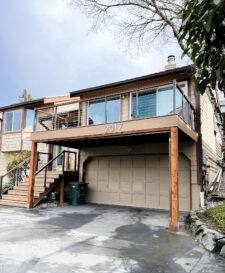
What Whatcom County Weather Actually Does to a Deck
Driving Rain and Standing Moisture
Wind-driven rain gets pushed sideways under railings, into the gap between decking boards, and behind ledger boards where the deck attaches to the house. Once water gets past the surface, it doesn't evaporate quickly in our climate. It sits in end grain, around fastener heads, and in the framing cavity, which is where rot actually starts — almost never on the visible top surface first.
Moss, Algae, and Slip Risk
A long moss season means organic growth gets a real foothold on any deck surface that stays shaded or doesn't dry out between rain events. Beyond the obvious slip hazard, moss and algae hold water against the wood or composite surface, which accelerates surface breakdown and can trap moisture in joints and fastener holes.
Salt Air and Hardware Corrosion
Homes closer to the bay deal with airborne salt that speeds up corrosion on anything less than a truly weather-rated fastener or bracket. We see this most often in older decks where standard hardware was used instead of stainless or properly rated hot-dip galvanized fasteners — the wood can still be sound while the hardware holding it together is failing underneath.
Freeze-Thaw Cycling
Whatcom County doesn't get brutal winters, but it gets enough freeze-thaw swings that trapped moisture in wood fibers or hairline cracks can expand and split material that was already compromised by rot. It's rarely the cold itself that does the damage — it's the combination of wet wood and a hard freeze.
The Deck Problems We Find Most Often in Lynden
- Soft or spongy decking boards, usually near the house or in shaded corners where moisture lingers
- Rot at the ledger board connection, often hidden behind flashing that was installed incorrectly or not at all
- Rusted or corroding joist hangers, screws, and bolts, especially on decks over ten to fifteen years old
- Cupped, warped, or splitting boards from repeated wet-dry cycling
- Loose or wobbly railings and posts, frequently tied to post-base rot rather than the railing hardware itself
- Moss and algae staining that homeowners assume is cosmetic but that signals a surface holding moisture too long
- Stair stringer rot, particularly at ground contact points
What a Correct Deck Repair Actually Involves
An honest repair starts with figuring out what's structural and what's cosmetic, because those get fixed very differently and cost very differently too. That means probing suspect boards and framing members, checking the ledger connection and its flashing, and inspecting posts and footings — not just looking at the surface and patching what's visible.
Structural First, Cosmetic Second
Framing members, ledger attachment, post bases, and stair stringers get evaluated before we talk about decking boards or railings. A deck with beautiful new boards over a compromised ledger connection is not a repaired deck — it's a deck with a hidden problem and a fresh coat of paint over it.
Flashing and Water Management
If the ledger board isn't properly flashed to keep water from running behind it and into the house rim joist, that gets corrected as part of the repair, not treated as a separate upsell. This is one of the most common gaps we find on older decks in this area, and it's also one of the most consequential if left alone.
Matching Hardware to the Climate
Fasteners and structural connectors get specified for this environment — stainless steel or properly rated hot-dip galvanized hardware, not standard interior-grade screws that will corrode within a few wet seasons this close to the bay.
Code-Compliant Connections
Ledger attachment, joist hangers, and guard/railing connections follow current residential building code requirements, which exist specifically because deck failures are almost always connection failures, not decking-board failures.
Repair or Replace? Honest Cost Factors
Not every deck problem calls for a full rebuild, and not every deck is worth saving. The table below covers the factors that actually drive that decision.
| Factor | Repair Usually Makes Sense | Replacement Usually Makes Sense |
|---|---|---|
| Framing and ledger condition | Structurally sound, isolated soft spots | Widespread rot at ledger or multiple joists |
| Age of the deck | Under 12–15 years, built to a reasonable original standard | Older deck nearing the end of typical framing lifespan |
| Extent of damage | Limited to specific boards, railings, or stairs | Damage spread across the whole surface or structure |
| Original construction quality | Adequate flashing and hardware, fixable gaps | Missing flashing, undersized framing, or code shortcuts throughout |
| Homeowner goals | Keep current footprint and layout as-is | Want a different size, layout, or material upgrade |
In many Lynden homes we've evaluated, the framing underneath is in better shape than the decking on top — which is good news, because framing replacement is the expensive part. Surface-level repair over a sound structure is often the more cost-effective and perfectly durable path.
Our Process for Lynden Deck Repairs
- Inspection. We walk the full deck, probe suspect areas, and check the ledger, posts, footings, and framing — not just the parts you can see from the yard.
- Written assessment. You get a clear explanation of what's structural, what's cosmetic, and what your realistic options are, in plain language.
- Scoped estimate. A defined price for the actual repair, broken down so you know what you're paying for and why.
- Repair work. Framing and connection repairs first, then decking, railings, and stairs, using hardware rated for this climate.
- Final check and cleanup. We confirm the repair is solid, cleaned up, and ready for the next several wet seasons before we call it done.
Materials We Use, and the Honest Tradeoffs
There's no single "best" decking material — there are tradeoffs, and we'd rather walk you through them than push whatever's easiest for us to install.
| Material | Moisture Behavior | Maintenance | Notes for This Climate |
|---|---|---|---|
| Pressure-treated lumber | Resists rot when properly maintained | Needs regular sealing/staining | Cost-effective; performance depends heavily on upkeep |
| Cedar | Naturally rot-resistant, but surface still weathers | Sealing recommended to hold color and resist moss | Popular locally for appearance; still needs care in a wet climate |
| Composite decking | Doesn't absorb water or rot like wood | Low maintenance; occasional cleaning to prevent surface moss/algae | Higher upfront cost, longer-term durability against our wet-dry cycling |
Whichever material a repair calls for, the framing and hardware underneath matter more than the surface material for long-term durability. We won't talk you into composite decking on top of framing that isn't sound, and we won't tell you wood is a bad choice if it's maintained — it's about matching the material to how much upkeep you actually want to do.
Keeping a Repaired Deck in Good Shape
A repair holds up a lot longer with a small amount of seasonal attention, especially given how long the wet season runs here.
- Sweep leaves and debris off the deck regularly in fall, before they trap moisture against the boards
- Rinse or brush off moss and algae buildup before it gets a strong foothold, particularly in shaded areas
- Check that gaps between boards stay clear so water can drain instead of pooling
- Inspect the ledger flashing area and post bases once a year for early signs of moisture intrusion
- Re-seal or re-stain wood decking on the schedule the product calls for — don't stretch it because it "still looks fine"
- Tighten or replace any hardware showing early rust before it becomes a structural issue
Why It Matters That We're a Local Semiahmoo-Area Crew
We work on decks throughout the Semiahmoo area and communities like Lynden regularly, which means we're not guessing at how this climate behaves — we're seeing the same rot patterns, the same moss buildup, and the same corroded hardware on a routine basis. That familiarity shows up in what we look for during an inspection and in the materials and hardware we default to, because we've already seen what holds up here and what doesn't.
It also means we're not disappearing after the invoice is paid. If a repair needs a follow-up look after the first hard winter, we're a local call, not a distant number.
If your Lynden deck has soft spots, loose railings, moss buildup, or you just want an honest read on its condition, we're glad to take a look. Reach out for a free, no-pressure estimate using the form below.