 Semiahmoo Siding
 Why Point Roberts Decks Wear Out Faster Than You'd Expect
Point Roberts sits on a peninsula surrounded by water on three sides, which means almost every deck out here gets more salt-laden air, more wind-driven rain, and more standing moisture than a deck twenty miles inland in Whatcom County would ever see. That combination is hard on wood, hard on fasteners, and hard on the connections that hold a deck together. It's not that the decks were built badly — it's that this specific stretch of coastline asks more of a structure than most manufacturers' warranties or generic install guides account for.
We see the same pattern on home after home: the deck looks fine from a few feet away, but the parts you can't easily see — ledger board connections, joist hangers, under-deck framing, and fastener heads — are where the damage actually starts. Add in a long moss season where shaded or north-facing decks stay damp for weeks at a stretch, and you've got the exact conditions that accelerate wood rot and corrode metal hardware.
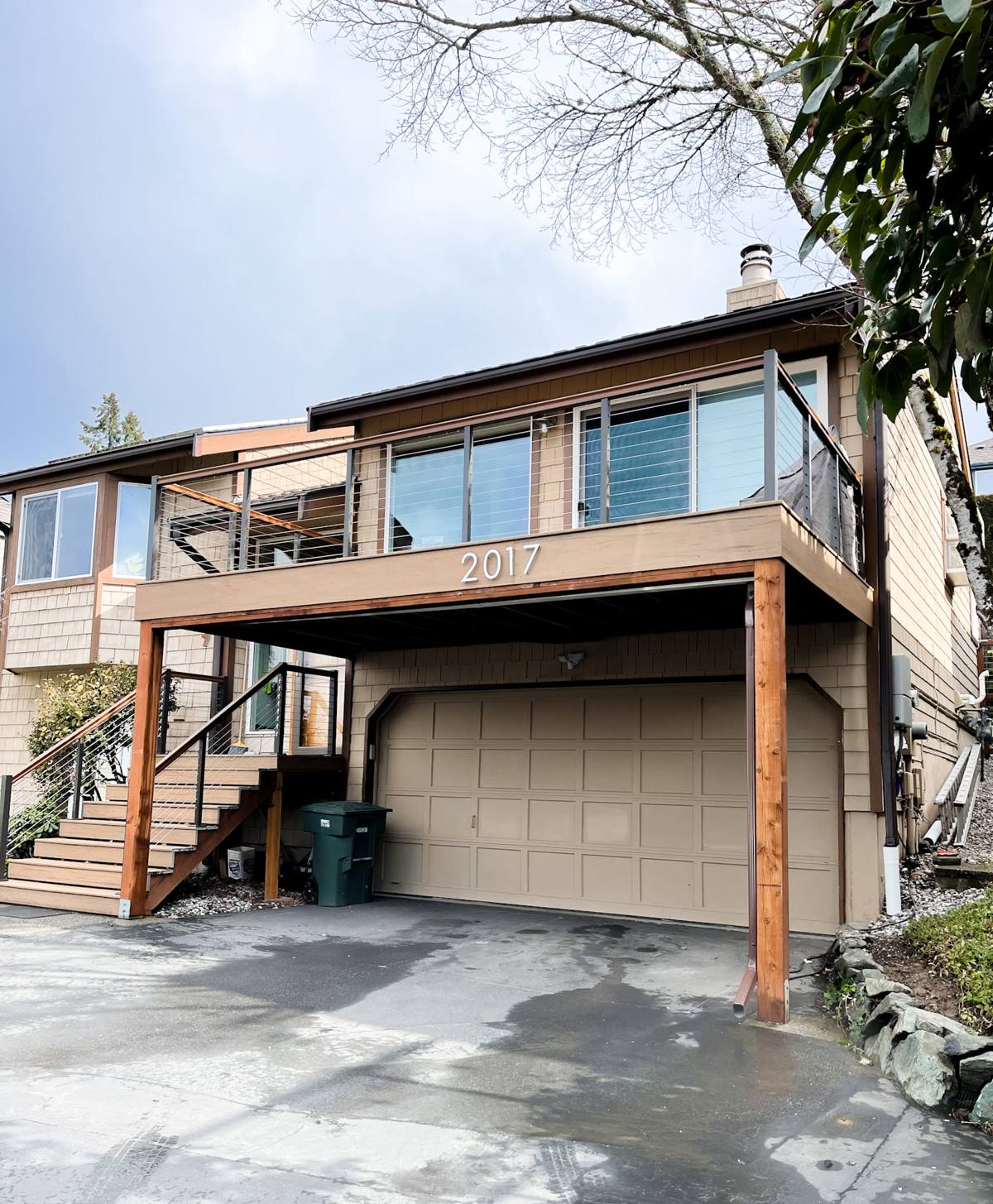
What Salt Air, Rain, and Moss Actually Do to a Deck
Salt air and corrosion
Airborne salt speeds up corrosion on any exposed metal — nails, screws, joist hangers, bolts, and railing brackets. Once a fastener starts rusting, it loses holding strength long before it looks obviously bad. A deck can feel solid underfoot while the connections that actually carry the load are quietly failing.
Driving rain and water intrusion
Wind-driven rain doesn't just fall straight down — it gets pushed sideways into ledger boards, under flashing, and into any gap where the decking meets the house. Over time this drives water into places it was never designed to sit, which is where rot starts, usually from the inside out.
Moss and prolonged moisture
Moss doesn't just look bad — it holds water against the deck surface and framing far longer than open air and sun would allow. Shaded decks, decks under trees, and north-facing decks in this area can stay damp for weeks during the wetter months, which is ideal for wood decay fungi and gives moss time to work into seams and fastener holes.
Signs Your Deck Needs Repair — Not Just a Pressure Wash
A lot of homeowners try to fix deck problems with cleaning or a fresh coat of stain. Sometimes that's genuinely all that's needed. Other times it masks a structural issue that gets worse underneath. Here's how to tell the difference:
- Boards that feel spongy, soft, or flex noticeably when you walk on them
- Visible gaps opening up where the deck meets the house (ledger separation)
- Rust streaks running down from fasteners or hardware
- Railings or posts that wiggle more than a firm push should allow
- Green or black staining that keeps coming back within weeks of cleaning
- Stairs that feel uneven, bouncy, or have started to pull away from the deck
- Standing water that doesn't drain within an hour or two after rain stops
Any one of these on its own might be minor. Several together usually mean the deck needs a real inspection, not just surface maintenance.
What a Correct Deck Repair Actually Involves
Deck repair done right isn't just swapping a few bad boards and calling it done. A proper repair follows the problem to its source:
1. Structural inspection first
We check the ledger board connection to the house, the condition of joists and beams underneath, post bases, and footing condition where accessible. This is the part that determines whether you're looking at a repair or something closer to a rebuild.
2. Fastener and hardware assessment
Corroded nails, screws, and joist hangers get identified and replaced with hardware rated for coastal, high-moisture exposure — not the standard-grade fasteners that are common in inland construction and simply weren't built for this air.
3. Decking and framing repair
Rotted or damaged boards and framing members are cut back to solid wood and replaced — not painted over or patched. Partial fixes on rot almost always come back within a season or two because the fungus is still active in the wood that's left behind.
4. Drainage and flashing correction
Where water intrusion is the underlying cause, we address flashing at the ledger, deck slope, and gaps that let driving rain in, so the repair doesn't just fail again the next wet season.
5. Final check and homeowner walkthrough
We walk the finished repair with you, point out anything worth watching, and give straightforward guidance on maintenance going forward — no upsell, just what actually matters for your specific deck.
Repair or Replace? What Actually Drives That Decision
Homeowners often ask us this before we've even looked at the deck. The honest answer is that it depends on how far the damage has spread and where it's located. This table covers the main factors we weigh:
| Factor | Leans Toward Repair | Leans Toward Replacement |
|---|---|---|
| Ledger board condition | Solid, properly flashed, minor surface wear | Rotted, poorly flashed, or separating from the house |
| Framing/joists | Damage limited to a few members | Widespread soft spots or rot across the frame |
| Age of deck | Under 15 years, built with adequate hardware | Older deck near or past typical service life |
| Fastener condition | Localized rust, easily replaced | Widespread corrosion throughout structure |
| Footings/posts | Stable, properly set | Heaving, undersized, or improperly footed |
| Overall footprint | You're happy with the size and layout | You want a different size, shape, or elevation |
As a general rule: if the framing and ledger are sound and the damage is limited to decking boards, railings, or isolated hardware, repair is usually the smarter dollar-for-dollar move. If the frame itself is compromised, a repair is often just delaying a bigger job — and we'll tell you that plainly rather than patch something that won't hold.
Materials We Use — and Why
Given the salt air and moisture exposure specific to this area, we're selective about what goes into a repair:
- Fasteners: stainless steel or high-grade coated fasteners rated for coastal exposure, not standard galvanized hardware that corrodes faster in salt air
- Framing lumber: pressure-treated lumber rated for ground contact or moisture exposure where it's in contact with wet-prone areas
- Decking material: we'll talk through wood versus composite honestly — composite reduces maintenance and moss buildup on the surface but costs more upfront, while wood is more affordable initially but needs more consistent upkeep in this climate
- Flashing: proper ledger flashing that directs water away from the house rather than trapping it against the band board
We don't push a specific brand of composite decking or hardware as a one-size-fits-all answer. Every product has trade-offs in maintenance, moisture behavior, and cost — our job is to walk you through those honestly so the repair matches your deck, your budget, and how much upkeep you actually want to do.
How Our Process Works for Point Roberts Homes
Point Roberts is a bit of a logistical outlier — it's only reachable by road through Canada, which means not every contractor based elsewhere is set up to service it efficiently. We schedule Point Roberts jobs deliberately, grouping visits so we're not making the trip for a single small task, which keeps our estimates honest and our scheduling realistic instead of open-ended.
Our process on a typical repair job:
- Initial conversation about what you're seeing and any history of prior repairs
- On-site inspection of decking, framing, ledger, hardware, and drainage
- A clear, written scope — what needs fixing, what we recommend watching, and what's optional
- A straightforward estimate with repair versus replacement laid out if it's a close call
- Scheduled repair work, done to code, with cleanup when finished
Why It Matters That We Already Work in Point Roberts
A crew that only occasionally makes it out to this part of Whatcom County is going to treat every deck the same way they'd treat one twenty miles inland — same fastener specs, same assumptions about moisture exposure, same maintenance advice. That approach misses what actually shortens the life of a deck out here.
Working regularly in Point Roberts and the surrounding Semiahmoo area means we've seen how quickly standard-grade hardware corrodes in this air, which north or shaded exposures hold moss and moisture longest, and where driving rain tends to find its way into ledger connections. That's not a marketing point — it's the difference between a repair that holds up through a few more wet seasons and one that needs redoing in two years.
Simple Maintenance That Extends a Repair's Life
Once your deck is repaired, a little seasonal attention goes a long way given the local conditions:
- Sweep debris and standing leaves off the deck surface regularly, especially in fall
- Clean moss growth promptly rather than letting it establish — the longer it sits, the more moisture it holds against the wood
- Check that gaps between boards stay clear so water can drain rather than pool
- Look at fastener heads once or twice a year for early rust staining
- Reapply sealant or stain on wood decking on the schedule the product recommends — coastal exposure tends to wear finishes faster than inland conditions
- Keep an eye on the ledger board area where the deck meets the house, since that's where hidden water damage usually starts
If your deck is showing any of the signs above, or you just want an honest read on whether it needs repair or replacement, we're happy to take a look. Fill out the form below for a free, no-pressure estimate — we'll tell you straight what we find and what it would take to fix it right.