 Semiahmoo Siding
 Point Roberts' Roofing Climate: What a New Roof Is Actually Up Against
Point Roberts sits out on its own point of land off the Boundary Bay coastline, and that location means every roof out there takes a beating from three directions at once. Salt-laden air off the water works on exposed metal — nails, flashing, vent boots, and drip edge — faster than it does even a few miles inland. Driving rain off Georgia Strait pushes water sideways under shingles and around penetrations that would stay dry in a calmer climate. And the long, wet, mild-temperature stretch that defines a Whatcom County winter gives moss and algae months on end to get established on anything north-facing or shaded by trees.
None of that means a roof out here can't last its full service life. It means the installation has to account for those three stressors from the start — material selection, fastener choice, underlayment coverage, and ventilation all matter more here than they do on a dry-side roof. A new roof installation that ignores salt air, wind-driven rain, and moss pressure is a roof that's already behind schedule on maintenance the day it's finished.
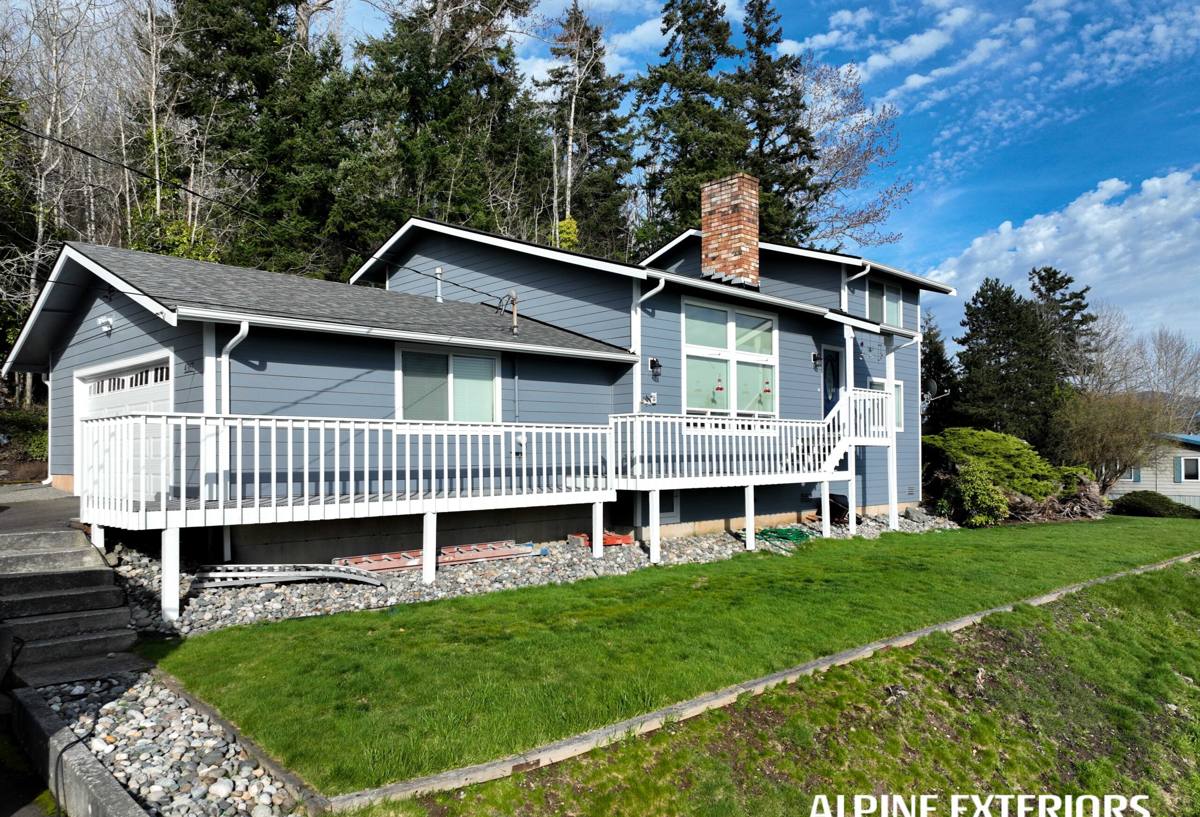
Signs a Point Roberts Roof Needs Full Replacement, Not Another Repair
Homeowners often ask us to look at a leak or a soft spot expecting a patch, and sometimes that's exactly what's needed. But a marine climate accelerates certain failure patterns, and once you see them spread across a roof rather than isolated to one spot, replacement is usually the more honest recommendation.
- Granule loss heavy enough that you're finding shingle grit in the gutters every time it rains
- Shingles that are cupping, curling, or cracking across multiple slopes, not just one sun-exposed section
- Moss mats thick enough to be lifting shingle edges rather than just staining the surface
- Flashing around chimneys, skylights, or valleys that's rusted, separated, or was never properly step-flashed to begin with
- Daylight or water staining visible in the attic along the roof deck, especially near eaves or valleys
- A roof already past 20-25 years old with asphalt shingles, since salt air and rain exposure tend to shorten the practical lifespan versus a drier climate
If two or three of these show up together, patch repairs usually just move the leak somewhere else on the same roof within a season or two.
What a Correct New Roof Installation Includes
A new roof is more than shingles nailed to plywood. In a climate that pushes rain sideways and grows moss on schedule, the layers underneath the visible surface do most of the actual work.
Tear-off and deck inspection
We remove the existing roofing down to the deck rather than layering over it. That lets us actually see the sheathing — soft, delaminated, or water-stained plywood gets replaced before anything new goes down, and it's the only reliable way to catch rot that's been hiding under old shingles.
Underlayment built for wind-driven rain
A synthetic underlayment across the full roof, with self-adhered ice-and-water membrane at eaves, valleys, and around every penetration, gives the roof a second line of defense when wind pushes rain up and under the shingle edge — which happens regularly on an exposed, waterfront-adjacent lot.
Flashing done properly, not caulked shut
Step flashing at walls and chimneys, correctly lapped valley flashing, and proper flashing at every vent penetration. Caulk and roofing cement are a short-term patch, not a substitute for flashing installed to shed water the way it's designed to move.
Fasteners and metal components rated for salt exposure
Standard fasteners corrode faster this close to salt air. We use corrosion-resistant nails and, where metal roofing or flashing is involved, materials and coatings chosen to hold up rather than chalk and stain within a few years.
Roofing Materials That Actually Hold Up in a Salt-Air, High-Moss Climate
There's no single "best" roofing material for every home — pitch, budget, and the look you want all factor in. But some materials tolerate this climate better than others, and it's worth understanding the trade-offs before you pick one.
| Material | How It Handles Salt Air & Rain | Moss Resistance | Typical Lifespan Here |
|---|---|---|---|
| Architectural asphalt shingle | Good, especially with corrosion-resistant fasteners and full flashing | Moderate — needs periodic cleaning on shaded slopes | 20-30 years |
| Standing seam metal | Very good with proper coatings; sheds wind-driven rain well | High — moss struggles to grip a smooth metal surface | 40-50+ years |
| Cedar shake | Handles the marine climate visually well but needs consistent upkeep | Low without regular treatment — shakes hold moisture longer | 20-30 years with maintenance |
| Synthetic/composite shingle | Good; resists salt corrosion since it's not a metal surface | Moderate to high depending on product | 30-50 years |
We'll walk through what makes sense for your roof's pitch, your budget, and how much maintenance you actually want to sign up for. We don't push cedar shake as a low-maintenance option in this climate — it can look great, but it needs a real upkeep commitment to avoid moisture problems, and we'd rather tell you that upfront than sell you a product that turns into a headache in year five.
Our New Roof Installation Process, Start to Finish
- On-site inspection and estimate. We look at the existing roof, deck condition where visible, ventilation setup, and any trouble spots before quoting anything.
- Material selection. We go over the options above in plain terms — cost, lifespan, moss resistance, and appearance — so you're picking based on trade-offs you actually understand.
- Scheduling and material delivery. For Point Roberts specifically, we plan delivery timing around access logistics rather than assuming a standard mainland schedule.
- Full tear-off. Old roofing comes off completely so the deck can be inspected and repaired where needed.
- Underlayment and flashing installation. Ice-and-water membrane at vulnerable points, synthetic underlayment across the field, and properly lapped flashing throughout.
- Roofing material installation. Installed to manufacturer spec, with fastening patterns and exposure rates matched to the wind and rain exposure of your specific lot.
- Ventilation check. Intake and exhaust ventilation confirmed or corrected — this matters as much as the shingles for long-term moss and moisture control.
- Final cleanup and walkthrough. Site cleared of debris and nails, and we walk the finished roof with you before calling the job done.
Why a Crew That Already Works Point Roberts Matters
Point Roberts is a geographic exclave — it's cut off from the rest of Washington State by land, with road access running through Canada. That's not just trivia; it directly affects how a roofing project gets planned and run. Material deliveries, crew scheduling, and border logistics all take extra coordination that a contractor unfamiliar with the area tends to underestimate, which shows up as delayed start dates, mid-project material shortages, or a crew that's late every single day because they didn't plan around crossing times.
We already build our scheduling around this. Materials get ordered and staged with the crossing in mind, our crew's paperwork and routine are already sorted out, and we're not learning the logistics on your project's timeline. For a homeowner, that translates into a project that actually runs on the schedule we give you, instead of one that stalls out because the contractor is figuring out Point Roberts access for the first time on your roof.
It also means we're familiar with the specific way homes out here get hit by the weather — which slopes hold moss longest, which orientations take the worst of the wind-driven rain, and where salt exposure tends to concentrate corrosion. That's the kind of thing you only learn by actually working the area repeatedly, not by reading a spec sheet.
Ventilation and Moss Prevention Built Into the Installation
Moss doesn't just grow because a climate is wet — it grows because a roof surface stays wet and cool longer than it should. Poor attic ventilation makes that worse by trapping warm, moist air against the underside of the roof deck, which condensates and keeps the whole assembly damper than the weather alone would cause.
When we install a new roof, we check that intake ventilation (usually at the soffits) and exhaust ventilation (ridge or roof vents) are balanced and adequate for the attic size. On older Point Roberts homes we sometimes find ventilation that was undersized or blocked by insulation, which we'll flag and correct as part of the job rather than leaving it as a hidden problem under new shingles. Proper airflow won't stop moss from ever landing on the roof, but it meaningfully slows how fast it establishes and spreads, especially on the shaded, north-facing slopes that struggle most in this climate.
What a New Roof Actually Costs to Install
Exact pricing depends on your roof's size, pitch, current condition, and material choice, so we won't quote a number without seeing the roof. What we can do is lay out the factors that move the price up or down, so you're not going in blind.
| Cost Factor | Why It Matters |
|---|---|
| Roof size and pitch | More square footage and steeper pitches both increase labor time and material use |
| Number of tear-off layers | Removing multiple old layers of roofing costs more than a single-layer tear-off |
| Deck repair needed | Rotted or delaminated sheathing found during tear-off adds material and labor |
| Material choice | Asphalt, metal, cedar, and composite carry different material and installation costs |
| Roof complexity | Valleys, dormers, skylights, and multiple penetrations all add flashing work |
| Access and logistics | Delivery and crew scheduling around Point Roberts' access can affect project timeline |
Broadly speaking, a full asphalt shingle replacement on an average home tends to run in the mid four figures to low five figures, with metal or premium materials running higher. We'll give you an itemized, honest number after we've actually looked at your roof — not a ballpark meant to get a signature.
Caring for Your New Roof in This Climate
A correctly installed roof still needs some basic upkeep to hit its full lifespan out here. None of this is complicated, but skipping it is how a 30-year roof underperforms.
- Clean gutters and downspouts at least twice a year so water isn't backing up under the roof edge
- Have moss treated or gently removed before it mats up thick enough to lift shingle edges
- Keep overhanging branches trimmed back to reduce shade, debris, and abrasion on the roof surface
- Walk the attic once a year (or have us do it) to check for early signs of moisture or ventilation issues
- Address any flashing or fastener corrosion early — small metal fixes are cheap compared to the water damage they prevent
If you're weighing a new roof for a Point Roberts property, we're glad to come take a look, walk you through what your roof actually needs, and put together a straightforward estimate — no pressure, no pushy upsell. Use the form below to get started.