 Semiahmoo Siding
 Roof Repair Built for Point Roberts' Coastal Conditions
Point Roberts sits on its own peninsula at the southern tip of the Tsawwassen headland, surrounded on three sides by the Strait of Georgia and Boundary Bay. That location is part of what makes it a special place to live, and it's also exactly why roofs here wear differently than roofs ten or twenty miles inland. Salt-laden air off the water, wind-driven rain that comes in sideways during winter storms, and a moss season that can run most of the year all put steady, cumulative stress on shingles, flashing, and fasteners. A roof repair here isn't just patching a leak — it's addressing the specific way this stretch of Whatcom County coastline breaks roofs down.
We work on homes throughout Point Roberts and understand the practical realities of the exclave: limited local supply options, the border crossing for materials and crew, and a housing stock that ranges from older cottages to newer builds, many of them seasonal or vacation properties that don't get eyes on them every week. A roof problem that goes unnoticed for a season can turn a $400 repair into a $4,000 one.
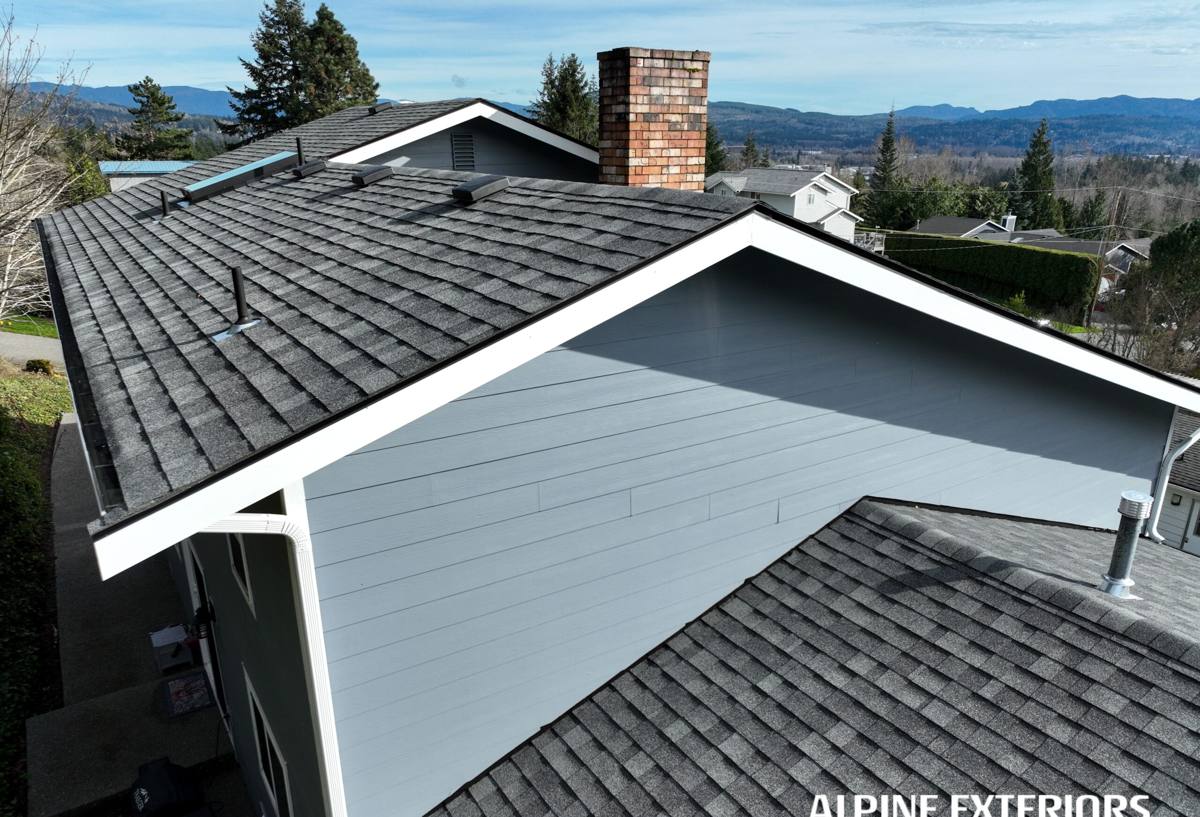
Why Roofs in Point Roberts Fail Sooner Than Roofs Inland
Salt Air and Corrosion
Airborne salt doesn't just affect siding and outdoor metal — it accelerates corrosion on roofing fasteners, flashing, vent boots, and any exposed metal drip edge. Galvanized nails and flashing that would last decades in a dry inland climate can start showing rust streaks and pinhole corrosion much sooner this close to the water. Once a fastener corrodes, it loses its grip on the shingle or panel it's holding, and that's how small leaks start.
Driving Rain and Wind-Driven Water
Storms coming off the Strait of Georgia don't always drop rain straight down. Wind-driven rain gets pushed sideways and upward under shingle edges, around chimney flashing, and into any gap in a ridge cap or valley that wouldn't leak in calmer weather. This is one of the most common reasons we get called out to a "mystery leak" — the water isn't coming through the roof field, it's getting pushed in sideways at a transition point.
Moss, Algae, and Trapped Moisture
Point Roberts' mix of marine moisture and shaded, tree-lined lots creates ideal conditions for moss and algae growth on north-facing and shaded roof slopes. Moss isn't just a cosmetic issue — its root structure lifts shingle edges and holds moisture directly against the roofing material, which shortens the life of asphalt shingles and creates rot risk on the sheathing underneath if it's left untreated for years.
Signs Your Roof Needs Repair, Not Just a Look
Because Point Roberts properties are often not occupied full-time, roof damage tends to be caught later here than in a home someone walks around daily. Watch for these signs, or have someone check for you between visits:
- Granules collecting in gutters or at downspout outlets — a sign shingles are wearing thin
- Curling, cracked, or missing shingles, especially on the side that faces prevailing storms
- Moss buildup thick enough to hold visible water after rain
- Rust staining or visible corrosion around vent pipes, flashing, or chimney counterflashing
- Water stains on interior ceilings, especially near chimneys, skylights, or where roof planes meet
- Sagging in the roofline or soft spots noticeable when walking the attic
- Daylight visible through the roof deck from inside the attic
What a Correct Roof Repair Actually Involves
A roof repair done right isn't just slapping sealant over the spot where water is showing up inside. Water travels along roof decking and framing before it shows itself, so the visible stain and the actual entry point are often in different spots. Our process on a repair call typically includes:
1. Full Diagnosis, Not Just the Symptom
We trace the leak or damage back to its actual source — flashing, a failed pipe boot, a wind-lifted shingle, a compromised valley — rather than treating the spot where it's visible inside the house.
2. Checking What's Underneath
If water has been getting in for a while, we check the decking and underlayment in that area for soft spots or rot before closing anything back up. Repairing shingles over compromised decking just delays a bigger problem.
3. Matching Materials and Method to the Cause
A fastener corrosion problem gets fixed with corrosion-resistant hardware, not just a fresh nail of the same type that failed. A wind-driven rain problem at a valley or wall transition gets addressed with proper flashing and underlayment detail, not just caulk.
4. Sealing and Fastening for Coastal Exposure
Given the salt air here, we favor corrosion-resistant fasteners and flashing materials suited to marine-influenced climates, and we make sure sealants used are rated for the temperature swings and UV exposure this exposed peninsula sees.
Common Point Roberts Roof Repairs — What Drives the Scope
Every roof and every leak is different, but repair jobs here tend to fall into a few categories. This table is meant to help you understand what factors push a repair toward the simpler or more involved end of the range — not to replace an actual on-roof assessment, which is the only way to give you a real number.
| Repair Type | Typical Cause Locally | What Affects Scope/Cost |
|---|---|---|
| Flashing repair/replacement | Corrosion, wind-driven rain intrusion at chimneys, walls, skylights | Metal type, extent of corrosion, whether siding or trim must come off to access |
| Shingle patch/replacement | Wind lift, granule loss, moss-related lifting | Number of shingles, age/availability of matching material, roof pitch and access |
| Valley repair | Water concentration and wind-driven rain at roof plane intersections | Whether decking underneath is affected, valley length |
| Vent boot/pipe flashing | Rubber gasket UV breakdown, corrosion of metal collar | Usually straightforward unless leak has traveled to decking |
| Moss remediation + repair | Shaded, north-facing slopes near tree cover | Extent of shingle lift damage, whether treatment or removal is needed |
| Decking/sheathing repair | Long-term undetected leaks on seasonally occupied homes | Size of affected area, whether insulation or interior finishes are involved |
Why It Matters to Hire a Crew That Already Works in Point Roberts
Point Roberts is a U.S. exclave reached by land only through Canada, or by boat or small aircraft. That's a fact of geography, not an inconvenience we're pointing out to complain — but it does change what a roofing job requires logistically. A contractor unfamiliar with the area has to plan the border crossing for every visit, figure out material delivery, and build in time buffers most inland jobs don't need. A crew that already works Point Roberts regularly has that figured out: materials get ordered and staged efficiently, crossing times get planned around, and your repair doesn't get delayed because someone forgot Point Roberts isn't accessible the same way as the rest of Whatcom County.
There's also a trust factor specific to a place with a lot of part-time and seasonal residents. If you're not on-site to watch the work happen, you want a crew that documents what they found, explains what they fixed and why, and doesn't try to sell you a full roof replacement when a targeted repair will do the job. Honest scoping matters everywhere, but it matters more when the homeowner can't just walk outside and look.
Repair vs. Replacement — An Honest Read
Not every roof problem is a repair candidate, and we won't tell you it is just to get the smaller job. Generally, repair makes sense when damage is localized, the roof is within a reasonable portion of its expected service life, and the decking underneath is sound. Replacement becomes the more honest recommendation when a roof has widespread granule loss and brittleness across multiple slopes, when repeated repairs are happening in different spots each year, or when decking damage is extensive enough that patching around it just moves the problem. We'll tell you plainly which category your roof falls into and why, with photos and a clear explanation — not a hard sell either direction.
Maintenance That Extends Roof Life Between Repairs
Because of the moss season and salt exposure here, a roof in Point Roberts benefits from more attention than the same roof would need in a drier, inland part of the county. A simple maintenance rhythm goes a long way:
- Clear moss growth before it thickens enough to hold standing moisture against shingles
- Keep gutters and downspouts clear so wind-driven rain has somewhere to drain instead of backing up under the roof edge
- Trim back overhanging branches that keep roof sections shaded and slow to dry
- Have flashing points — chimneys, vents, skylights — checked periodically for corrosion, especially on homes not visited weekly
- Address small issues (a lifted shingle, a rusting vent boot) before winter storm season rather than after
Our Process, Start to Finish
We keep the repair process straightforward: an on-roof inspection to find the actual cause, a clear explanation of what we found and what it will take to fix it, a written scope before any work starts, and a repair that addresses the root cause — not just the symptom you noticed inside. For seasonal or part-time residents, we're glad to coordinate timing around your visits or work independently with photo documentation, whichever makes more sense for you.
If you're seeing signs of roof trouble at your Point Roberts property, or it's just been a while since anyone looked closely at flashing and shingle condition, we're happy to come take a look. Reach out for a free, no-pressure estimate using the form below — we'll give you a straight answer about what your roof actually needs.