 Semiahmoo Siding
 Why Blaine Homes Wear Out Siding Faster Than Inland Homes
Blaine sits about as close to salt water and open weather as a Whatcom County home can get. That location is part of what makes the area beautiful, and it's also exactly why siding here takes more punishment than siding twenty or thirty miles inland. Homes near Semiahmoo Bay and Drayton Harbor deal with a near-constant mix of salt-laden air, wind-driven rain that hits siding at an angle instead of falling straight down, and a moss and algae season that can stretch from fall through spring. None of that is unusual for this stretch of the Washington coast, but it does mean siding decisions that work fine in Bellingham's more sheltered neighborhoods don't always hold up the same way in Blaine.
When we talk about "siding replacement in Blaine," we're not talking about a generic re-side job. We're talking about matching a product and an installation method to a specific set of conditions: airborne salt that accelerates corrosion on fasteners and trim, driving rain that finds every gap in a weak water-resistive barrier, and moisture that lingers on north- and west-facing walls long enough for moss to take hold. A siding replacement that ignores those realities may look fine for a year or two and then start showing problems that are expensive to trace back to the install.
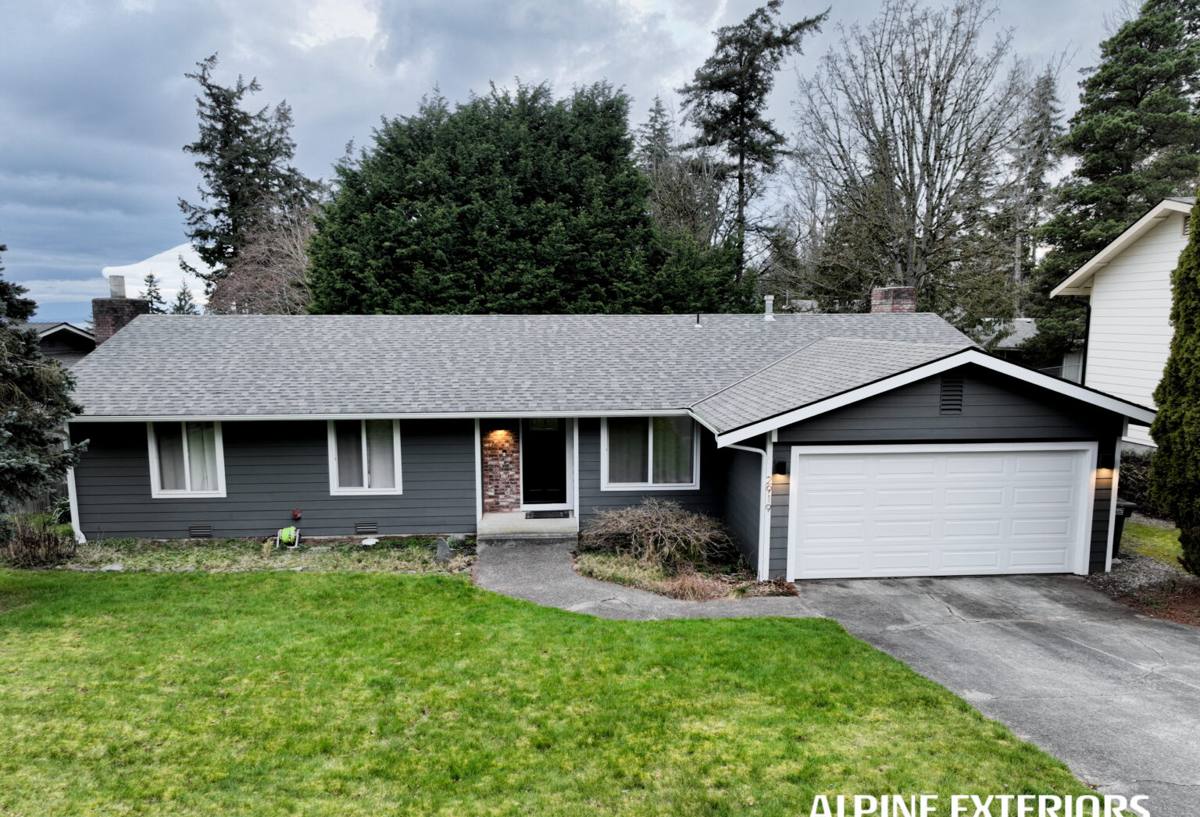
What Salt Air Actually Does to Siding Over Time
Salt air is corrosive to metal and hard on many finishes. Over years of exposure, homes close to Semiahmoo Bay can see accelerated corrosion on exposed fasteners, flashing, and trim connectors if the wrong materials or finishes were used. It's also hard on some paint and coating systems, which can chalk, fade, or lose adhesion faster near open water than they would a few miles inland.
This is one of the reasons material choice matters more in Blaine than in a lot of other places we work. Fiber cement siding with a factory-applied finish holds up differently than field-painted wood or vinyl in a salt-air environment, because the finish is baked on under controlled conditions rather than applied on-site where wind, humidity, and temperature all affect the result. Fastener choice matters too — corrosion-resistant fasteners and flashing are not optional upgrades near the bay, they're a baseline requirement.
Driving Rain and Wind-Driven Water
Blaine's exposure to open water means rain doesn't always fall straight down. Wind off the Strait and the bay pushes rain sideways into walls, which puts far more stress on a home's water management system than rainfall in a sheltered inland lot. A siding system that relies purely on the surface material to keep water out — rather than a properly lapped, flashed, and drained assembly behind it — is more likely to let moisture through over time in this kind of exposure.
This is why correct water-resistive barrier installation, proper flashing at windows and penetrations, and correct lap and fastening details matter as much as the siding product itself. We've seen siding fail prematurely not because the panel material was bad, but because water got behind it through a detail that wasn't built for a driving-rain climate.
The Moss Season Problem
Whatcom County's long wet season means moss and algae have plenty of time to establish themselves on north-facing walls, shaded elevations, and anywhere siding stays damp longer than it should. Moss holds moisture against the siding surface, and that sustained dampness is hard on materials that aren't dimensionally stable or that absorb water into their structure. Over years, homeowners in shaded or bay-facing lots can see real differences in how siding materials age depending on how well they resist moisture absorption and how easy they are to clean without damaging the finish.
A siding replacement in Blaine should account for this from the start — not just in the product chosen, but in details like keeping siding properly clear of grade and landscaping, maintaining flashing that sheds water away from the wall, and using a material that can be cleaned periodically without the surface degrading.
Signs Your Blaine Home Needs Siding Replacement, Not Just Repair
- Soft or spongy spots when you press on the siding, especially near the bottom courses or around windows
- Visible warping, cupping, or separation at seams and laps
- Paint that's failing repeatedly in the same spots no matter how often it's redone
- Persistent moss or algae growth that returns quickly after cleaning
- Rust streaking from fasteners or trim connectors
- Rot at corners, butt joints, or anywhere two pieces of siding meet
- Interior signs — musty smells, peeling interior paint, or staining on walls that share an exterior wall
Any one of these on its own might be a spot repair. Several of them together, especially on a home that's original or has old cedar or spruce siding, usually points to a water-management problem behind the siding rather than a cosmetic issue on the surface — and that's when full replacement is the more honest answer than another round of patching.
What a Correct Siding Replacement Involves in This Climate
Tear-Off and Sheathing Inspection
Replacement starts with removing the old siding and actually looking at what's underneath. In a bay-exposure climate like Blaine's, this step matters more than it does elsewhere, because it's often the only chance to catch rot, damaged sheathing, or a failed water-resistive barrier before it's sealed back up behind new siding. Skipping a real inspection here just buries a problem instead of fixing it.
Water-Resistive Barrier and Flashing
A new, correctly lapped water-resistive barrier goes on next, with flashing integrated at every window, door, and penetration so water is directed out and down rather than trapped behind the siding. Given how much wind-driven rain Blaine sees, this layer is doing more of the actual water-keeping-out work than most homeowners realize.
Corrosion-Resistant Fastening
Near open salt water, fastener and flashing corrosion resistance isn't a nice-to-have. We use fasteners and flashing details suited to a coastal-exposure environment so the metal components don't become the weak point of the assembly years before the siding itself would otherwise need attention.
Installing to Manufacturer Spec
Correct clearances from grade, roofing, and decks; correct fastener spacing and placement; correct caulking and sealant at joints; correct starter strip and trim details — these aren't optional steps, and skipping any of them is one of the most common ways a siding job fails early regardless of how good the material itself is.
| Climate Factor in Blaine | What It Stresses | What the Installation Needs to Address |
|---|---|---|
| Salt air off Semiahmoo Bay | Fasteners, flashing, finishes | Corrosion-resistant hardware, factory-cured finish |
| Wind-driven rain | Laps, seams, window/door flashing | Correct flashing integration and lap sequencing |
| Long moss/algae season | Shaded and north-facing walls | Moisture-resistant material, proper grade clearance |
| Temperature swings | Dimensional stability of the panel | Material that resists warping, cupping, and shrinkage |
Why We Only Install James Hardie Fiber Cement
We made the decision to standardize on James Hardie fiber cement siding for every replacement job we do, including here in Blaine, and it's worth explaining why rather than just stating it. We don't install vinyl siding, LP SmartSide, Cemplank, Allura, primed spruce, or cedar — not because those products have no merit anywhere, but because we've weighed the trade-offs against what this specific coastal climate demands and don't think they hold up as well here over the long run.
Wood siding — cedar or primed spruce — looks good going in, but it's an organic material in a climate that stays damp for months at a time. It needs regular repainting and sealing to keep moisture out, and if that maintenance schedule slips even one season, rot and moss can get a foothold, especially on shaded bay-facing walls. Vinyl siding is low-maintenance and inexpensive, but it's a thin material that can warp or become brittle with temperature swings, and it's not fire-resistant. LP SmartSide is an engineered wood product — better moisture resistance than raw wood, but still wood-based, meaning it can swell or degrade at cut edges and joints if water gets in and isn't dealt with quickly. Cemplank and Allura are also fiber cement, and fiber cement as a category is the right call for this climate — but we chose to standardize on one manufacturer's system rather than mix products, so our crews build deep expertise on one set of installation details, warranty terms, and factory finishes instead of spreading that knowledge thin across several product lines.
James Hardie fiber cement is non-combustible, holds up to moisture without swelling or rotting the way wood-based products can, and comes with a factory-applied ColorPlus finish that's cured under controlled conditions rather than painted on-site — which matters in a salt-air environment where field-applied paint tends to fail faster. Hardie also makes climate-engineered HZ product lines built for specific weather exposures, which is directly relevant in a place like Blaine where wind, rain, and salt all show up together. Backed by a strong transferable warranty and a track record of holding up when installed to spec, it's the product we're willing to put our name behind on every home we side.
Our Process for a Blaine Siding Replacement
- On-site assessment. We look at your home's exposure — how close to the water, which walls take the most wind-driven rain, where moss and staining are already showing up — and use that to plan the job, not just measure square footage.
- Product and color selection. We walk you through Hardie's plank profiles, panel options, and ColorPlus palette so the new siding fits the home and the neighborhood.
- Tear-off and sheathing check. Old siding comes off, and we inspect what's underneath before anything new goes on.
- Water-resistive barrier and flashing installation. Built for wind-driven rain exposure, with careful attention at every window, door, and penetration.
- Siding installation to manufacturer spec. Correct fastening, clearances, and joint treatment, using corrosion-resistant hardware suited to a coastal environment.
- Final walkthrough. We go over the finished job with you before we consider it done.
Questions Worth Asking Before You Hire Anyone for This Job
- Have you installed siding on homes with similar exposure to open water or wind-driven rain?
- What water-resistive barrier and flashing details do you use, and why?
- What fasteners and flashing metals do you use in a salt-air environment?
- Will you inspect and document the sheathing condition before re-siding?
- What does your warranty cover, and what's covered by the manufacturer versus your labor?
Why Local Experience in Blaine Specifically Matters
Whatcom County isn't one uniform climate — a lot changes between a sheltered inland lot and a home with direct exposure to Semiahmoo Bay or Drayton Harbor. A crew that's worked on homes in and around Blaine has already seen how salt air behaves on this stretch of coast, which walls tend to hold moss the longest, and where driving rain typically finds weak points in an older install. That kind of familiarity doesn't replace a proper on-site assessment of your specific home, but it does mean fewer surprises and a plan built around how this area actually behaves through a full year of weather, not a generic install checklist.
If your Blaine home's siding is showing its age — or you're just weighing your options before problems start — we're happy to take a look and give you a straight assessment of what condition it's in and what it would take to replace it correctly for this climate. Reach out for a free, no-pressure estimate using the form below.