 Semiahmoo Siding
 Cherry Point's Siding Problem Isn't Like Inland Whatcom County
Homes set along the water in Cherry Point deal with a combination of stresses that inland Whatcom County houses simply don't see as often. Salt-laden air off the water works into seams, fastener heads, and any exposed wood grain. Wind-driven rain doesn't just fall straight down here — it gets pushed sideways into wall assemblies, which means siding, flashing, and house wrap all have to do more work than a spec-sheet installation assumes. And the long, wet Pacific Northwest fall-through-spring stretch means moss and algae get a head start on any surface that holds moisture or sits in shade, which is most north- and west-facing walls this close to the shoreline.
None of that is unique to any one house. It's a site condition, and it should change how a siding replacement is planned and installed — not just which product goes up, but how the wall behind it is prepped, flashed, and ventilated. A crew that treats a Cherry Point replacement the same as a job twenty miles inland is setting the homeowner up for the same problems again in ten years.
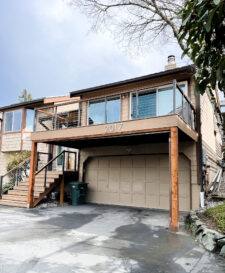
Signs a Cherry Point Home Needs Replacement, Not Repair
Coastal exposure accelerates siding failure, but it doesn't always announce itself clearly. Some damage hides behind paint or under moss for years before it becomes obvious. Before assuming a few boards or a patch job will solve the problem, it's worth checking for the following:
- Soft or spongy spots when you press on siding, especially near the bottom courses and around window and door trim
- Paint that's bubbling, peeling, or won't hold no matter how often it's redone
- Persistent moss or dark streaking that comes back within a season of cleaning
- Visible cupping, warping, or delamination of panels or lap boards
- Rust streaks below nail heads or fastener lines
- A musty smell or visible staining on interior walls that share an exterior with a suspect section of siding
- Gaps opening up at seams, corners, or where siding meets trim, window casings, or the foundation
One or two of these on an otherwise sound wall can sometimes be addressed with targeted repair. But when several show up together, or when they cluster on the walls facing the water and prevailing weather, that's usually a sign the water-resistive barrier behind the siding has been compromised, not just the visible surface. At that point, patching is cosmetic — the fix that actually holds up is a full replacement that gets behind the siding and deals with what's underneath.
What a Correct Replacement Involves Here
Getting Behind the Old Siding
Removing the existing siding is the only way to actually see the condition of the sheathing and the house wrap or building paper underneath. On a coastal property, we expect to find at least some moisture staining or soft sheathing around window openings, at the base of walls, and anywhere the original flashing was skipped or installed short. That inspection isn't optional — it's the step that determines whether the wall assembly needs sheathing repair before new siding goes on, and skipping it is how a fresh siding job ends up hiding the same rot problem it was supposed to fix.
Flashing and Water Management
Wind-driven rain finds every gap in flashing, and a wall facing open water gets tested harder and more often than one that's sheltered. Correct replacement means new flashing at every window and door, proper head flashing, and a weather-resistive barrier lapped correctly from the bottom of the wall up — shingle-style, so water always sheds outward and down, never into a seam. This is the part of the job that's invisible once the siding is on, and it's also the part that determines whether the replacement lasts fifteen years or forty.
Ventilation Behind the Cladding
A wall that can't dry out is a wall that stays wet, and a wall that stays wet grows mold, rots sheathing, and pushes moisture through to interior finishes. On exposed sites we pay close attention to drainage and airflow behind the siding so that any moisture that does get in has a way out, rather than sitting against the sheathing.
Why We Only Install James Hardie Fiber Cement
We install James Hardie fiber cement siding exclusively, and on a site like Cherry Point that's not a marketing preference — it's a practical one. Fiber cement is non-combustible and dimensionally stable, meaning it doesn't expand, contract, warp, or absorb water the way wood-based products can. That matters directly here: vinyl siding can become brittle and distort with the temperature swings and wind loads coastal properties see, and wood-based composite products depend heavily on paint and caulking staying intact to keep salt-laden moisture out of the substrate — a maintenance schedule that's hard to keep up with on a house exposed to this much weather.
Hardie's ColorPlus factory finish is baked on and warrantied against cracking, peeling, and fading, which takes the paint-maintenance burden largely off the table — a real advantage in a moss and mildew climate where a homeowner doesn't want to be repainting every few years just to keep water out. Hardie's HZ5 product line is specifically engineered for climates with significant moisture exposure, which fits Cherry Point's conditions better than the general-purpose HZ10 line used in drier regions. It's also backed by a strong transferable warranty, which matters if the home changes hands.
None of this means other products are junk — vinyl, LP SmartSide, and cedar all have legitimate uses. But we've made a professional call to standardize on one product system we can install to spec, warranty with confidence, and stand behind on a coastline that doesn't forgive shortcuts.
Our Cherry Point Replacement Process
- On-site assessment. We walk the exterior, check the walls that take the worst weather exposure, and look for the soft spots, staining, and failure signs described above.
- Removal and sheathing inspection. Old siding comes off in sections so we can inspect and, where needed, repair or replace damaged sheathing before anything new goes up.
- Water-resistive barrier and flashing. New house wrap, window and door flashing, and drainage detailing go in correctly the first time — this is the step that determines long-term performance.
- Hardie installation to manufacturer spec. Correct fastener spacing, gapping, and caulking at seams — installation errors are the most common reason fiber cement siding underperforms, not the product itself.
- Trim, caulking, and paint touch-up. Factory-finished ColorPlus panels need minimal field painting, which is part of why the finish holds up.
- Final walk-through. We review the finished work with the homeowner before calling the job done.
Cost Factors for a Cherry Point Siding Replacement
Every home is different, and we don't quote a project without seeing it, but the factors that move the price on a coastal Whatcom County replacement are fairly consistent:
| Factor | Why It Matters Here |
|---|---|
| Extent of sheathing damage found on removal | Water-exposed walls more often need sheathing repair before new siding goes on |
| Wall exposure to wind and driving rain | Water-facing elevations need more careful flashing and detailing work |
| Home size and number of stories | More surface area and access complexity affect labor time |
| Trim, window, and corner detail count | Every penetration is a place water can get in and needs its own flashing |
| Siding profile and color selection | Some Hardie profiles and colors run at a different price point than others |
The honest range for a full siding replacement varies widely based on these factors, which is why we walk every property before giving a number rather than quoting off square footage alone.
Living With New Siding: What Moss Season Still Requires
Correctly installed Hardie siding dramatically cuts down on maintenance compared to what most Cherry Point homeowners are used to, but "low-maintenance" isn't "no-maintenance" on a site this exposed. A yearly rinse-down on north- and west-facing walls before moss season sets in goes a long way, as does keeping gutters clear so runoff doesn't sheet down the siding face. Caulking at trim joints and penetrations should get a visual check annually — it's the one part of the system that isn't factory-finished and can wear before the panels do. None of this is heavy work, but skipping it on a coastal property lets moss and moisture get a foothold faster than it would inland.
Why a Crew That Already Works Cherry Point Matters
A lot of what makes a siding replacement hold up here isn't visible in the finished product — it's in the flashing details, the sheathing decisions made mid-tear-off, and the small calls about where to add extra protection on the walls that take the worst of the weather. A crew that's already worked this stretch of coastline has seen what fails first on exposed Whatcom County homes and builds around it as a matter of habit, not as an afterthought. That experience is the difference between a replacement that looks right on day one and one that's still performing after fifteen winters of salt air and driving rain.
If your Cherry Point home's siding is showing wear, or you're just not sure whether you're looking at a repair or a replacement, we're happy to take a look. Reach out for a free, no-pressure estimate using the form below.