 Semiahmoo Siding
 Why Birch Bay Roofs Wear Differently
Birch Bay sits close enough to Semiahmoo Bay and the Strait of Georgia that homes here take on a mix of stresses that inland Whatcom County roofs rarely see in the same combination. Salt-laden air off the water accelerates corrosion on exposed metal — nail heads, flashing, gutter fasteners, and vent caps all age faster near the shoreline than they do a few miles inland. Add the region's driving, wind-pushed rain, which finds its way sideways under loose or lifted shingle edges instead of simply running off, and you get a roof that's constantly being tested at its weakest points: flashing seams, valleys, and penetrations around vents and chimneys.
Then there's the moss. Western Washington's long wet season, mild temperatures, and heavy tree cover give moss and algae months to establish themselves on north-facing slopes and shaded sections of roof. Once moss takes hold, it doesn't just sit there — it lifts shingle tabs, holds moisture against the roof deck, and slowly works its way under the roofing material. A roof that looks intact from the ground can still be losing its watertight seal underneath a mat of moss.
None of this means Birch Bay roofs fail faster than they should. It means repairs here need to account for salt exposure, wind-driven rain, and moss growth specifically — not just patch a leak and move on.
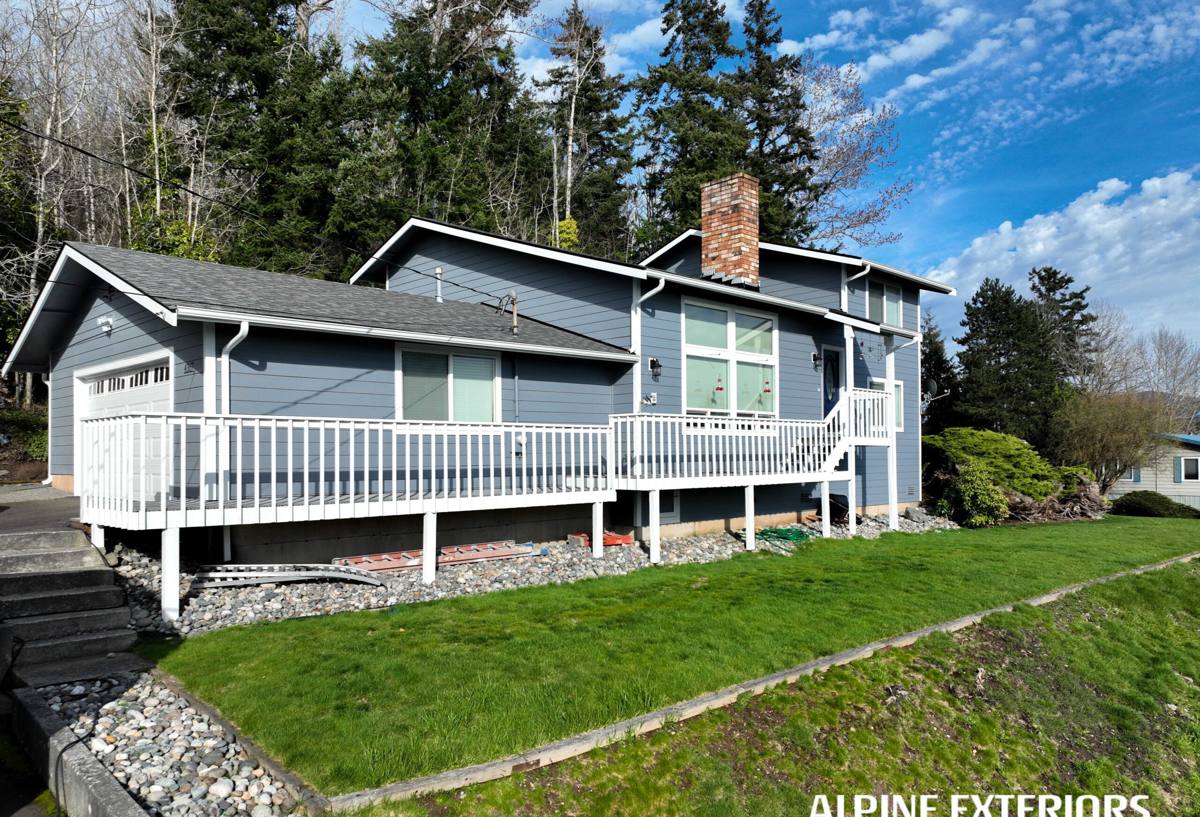
Common Repair Issues We See in Birch Bay
Most roof repair calls in this area fall into a handful of categories. Recognizing which one you're dealing with helps set expectations before a crew ever gets on the roof.
- Moss-related shingle lift — moss growing under shingle tabs breaks the seal and creates channels for water to travel.
- Flashing failure — corroded or improperly sealed flashing around chimneys, skylights, and roof-to-wall transitions, worsened by salt air.
- Wind-lifted or cracked shingles — tabs loosened by storm gusts that never resealed, leaving an entry point for the next rain.
- Valley wear — valleys carry more water volume than any other part of the roof and show wear first.
- Gutter and edge damage — clogged or corroded gutters that back water up under the roof edge instead of carrying it away.
- Nail pops and fastener corrosion — exposed or rusted fasteners that work loose over time in a salt-air environment.
A single leak can trace back to any one of these, or a combination of two or three working together. That's why a real repair starts with figuring out the actual source, not just the spot where water is showing up inside the house — those two locations are often several feet apart.
What a Correct Repair Actually Involves
Diagnosis First
Water travels. A stain on a bedroom ceiling might trace back to a flashing gap a full roof section away. Before any material comes off the roof, we trace the path — checking the suspected area, the roof plane above it, and anywhere water could be channeling along rafters or sheathing before it shows up indoors.
Matching Materials
A patch that doesn't match the surrounding roofing — in color, profile, or age — stands out and can also perform differently than the rest of the roof. Where possible, we use materials consistent with what's already installed so the repair blends in and weathers at the same rate as the rest of the roof.
Flashing and Underlayment
Shingles get the attention, but flashing and underlayment are what actually keep water out at transitions, valleys, and penetrations. A repair that replaces shingles but ignores the flashing or underlayment beneath them is a repair that's likely to leak again in the same spot.
Moss and Debris Removal
If moss contributed to the failure, removing the visible growth isn't enough — the affected shingles usually need inspection for granule loss and cracking underneath, since moss can weaken material even after it's cleared away.
Repair or Replace?
Not every roof problem needs a full replacement, and not every leak can be permanently solved with a patch. The table below covers the honest factors that go into that call.
| Factor | Leans Toward Repair | Leans Toward Replacement |
|---|---|---|
| Roof age | Under roughly 12–15 years, isolated issue | Approaching or past the material's expected lifespan |
| Extent of damage | Localized to one section, valley, or penetration | Widespread granule loss, curling, or multiple failure points |
| Roof deck condition | Solid, dry sheathing under the affected area | Soft, rotted, or repeatedly wet decking |
| Leak history | First occurrence, clear single cause | Recurring leaks in different spots over time |
| Cost relative to value | Repair cost is a small fraction of replacement cost | Repair costs are climbing close to replacement pricing |
Roof repairs on a typical home are generally a modest investment compared to a full replacement, but the exact scope — how much decking needs attention, how many layers of shingle are involved, how the flashing is holding up — only becomes clear once we're actually inspecting the area. We'll always tell you plainly if what you're describing sounds like a repair job or if it's trending toward something bigger, before any work starts.
Our Repair Process, Step by Step
- Initial inspection — we look at the reported problem area, the roof plane above it, and any related penetrations or valleys.
- Interior check — where relevant, we look at attic space or ceiling staining to confirm how far water has traveled.
- Honest scope and estimate — you get a clear explanation of what's actually wrong and what fixing it involves, in plain language.
- Repair work — removal of damaged material, moss and debris clearing, flashing and underlayment correction, and reinstallation with matched materials.
- Cleanup and final check — the work area is cleared of debris, and the repair is checked before we consider the job done.
We don't upsell repairs into replacements that aren't needed, and we don't patch over problems that need a more complete fix. If a "quick patch" isn't going to hold given what we find underneath, we'll say so and explain why.
Materials and Products We Use
Shingle Matching
For asphalt shingle roofs, which make up most homes in this area, we source replacement shingles as close to the existing brand, color, and profile as availability allows. Exact matches aren't always possible on an older roof, since manufacturers update product lines over time — we'll tell you upfront if a perfect match isn't realistic and what the closest reasonable option looks like.
Sealants and Flashing Metal
Given the salt-air exposure common in Birch Bay, we favor corrosion-resistant flashing and fasteners over standard-grade materials wherever the repair scope allows it. It costs a little more upfront but holds up better this close to the water, and it's a judgment call we make based on the specific site, not a blanket upsell.
Underlayment
Where a repair opens up underlayment, we replace it with a synthetic or self-adhering product appropriate to that part of the roof — ice-and-water style membrane at valleys and eaves, for example, where water pressure and freeze-thaw risk are highest. Warranty terms on underlayment products vary by manufacturer, and we'll walk you through what applies to the materials used on your roof.
Homeowner Checklist: Signs Your Birch Bay Roof Needs Attention
- Dark streaks, green patches, or thick moss growth, especially on north-facing slopes
- Shingle tabs that look lifted, curled, or cracked when viewed from the ground
- Granules collecting in gutters or at the base of downspouts
- Water stains or discoloration on interior ceilings, especially after a windy storm
- Visible daylight or gaps around chimney, vent, or skylight flashing
- Sagging or soft-feeling spots on the roof plane
- Gutters that overflow or pull away from the fascia during heavy rain
- Rusted or discolored streaking on metal flashing or fasteners
Catching any of these early, before the next round of wind-driven rain, is almost always cheaper and simpler than waiting until water has made it inside.
Why a Local Semiahmoo-Area Crew Matters
Roof repair isn't one-size-fits-all, and a crew that works Whatcom County regularly builds a working knowledge of how local conditions actually affect roofs — which slopes hold moss longest, how salt air behaves on flashing near the water, and what a driving rainstorm off the Strait does to an already-weak seam. That's the kind of pattern recognition that only comes from doing this work in this specific climate, season after season.
There's also a practical side to being local: shorter response times when a storm causes damage, familiarity with the area's typical roofing materials and home styles, and accountability that comes from being a business that's easy to find and easy to reach if a question comes up after the work is done.
Keeping a Repaired Roof Healthy Going Forward
A good repair fixes the immediate problem, but a little upkeep afterward keeps it fixed. In this climate, that mostly comes down to two things: keeping moss from re-establishing and keeping water moving off the roof instead of pooling or backing up.
Periodic moss treatment or removal on shaded, north-facing slopes goes a long way toward preventing the exact problem that causes many of the repairs we see. Keeping gutters clear, especially heading into fall when trees are dropping debris, prevents water from backing up under the roof edge during heavy rain. And after any significant windstorm, a quick visual check from the ground — looking for lifted or missing shingles — can catch a small problem before it becomes a ceiling stain.
If you're dealing with a leak, storm damage, or just want an honest read on where your roof stands, we're happy to take a look. Fill out the form below for a free, no-pressure estimate — we'll tell you straight what we find and what it would take to fix it.