 Semiahmoo Siding
 Cherry Point's Siding Problem Isn't Cosmetic — It's Moisture
Cherry Point sits close enough to the water that homes here take on a different kind of weather than siding manufacturers assume when they write their installation manuals. Salt-laden air moves off the Strait of Georgia and works into every seam, fastener, and cut edge on a wall. Driving rain, pushed sideways by wind rather than falling straight down, finds gaps that would stay dry on a more sheltered lot. And the shade from mature evergreens combined with near-constant dampness through fall, winter, and spring gives moss and algae exactly what they need to take hold on north- and west-facing walls.
None of that is a reason to avoid siding your home — it's a reason to be precise about how it's installed. Siding failure in this part of Whatcom County is almost never about the material sitting on the wall being a bad product. It's about water finding a path behind it because a detail was rushed or skipped. A correct installation in Cherry Point has to assume the wall will get wet repeatedly, and be built so that water sheds off instead of soaking in.
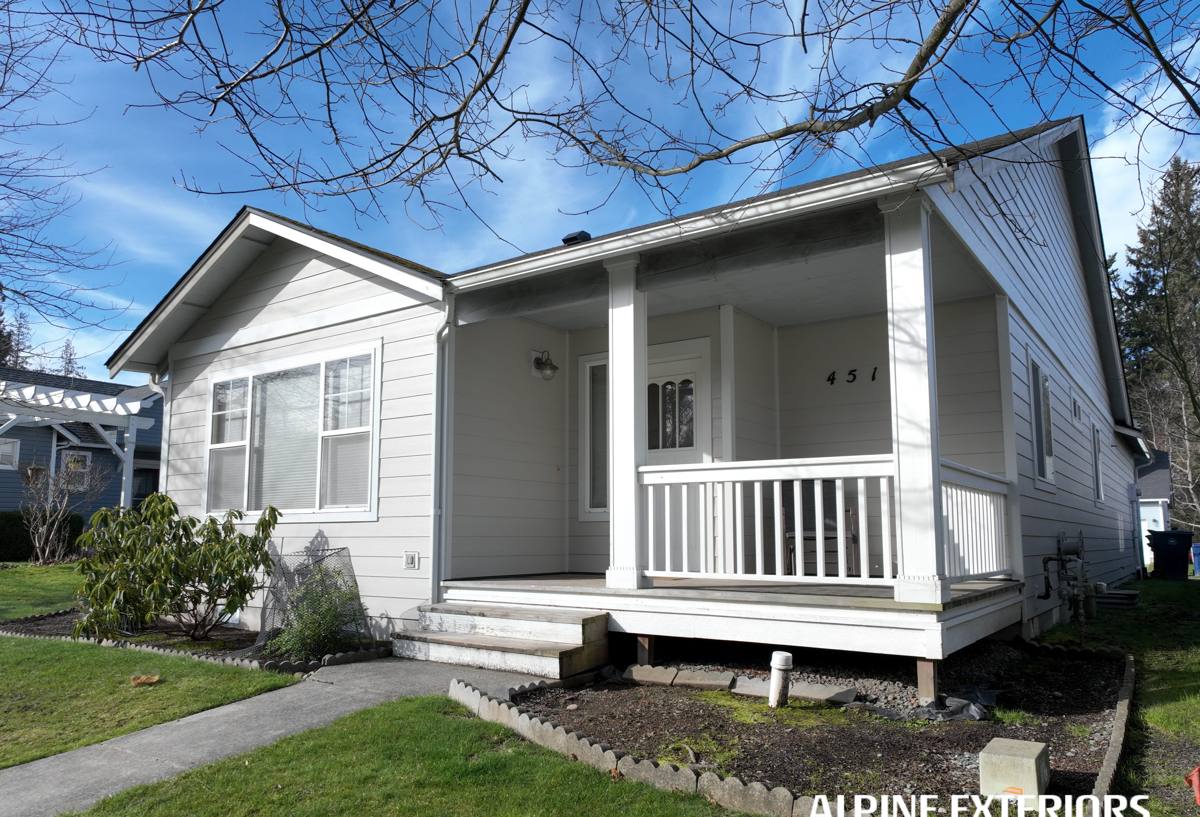
What Local Homes Actually Need From Their Siding
Homes exposed to this stretch of coastline need three things from their exterior cladding that don't show up as line items on most estimates:
- A drainage path behind the siding. Even well-installed siding gets damp behind it eventually. The wall needs somewhere for that moisture to go, not somewhere for it to sit.
- Fastening and flashing that doesn't loosen or corrode under salt exposure. Salt air accelerates corrosion on the wrong hardware, and loose fasteners open the door to water intrusion long before the siding itself looks worn.
- A surface that doesn't feed moss and algae. Some siding materials hold surface moisture and organic buildup more than others, which matters a lot on shaded, damp elevations.
Get those three right and the siding on a Cherry Point home will do its job for decades. Get any one of them wrong and you're looking at soft trim, stained walls, or hidden rot behind siding that still looks fine from the street.
What a Correct Installation Actually Involves
A proper siding installation is really a sequence of small, unglamorous decisions, each one either protecting the wall or leaving a weak point. In a coastal-exposure area like Cherry Point, we treat every one of these as non-negotiable:
Weather-Resistive Barrier and Drainage Plane
The house wrap or building paper underneath the siding is the actual waterproofing layer — the siding itself is the first line of defense, not the only one. We install a continuous weather-resistive barrier with a drainage gap behind the siding so that any moisture that gets past the cladding has a way to drain and dry rather than pooling against the sheathing.
Flashing at Every Penetration
Windows, doors, hose bibs, light fixtures, and vents are where siding installations most often fail. Each one needs proper flashing that directs water outward and downward, lapped correctly with the weather barrier above and below. This is the detail that gets skipped most often on rushed jobs, and it's the detail that causes the most expensive repairs later.
Fastening to Manufacturer Spec
Fiber cement siding has specific requirements for fastener type, spacing, and depth. Fasteners driven too deep, too shallow, or into the wrong substrate compromise the siding's ability to move with seasonal humidity changes and can void the manufacturer's warranty. In a salt-air environment, we also pay close attention to fastener material to reduce long-term corrosion risk.
Clearances and Gaps
Siding needs a gap above rooflines, decks, and paved surfaces, and clearance from grade. These clearances keep the bottom edge of the siding from sitting in standing water or splash-back, which is one of the most common places rot starts on any home near the water.
Caulking and Joint Treatment
Butt joints, corners, and trim intersections get sealed with the right sealant, applied correctly — not just enough caulk to make the seam look finished. Over-caulking can trap moisture just as badly as under-caulking.
Why We Install James Hardie Fiber Cement Here — and Only That
We standardized on James Hardie fiber cement siding for every home we work on, including here in Cherry Point, and the reasoning is specific to conditions like these:
Fiber cement is dimensionally stable — it doesn't swell, cup, or warp the way wood-based products can when they take on repeated moisture cycles. That matters enormously in an area where the siding is damp more months of the year than it's dry. It's also non-combustible, which is a real consideration anywhere in Washington given wildfire smoke and ember exposure in dry summer stretches, even in a generally wet climate like this one.
James Hardie's ColorPlus factory finish is baked on under controlled conditions rather than field-applied, which gives it better adhesion and UV resistance than a coat of paint applied on-site — and it matters more here than in a drier climate, because salt air and constant moisture are exactly the conditions that break down weaker field-applied coatings fastest. Hardie also engineers different product lines (their HZ5 line, for example) specifically for wetter, harsher climate zones, which is a level of climate-specific engineering most other siding materials don't offer.
We get asked why we don't install vinyl, LP SmartSide, or other fiber cement brands. The honest answer is that we've made a professional judgment call: we'd rather install one product system extremely well, back it with a strong transferable warranty, and stand behind it, than spread our crews thin across multiple systems with different installation requirements and different long-term track records in this climate. That's a standard we hold ourselves to — not a claim that every alternative product fails on every home.
Our Installation Process for Cherry Point Homes
| Step | What Happens | Why It Matters Here |
|---|---|---|
| Site & Substrate Assessment | We inspect the existing wall assembly, sheathing condition, and any signs of prior moisture intrusion before ordering material. | Coastal homes sometimes have hidden moisture damage behind old siding that needs addressing before new siding goes on. |
| Weather Barrier Installation | Continuous house wrap with a drainage gap, taped and lapped correctly. | Gives the wall a real second line of defense against wind-driven rain. |
| Flashing at Openings | Windows, doors, and penetrations flashed before siding goes on. | Prevents the most common source of hidden leaks. |
| Siding Installation | James Hardie panels or lap siding installed to manufacturer fastening and clearance specs. | Preserves warranty coverage and long-term performance. |
| Trim & Joint Sealing | Corners, joints, and trim sealed with appropriate sealant. | Closes remaining entry points without trapping moisture. |
| Final Walkthrough | We walk the exterior with the homeowner before calling the job complete. | Catches anything before it becomes a warranty callback. |
Where Installations in This Area Commonly Go Wrong
We've seen the same handful of shortcuts cause problems on homes exposed to this kind of weather:
- Skipping or skimping on the drainage gap behind the siding, so moisture that gets past the cladding has nowhere to go.
- Caulking window and door trim instead of properly flashing it — caulk alone isn't a substitute for flashing and it fails faster in constant damp conditions.
- Installing siding too close to grade, decks, or roof lines, leaving no clearance for water to drain away.
- Using fasteners that aren't suited to a salt-air environment, leading to early corrosion and loosening.
- Rushing joint and corner sealing on the last day of a job, when it's often the most weather-exposed detail on the whole house.
None of these mistakes show up on day one. They show up two, five, or ten years later as stained sheathing, soft trim, or siding that's pulling away from the wall — which is exactly why installation quality matters more than most homeowners realize when they're comparing quotes.
Cost Factors for a Cherry Point Siding Job
| Factor | How It Affects Cost |
|---|---|
| Home size and wall complexity | More corners, dormers, and roof intersections mean more flashing and cutting labor. |
| Existing wall condition | Sheathing repair or rot remediation found during tear-off adds cost but has to be addressed, not covered over. |
| Siding profile chosen | Lap siding, panel siding, and shingle-style Hardie products differ in material and labor cost. |
| Access and site conditions | Tight lots, steep grades, or limited equipment access affect labor time. |
| Trim and detail work | Homes with more window and door openings require more flashing and trim labor per square foot. |
We give homeowners a real number after seeing the home, not a generic per-square-foot estimate — the wall condition and detail work matter more to the final price than the raw square footage does.
Keeping Moss and Algae From Taking Over After Installation
Even correctly installed siding needs a little homeowner attention in a shaded, damp environment like this one. A short annual routine keeps a new installation looking the way it should for years:
- Rinse shaded, north-facing walls once a year to remove surface algae before it builds up.
- Keep tree branches and shrubs trimmed back from the siding so walls can dry between rain events.
- Check gutters and downspouts each fall — overflow during heavy rain is a common source of localized water damage on lower siding courses.
- Watch for caulking that's cracked or pulled away at trim joints and have it addressed before it becomes a leak path.
Why Hiring a Crew That Already Works This Area Matters
Siding installation manuals are written for average conditions. A crew that's only worked drier, more sheltered parts of Washington will follow the manual and still end up with a wall that isn't built for what Cherry Point actually throws at it. A crew that installs siding on homes exposed to this stretch of coastline regularly already knows where the extra attention needs to go — the drainage detailing, the fastener choices, the flashing at every penetration — because they've seen what happens on the homes where it wasn't done.
That local pattern recognition is worth more than a lower bid from a crew that treats every job the same regardless of exposure. Siding here either accounts for salt air, driving rain, and a long moss season, or it doesn't — and the difference doesn't show up on the invoice, it shows up in how the wall looks and performs ten years out.
If you're considering new siding for a home in the Cherry Point area, we're happy to take a look and walk you through what your home specifically needs. Reach out for a free, no-pressure estimate using the form below.