 Semiahmoo Siding
 Decking in Birch Bay Has to Work Harder Than Decking Almost Anywhere Else
Birch Bay sits right where marine weather meets a lot of exterior wood, and that combination is unforgiving on decks. Salt-laden air off the water accelerates corrosion on fasteners and hardware. Driving rain off Georgia Strait and Semiahmoo Bay drives moisture sideways into board edges and connections that were only ever designed to shed water from above. And Whatcom County's long, gray moss season means anything that stays damp for weeks at a time becomes a growing surface, not just a walking surface. A deck built with generic assumptions — the kind you'd use for a dry inland yard — tends to show its age here in three or four years instead of fifteen.
Composite decking, installed correctly for this specific climate, is one of the few products that holds up to all three of those stresses at once without demanding constant homeowner upkeep. This page is about what that actually takes in Birch Bay specifically, not composite decking in general.
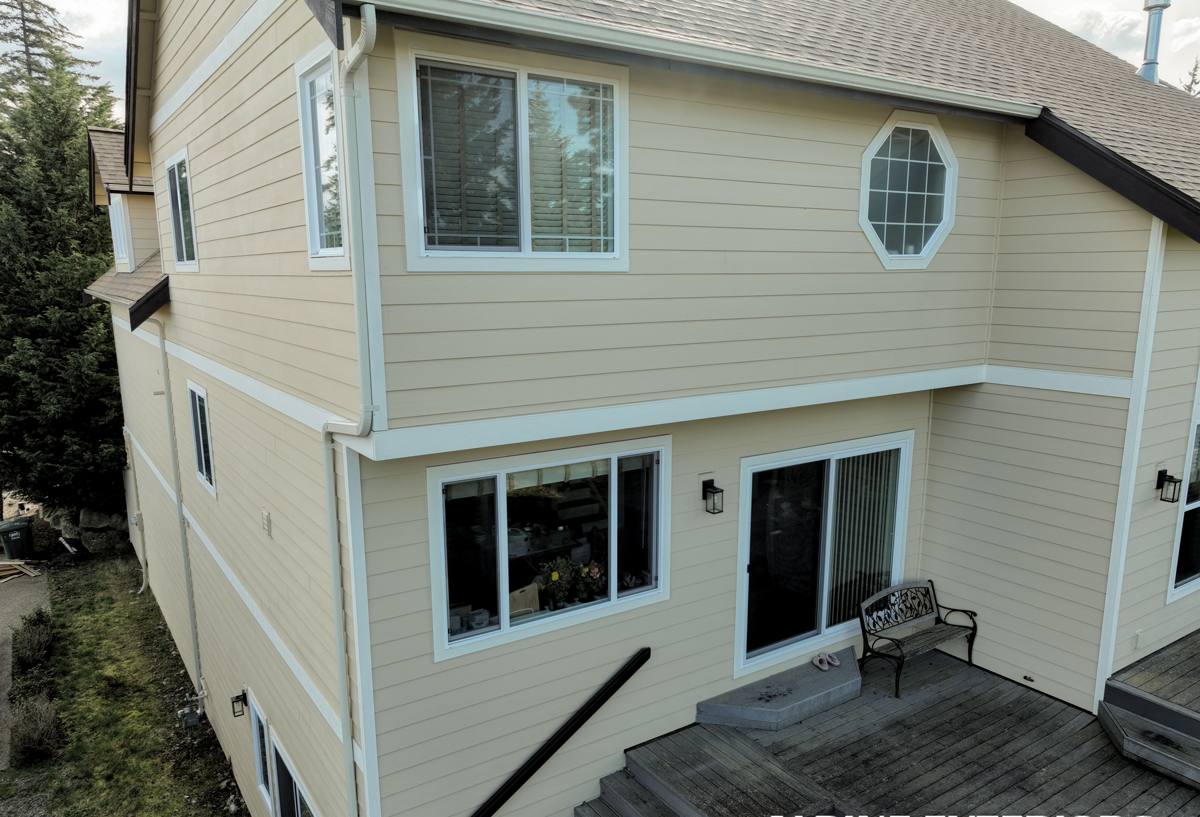
What Salt Air, Driving Rain, and Moss Actually Do to a Deck Here
Salt air
Airborne salt doesn't need direct ocean spray to do damage — it travels on wind and settles on any exposed metal. Screws, joist hangers, post bases, and railing hardware corrode faster near Birch Bay's shoreline than they would even a few miles inland. Once a fastener starts rusting, it weakens, stains the surrounding material, and eventually needs to be replaced — which is a much bigger job once decking is already down.
Driving rain
Rain that comes in at an angle, which is common in this part of Whatcom County during fall and winter storms, gets past gaps that would stay dry in calmer weather. It works into board-end joints, around post connections, and along ledger boards where a deck meets the house. If that water has nowhere to go, it sits — and sitting water is what causes rot in wood framing and premature failure in poorly-fastened composite boards alike.
Moss season
Whatcom County's wet season can stretch from October well into spring. Any deck surface that doesn't drain and dry between rain events becomes a host for moss and algae. Beyond looking bad, moss holds moisture against the board surface and makes decking genuinely slick — a real safety issue on stairs and near door thresholds.
Why Composite Fits This Climate Better Than Wood
We install both wood and composite decking, and we're honest with clients about the trade-offs rather than pushing one product on everyone. But for Birch Bay's specific conditions, composite has real advantages that matter more here than they would in a drier climate:
- It doesn't absorb water into the board the way wood fibers do, so it isn't feeding rot from the inside out.
- It doesn't need annual staining or sealing to keep water out — a maintenance cycle that's easy to fall behind on through a wet Pacific Northwest winter.
- Modern capped composite boards resist mold and algae staining far better than untreated wood, though nothing is fully immune in a climate this damp.
- It won't cup, splinter, or check the way cedar or pressure-treated lumber does after repeated wet-dry cycles.
The trade-off is upfront cost and the fact that composite still depends entirely on correct framing and fastening underneath — a composite deck built on a poorly ventilated or under-drained substructure will still fail early, just in different ways than wood does.
Composite vs. Wood vs. PVC: An Honest Comparison for This Climate
| Factor | Wood (cedar/PT) | Composite | PVC/Vinyl |
|---|---|---|---|
| Moisture absorption | High — feeds rot over time | Low, with capped boards | Very low |
| Moss/algae resistance | Poor without regular treatment | Good with capped products | Good |
| Annual maintenance | Staining/sealing needed yearly | Occasional washing | Occasional washing |
| Upfront cost | Lowest | Mid to upper-mid | Highest |
| Feel underfoot in cold, wet weather | Natural, but can be slick when mossy | Textured, generally grippier | Can feel harder/plasticky |
| Long-term appearance | Grays and weathers, needs refinishing | Holds color well | Holds color, can look less natural |
None of these is universally "best" — it depends on budget, how the deck is used, and how much maintenance a homeowner actually wants to keep up with. For most Birch Bay homes we work on, composite hits the balance between upfront cost and long-term durability in this climate.
What a Correct Composite Deck Installation Involves Here
The board is only part of the system. In a salt-air, high-rainfall environment, the details underneath and around the boards matter more than the brand printed on them.
Substructure and framing
Joists and beams need to be sized and spaced for the specific composite product being used — composite boards flex differently than wood and many manufacturers require tighter joist spacing than a traditional wood deck would use. We also treat or wrap framing lumber to reduce moisture wicking, since the framing is still typically wood even when the surface isn't.
Fasteners and hardware
Given the corrosion risk from salt air, we use stainless steel or coated fasteners rated for coastal exposure rather than standard hardware. Cutting corners here is one of the most common reasons decks in this area fail early — the boards look fine while the connections underneath are quietly rusting away.
Drainage and ventilation
Every deck needs a way for water that gets underneath to actually leave. That means proper slope away from the house, gaps for airflow beneath the deck surface, and — on decks attached to the house — flashing at the ledger board that actually sheds water instead of trapping it against the siding. This is one of the most common failure points we see on older Birch Bay decks: a ledger connection that was never properly flashed, letting driving rain work its way into the house framing over years.
Board spacing and expansion
Composite expands and contracts with temperature more than wood does. Gaps between boards need to account for that movement — too tight and boards can buckle; too loose and moss-holding debris collects in the gaps.
Our Process for a Birch Bay Composite Deck
- On-site assessment of the existing structure (if replacing decking) or the build site, including drainage patterns and prevailing wind/rain exposure
- Framing inspection or new framing built to the composite manufacturer's spacing requirements, not generic wood-deck spacing
- Ledger flashing and house-connection detailing sized for driving rain, not just vertical rainfall
- Coastal-rated fastener and hardware selection throughout
- Composite board installation with manufacturer-specified gapping for thermal movement and drainage
- Railing and stair installation matched to the same hardware standard as the deck itself
- Final walkthrough covering drainage, gaps, and what to expect as the deck settles through its first wet season
What Drives Cost on a Birch Bay Composite Deck
| Cost factor | Why it matters here |
|---|---|
| Deck size and shape | More linear feet of board edge and framing means more labor and material |
| Existing framing condition | Salt-air corrosion or old rot often means replacing more of the substructure than expected |
| Board tier/brand | Capped composite costs more upfront than uncapped, but resists moss and staining better |
| Height and railing requirements | Elevated decks need code-compliant railings, which add material and labor |
| Site access | Waterfront and bluff-adjacent lots can add cost for material staging and equipment access |
We give straightforward, itemized quotes rather than vague per-square-foot numbers, because two decks the same size can cost quite differently depending on what's underneath and how exposed the site is to weather.
Living With a Composite Deck Through Whatcom County's Wet Season
Composite decking cuts maintenance significantly compared to wood, but it isn't zero-maintenance in this climate. A periodic wash — a stiff broom and mild soap, or a low-pressure rinse — keeps organic buildup from getting a foothold before moss season sets in. Keeping gutters and downspouts near the deck clear matters too, since concentrated runoff onto or near decking accelerates the exact moss and algae growth composite is otherwise good at resisting. Furniture and planters should be moved periodically rather than left in one spot all winter, since trapped moisture under a static object is often where the first sign of surface staining shows up, even on capped boards.
Why Hiring a Crew That Already Works This Coastline Matters
A lot of what separates a composite deck that looks good for twenty years from one that needs early repairs isn't the board — it's whether the crew building it actually accounted for this specific stretch of coastline. Framing spacing, fastener selection, ledger flashing, and drainage detailing all need to be built for salt air and driving rain from the start; retrofitting those details after a deck is already failing is far more expensive than getting them right the first time. As a Semiahmoo Siding Company crew working Whatcom County's coastal communities, including Birch Bay, we build decking with these local conditions as the baseline, not an afterthought.
If you're planning a new composite deck or replacing an aging one in Birch Bay, we're happy to take a look and give you a straightforward, no-pressure estimate — just fill out the form below.