 Semiahmoo Siding
 Siding That Has to Work in Laurel's Marine Climate
Laurel sits inland from Semiahmoo Bay but still lives inside the same wet, salt-touched air mass that defines exterior work across our Whatcom County service area. Homes here deal with a long wet season, moisture-laden wind off the water, and shaded, tree-lined lots where moss and algae get a head start every fall and don't let go until late spring. Siding engineered for a drier inland climate, or built to a generic national spec, tends to show its age fast under these conditions. That's the specific problem James Hardie fiber cement siding was engineered to solve, and it's the only siding system we install on Laurel homes.
This page covers what the local climate actually does to siding over time, what a correct James Hardie installation looks like on a Laurel home, and why the installation details matter more here than they would in a drier climate.
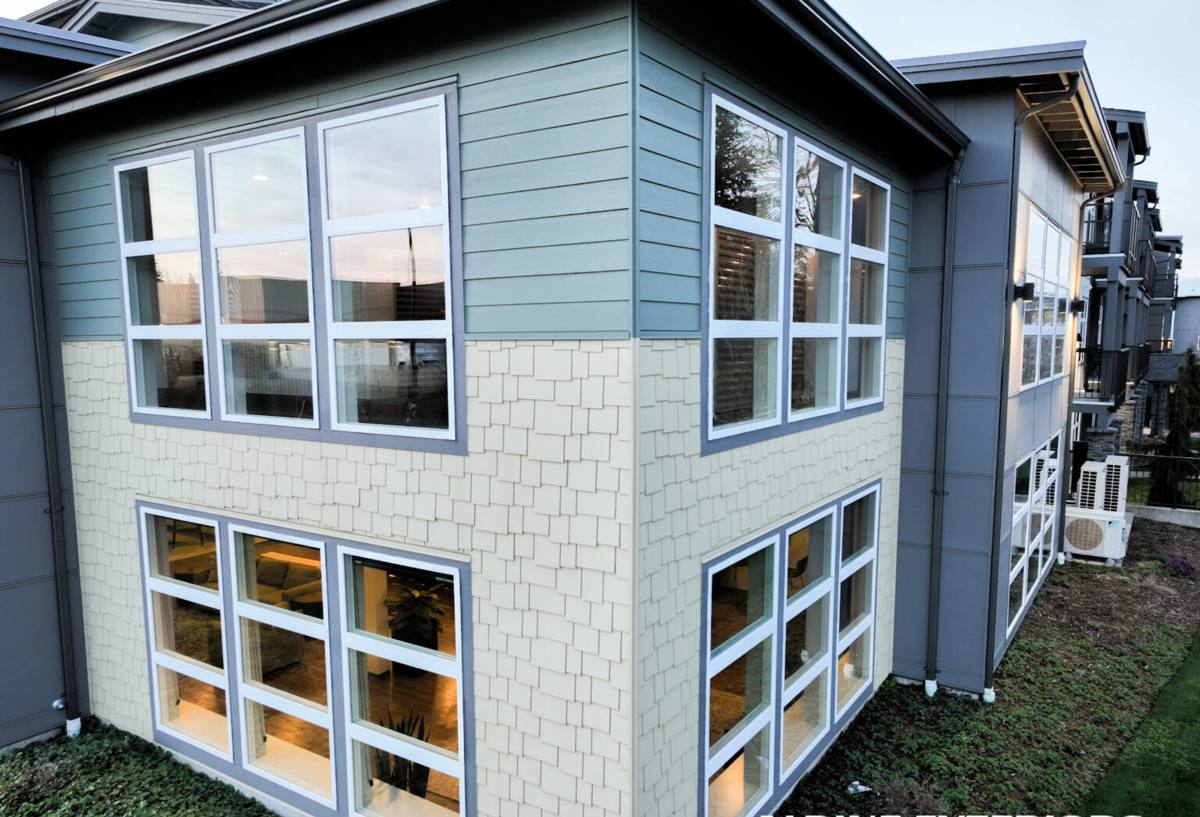
What Salt Air, Driving Rain, and Moss Season Actually Do to a Wall
Most siding failures we get called out to inspect trace back to one of three things: water finding a way behind the cladding, a material that can't handle sustained moisture, or an installation that ignored one of the two problems above. In Laurel and the surrounding Whatcom County lowlands, all three risks run higher than average for specific reasons.
Salt-laden air
Wind moving inland off Semiahmoo Bay carries fine salt particulate that settles on exterior surfaces. On unprotected wood or certain composite products, that salt accelerates the breakdown of surface coatings and speeds up deterioration at seams and fastener points. Metal fasteners and trim are also more prone to corrosion in this air than they would be further from the water.
Driving, wind-driven rain
Rain here rarely falls straight down. Storms move through with enough wind to drive water sideways into laps, corners, and any gap in the weather barrier. A siding system that relies on paint or caulk alone to stay watertight, rather than on correct lap geometry and flashing, will eventually let water in — it's a matter of when, not if.
A long, shaded moss season
Whatcom County's wet season runs long, and many Laurel lots have mature trees that keep siding shaded and slow to dry. Moss and algae take hold on any surface that stays damp for extended stretches, and once established they hold moisture directly against the cladding, which is worse for the wall underneath than the moss itself.
Why James Hardie Is Built for This Specific Climate
James Hardie fiber cement is manufactured for regional climate zones, not sold as a one-size-fits-all product. For our part of Washington, that means the HZ5 formulation, engineered for climates with sustained moisture exposure. Fiber cement doesn't rot, doesn't support insect activity, and doesn't absorb water the way wood-based or wood-derived siding products do — it's made from cement, sand, and cellulose fiber, cured into a dense, dimensionally stable board.
The factory-applied ColorPlus finish is the other half of the equation. It's baked on under controlled conditions rather than applied on site, which gives it far more resistance to the fading, chalking, and peeling that salt air and UV exposure cause on field-painted siding. Touch-ups and re-coats become the exception on a Hardie home rather than a recurring maintenance line item.
We install James Hardie exclusively — not LP SmartSide, not vinyl, not Cemplank, not Allura, and not primed spruce or cedar. Each of those products has legitimate uses somewhere, but none of them combine non-combustible fiber cement construction, a climate-matched formulation, a factory finish backed by a strong transferable warranty, and a track record proven in exactly this kind of marine, high-moisture environment. That combination is why we standardized on one manufacturer instead of offering a menu of lower-cost alternatives.
What a Correct Installation Involves
The product only performs as designed if the installation respects the manufacturer's spec, and this is where most siding problems actually start — not in the material itself. On a Laurel home, we pay particular attention to the details that matter most under wind-driven rain and a long wet season.
- Weather-resistive barrier and flashing first. The siding is the last line of defense, not the only one. A continuous, properly lapped weather barrier with correctly integrated window and door flashing has to be right before a single board goes up.
- Drainage gap where called for. A small air gap behind the siding lets any moisture that does get past the cladding drain and dry instead of sitting against the wall sheathing.
- Correct fastener placement and type. Hardie specifies fastener size, spacing, and embedment depth, and calls for corrosion-resistant fasteners in coastal-exposure areas. Getting this wrong is one of the most common causes of premature siding failure we see on inspections.
- Proper clearance at grade and hardscape. Siding kept too close to soil, decking, or paved surfaces wicks up moisture and stays wet longer. Manufacturer-specified clearance prevents that.
- Sealed penetrations, not painted over. Every hose bib, vent, and fixture penetration needs proper sealing at the time of install, not as an afterthought.
- Correctly finished joints and corners. Butt joints and corners are the most common entry point for water on any siding job; how they're finished determines whether that joint stays watertight for decades or fails within a few years.
None of this is exotic work, but it is unforgiving of shortcuts, and it's exactly what separates a siding job that looks fine at handoff from one that still looks and performs well after a decade of Whatcom County winters.
James Hardie Compared to the Alternatives
Laurel homeowners sometimes ask why we don't offer a lower-cost siding option alongside Hardie. The honest answer is that in this climate, the trade-offs on the alternatives tend to show up as maintenance calls and premature replacement, not as savings that hold up over time.
| Factor | James Hardie Fiber Cement | Vinyl | LP SmartSide / Wood-Based |
|---|---|---|---|
| Moisture resistance | Does not rot or swell; engineered for wet climates | Won't rot, but seams and gaps can trap moisture behind the panel | Wood-derived core is vulnerable to swelling and rot if the finish fails |
| Salt air exposure | Fiber cement core is inert to salt exposure | Panels can become brittle and discolored over time | Coatings degrade faster under salt-laden wind |
| Moss / algae resistance | Dense, stable surface holds a factory finish well and cleans up without damaging the board | Surface can host algae growth in shaded, damp areas | Porous or damaged coating areas are more prone to organic growth |
| Fire performance | Non-combustible | Combustible; can melt or deform near heat sources | Combustible, wood-based core |
| Finish longevity | Factory-baked ColorPlus finish resists fading and chalking | Color is through-body but can fade and chalk over time | Field or factory coating, sensitive to moisture intrusion at edges |
| Warranty structure | Strong, transferable manufacturer warranty on substrate and finish | Varies widely by manufacturer and product tier | Coverage often narrows significantly if moisture damage occurs |
We're not suggesting the alternatives are unusable products everywhere. We're saying that for the specific combination of salt air, driving rain, and extended moss season Laurel homes deal with, James Hardie is the product that holds up with the least long-term maintenance burden — which is exactly why it's the only one we put on a wall.
Signs Your Current Siding May Already Be Struggling
A lot of siding problems in this climate stay hidden until they're expensive. These are worth a closer look, especially on a Laurel home with mature landscaping or exposure to prevailing storms:
- Persistent dark streaking or moss growth that returns quickly after cleaning
- Soft or spongy spots when you press on the siding near the bottom courses or trim
- Visible gaps, warping, or buckling at seams and corners
- Paint that is peeling, bubbling, or chalking heavily in patches rather than evenly
- Musty smells, peeling interior paint, or discoloration near exterior walls
- Fastener heads showing rust streaks or backing out of the siding face
Any one of these can be minor on its own, but they're worth having looked at before a wet winter turns a surface issue into a sheathing or framing repair.
How We Approach a Laurel Siding Project
The process is straightforward, but we don't skip steps to move faster:
- On-site assessment. We look at the existing siding, the wall assembly where it's visible, drainage patterns around the home, and any moisture or moss problem areas specific to the lot.
- Written estimate and product selection. We walk through the appropriate James Hardie product line, the HZ5 formulation, and ColorPlus color options for the home, with a clear, itemized scope.
- Prep and weather barrier work. Before any siding goes up, we address the weather-resistive barrier, flashing at windows and doors, and the drainage plane — the part of the job that determines how the siding performs for decades.
- Installation to manufacturer spec. Fastening, clearances, joint treatment, and trim details are installed to James Hardie's published requirements for our climate zone, not a generic national minimum.
- Final walkthrough. We review the finished work with the homeowner, including warranty registration and basic care going forward.
Ongoing Care Through a Long Moss Season
A correctly installed James Hardie system is genuinely low-maintenance, but low-maintenance isn't no-maintenance in a climate that stays damp as long as ours does. An occasional gentle rinse to clear pollen, dust, and early moss growth keeps the ColorPlus finish looking like new far longer than letting organic growth build up season after season. Homeowners should avoid pressure-washing at close range or high pressure, since that can force water past the lap joints rather than simply cleaning the surface. Keeping gutters clear and trimming back vegetation that shades and dampens a wall section also goes a long way toward keeping moss from taking hold in the first place.
Why Hiring a Crew That Already Works in Laurel Matters
Siding installation isn't just a product decision — it's a craft decision, and the details that matter most are the ones that are invisible once the job is done. A crew that regularly works Laurel and the rest of our Whatcom County service area already knows which exposures take the worst of the driving rain, which lots hold moisture longest into spring, and where salt air exposure calls for extra attention to fastener selection and trim detailing. That local pattern recognition shows up as fewer callbacks and siding that still looks right ten and twenty years out, not just at the final walkthrough.
It also means accountability stays local. We install James Hardie because we've seen how it performs against this specific climate over time, and we back every installation with workmanship that stands alongside the manufacturer's transferable warranty on the product itself.
If your Laurel home is due for new siding, or you'd like a second opinion on moss, staining, or soft spots you've noticed, we're happy to take a look. Estimates are free and there's no pressure to move forward — just a straight assessment of what your home needs and what it would take to do it right.