 Semiahmoo Siding
 Fiber Cement Siding, Installed Right, for Lynden Homes
Lynden sits inland from the immediate coastline, but it's still squarely inside the marine weather system that shapes exterior work across northern Whatcom County. Salt-tinged air moves in off the Sound and settles over the whole region, driving rain through the fall and winter comes in sideways more often than straight down, and a mild, damp climate keeps moss and mildew active on shaded walls for most of the year. Those three conditions together are exactly what fiber cement siding was engineered to handle, and they're exactly what cheaper or less climate-appropriate siding products tend to struggle with a few years into ownership.
This page is specifically about fiber cement siding as a service for Lynden properties — what the climate demands of it, what a correct installation actually involves, and how we run the job from first call to final walkthrough. We install James Hardie fiber cement exclusively. No vinyl, no engineered wood, no cement-board alternatives from other manufacturers. That's a professional standard, not a sales pitch, and it comes from years of seeing what actually holds up on homes in this exact climate versus what looks fine on a spec sheet.
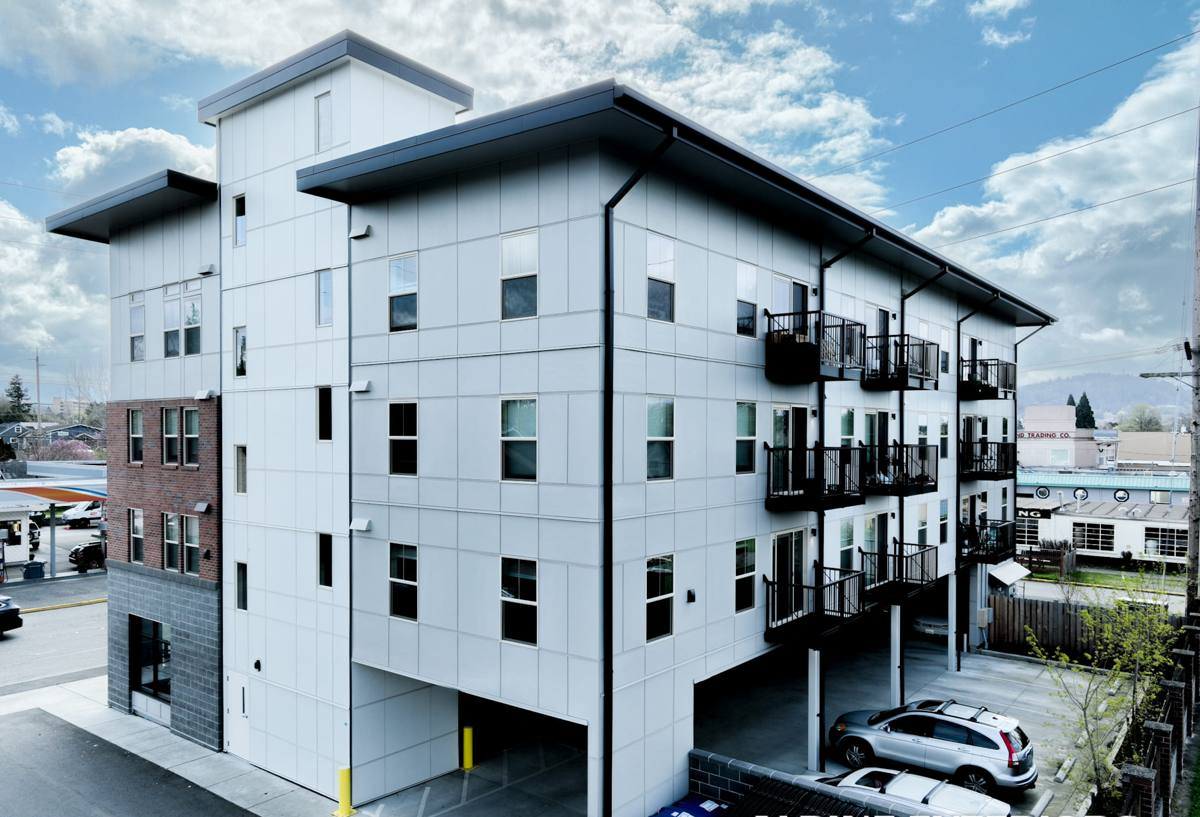
What Lynden's Climate Demands From a Siding System
Salt Air, Even This Far Inland
It's easy to assume salt exposure is only a waterfront problem, but marine air carries well inland across this part of Whatcom County. Over years, that salt content accelerates corrosion in fasteners, flashing, and lower-grade trim hardware, and it breaks down cheap paint and coatings faster than a dry inland climate would. A fiber cement installation needs corrosion-resistant fasteners and trim details from day one — retrofitting that after rust shows up means pulling siding back off.
Driving Rain That Hits Walls Sideways
Rain in this region rarely just falls — wind pushes it laterally into wall assemblies, window flashing, and the joints where trim meets field siding. That sideways load is the detail that separates a fiber cement job that lasts decades from one that starts letting water in behind the cladding within a few wet seasons. The material itself sheds water well when it's installed correctly; the failures we see almost always trace back to a joint, a lap, or a flashing detail that wasn't built for wind-driven rain in the first place.
A Moss and Mildew Season That Doesn't Really End
Mild temperatures, tree cover, and near-constant humidity add up to a moss and mildew season that can run close to year-round on shaded, north-facing walls. Lynden's mix of open farmland and tree-lined residential lots means exposure varies a lot from house to house — a wall facing an open field dries out fast after rain, while a wall shaded by mature trees or sitting close to a fence line often stays damp for days. Fiber cement's dense, non-porous composition resists that kind of sustained moisture far better than porous or wood-based alternatives, but it still needs proper drainage detailing behind it to perform the way it's designed to.
Why Fiber Cement Is the Only Siding We Install
We used to offer a broader range of siding products. We narrowed that down to one system after repeatedly seeing what actually held up on service calls and tear-offs in this climate, versus what struggled within a handful of winters.
- Non-combustible core: Fiber cement doesn't feed a fire the way wood-based siding can, which matters for safety and often for insurance underwriting as well.
- Factory-applied ColorPlus finish: The color is baked on under controlled factory conditions rather than brushed on in the field, and it holds up far longer against fading, chalking, and moisture intrusion than site-applied paint.
- Climate-engineered HZ product lines: Hardie's HZ5 formulation is built specifically for regions with heavy moisture exposure and freeze-thaw cycling, which describes Lynden and the rest of Whatcom County accurately.
- Dimensional stability: Fiber cement doesn't swell, cup, or warp the way engineered wood products can after repeated wetting cycles over a long wet season.
- A strong transferable warranty: Hardie backs the product with one of the more substantial warranty structures in the industry, provided installation follows their published specs.
We don't install LP SmartSide, vinyl siding, Cemplank, Allura, primed spruce, or cedar. Each of those has a legitimate place in the market, and plenty of homeowners are satisfied with them elsewhere. Our position is a professional one: in a climate with this much sustained moisture and salt exposure, we'd rather stand fully behind one system than offer a cheaper option that quietly shifts long-term maintenance risk onto the homeowner.
What a Correct Fiber Cement Installation Actually Involves
Fiber cement only performs the way it's engineered to when the installation matches Hardie's published specifications. A rushed or generic install can leave the same material vulnerable to the exact moisture problems it's supposed to resist.
The Details That Matter Most
- Correct fastener type, length, and spacing — under-fastened or improperly placed nails are one of the most common causes of premature siding failure.
- Proper clearance from grade, roof lines, and decks, so the bottom edge of the siding never sits in standing water or constant splash-back.
- A drainage plane or rain-screen gap behind the panels where the wall assembly calls for it, so any moisture that does get past the cladding can escape instead of sitting against the sheathing.
- Factory-mitered corners or properly caulked and primed field joints, since exposed cut edges are the most common entry point for moisture if left untreated.
- Flashing that integrates correctly with windows, doors, and roof-to-wall transitions — siding installed perfectly still fails if the flashing behind it is wrong.
We treat those details as the baseline for every job, not as an upgrade option. A Hardie product installed loosely will still develop moisture problems in this climate — the material is only as good as the installation behind it.
How a Lynden Fiber Cement Project Runs, Start to Finish
1. Walkthrough and Assessment
We start by walking the property in person, not quoting off photos or a phone description. That means checking the condition of the existing siding and sheathing, looking for any signs of trapped moisture or rot behind the current cladding, and noting exposure differences across the house — a shaded north wall and a sun-exposed south wall on the same property can need different detailing.
2. Tear-Off and Substrate Check
Once the old siding comes off, we check the sheathing and framing underneath for water damage before anything new goes up. This is the step that gets skipped on lower-bid jobs, and it's also the step most likely to reveal a problem that's been quietly developing for years. Any rot or moisture damage gets repaired before new siding goes on — covering it up only buries the problem.
3. Weather Barrier and Flashing
We install the weather-resistant barrier and flashing system according to Hardie's specifications, paying particular attention to window and door openings and any roof-to-wall transitions, since those are the highest-risk points for wind-driven rain intrusion in this climate.
4. Siding Installation
Panels or planks go up with the correct fastener schedule, clearances, and joint treatment described above. We keep an eye on how each wall's exposure — sun, shade, wind direction — should influence small detailing choices, rather than treating every elevation identically.
5. Final Walkthrough
We walk the finished job with the homeowner, review the warranty paperwork, and go over basic maintenance expectations so there are no surprises later.
Comparing Siding Options for a Lynden Home
| Material | Moisture Behavior in This Climate | Finish Durability | Where We Stand |
|---|---|---|---|
| James Hardie fiber cement | Dense, non-porous; resists sustained moisture and moss growth when installed with proper drainage detailing | Factory-applied ColorPlus finish holds color for years without repainting | What we install exclusively |
| Vinyl siding | Doesn't rot, but can warp or buckle under sustained heat and doesn't provide the same solid, non-combustible wall system | Color is molded in, but fades over time and can't be repainted easily | Not installed by our crew |
| LP SmartSide (engineered wood) | Wood-based core is more moisture-sensitive; performs adequately when installed and maintained exactly to spec | Factory finish is durable but the wood core remains the long-term variable | Not installed by our crew |
| Cedar | Natural wood; attractive but requires regular refinishing and is more vulnerable to sustained moisture and moss in shaded areas | Needs recoating or staining on a recurring schedule to hold up | Not installed by our crew |
| Primed spruce | Softwood substrate is highly moisture-sensitive without diligent paint maintenance | Field-applied paint fails faster than factory finishes in this climate | Not installed by our crew |
Why Hiring a Crew That Already Works Lynden Matters
A siding contractor who spends most of their time bidding jobs in a different climate zone doesn't necessarily know which details matter here. Fastener corrosion resistance, drainage detailing behind the cladding, and flashing integration at wall transitions aren't universal checklist items — they're responses to what actually happens to a wall assembly in this specific combination of salt air, wind-driven rain, and a long wet season. A crew that works this area regularly has seen what fails here and builds around it as a matter of course, not as a special request.
That familiarity also shows up in smaller, practical ways: knowing how exposure varies between an open farmland-facing wall and a tree-shaded one on the same lot, understanding how local permitting and inspection typically go, and being available for a service call if a question comes up after the job is done rather than being a one-time crew that's moved on to the next region.
Maintenance Expectations After Installation
Fiber cement is low-maintenance compared to most alternatives, but "low-maintenance" doesn't mean "no maintenance." A few simple habits keep a Hardie installation performing the way it's designed to for the long haul.
- Rinse siding periodically to clear off pollen, dust, and the early stages of moss or mildew before it takes hold, especially on shaded walls.
- Keep gutters clear so overflow doesn't run down the face of the siding or pool at the base of a wall.
- Trim back vegetation that keeps a wall shaded and damp, since airflow and sun exposure are the simplest defenses against moss.
- Have caulking at joints and trim checked every few years, since caulk is the one component in the system that ages faster than the siding itself.
- Address any impact damage — from a ladder, equipment, or storm debris — promptly rather than letting a chipped or cracked panel sit exposed.
What This Typically Costs
Fiber cement siding costs more upfront than vinyl and is generally comparable to or somewhat more than engineered wood siding, largely because of the material's weight, the labor involved in correct installation, and the finish quality. Exact pricing depends on the size of the home, the number of stories, existing siding removal and any substrate repair needed, and the trim package chosen. We don't quote off a generic price sheet — every estimate comes from an in-person walkthrough of the actual property.
Questions to Ask Before You Decide
- Ask which specific siding products a contractor installs and why, not just what's cheapest to bid.
- Ask how cut edges and field joints get sealed on the product being proposed, since that's where moisture problems usually start.
- Ask what the manufacturer's warranty actually requires to stay valid, including installation and maintenance conditions.
- Ask how the contractor handles substrate repair if tear-off reveals rot or moisture damage behind the existing siding.
- Ask for the specific product line being quoted, since performance can vary meaningfully within a single manufacturer's catalog.
Get a Free, No-Pressure Estimate
If you're planning a siding project for a Lynden home, we're glad to walk the property, look at what your walls are actually dealing with, and give you a straight answer about what we'd recommend and why. Reach out using the form below to schedule a free estimate — no pressure and no upsell script.