 Semiahmoo Siding
 Decks Near the Water Take a Different Kind of Beating
Homes in the Peace Arch area sit close enough to Semiahmoo Bay and Drayton Harbor that salt-laden air is part of daily life, not an occasional event. Add Whatcom County's long wet season, driving rain off the water, and months where a north-facing deck barely sees direct sun, and you've got conditions that expose weak decking work fast. A deck that would hold up fine forty miles inland can start showing problems within a few years out here if it wasn't built for this specific environment.
Salt air accelerates corrosion on anything metal — fasteners, joist hardware, railing brackets. Constant moisture without enough drying time between rain events is what drives moss, algae, and mildew growth on horizontal surfaces. And wind-driven rain doesn't just fall on a deck, it gets pushed sideways into ledger connections, stair stringers, and any gap where water can collect instead of shed. None of this means composite decking is a bad choice near the water — it's usually the better choice — but it means the details matter more here than they do in a drier, more sheltered lot.
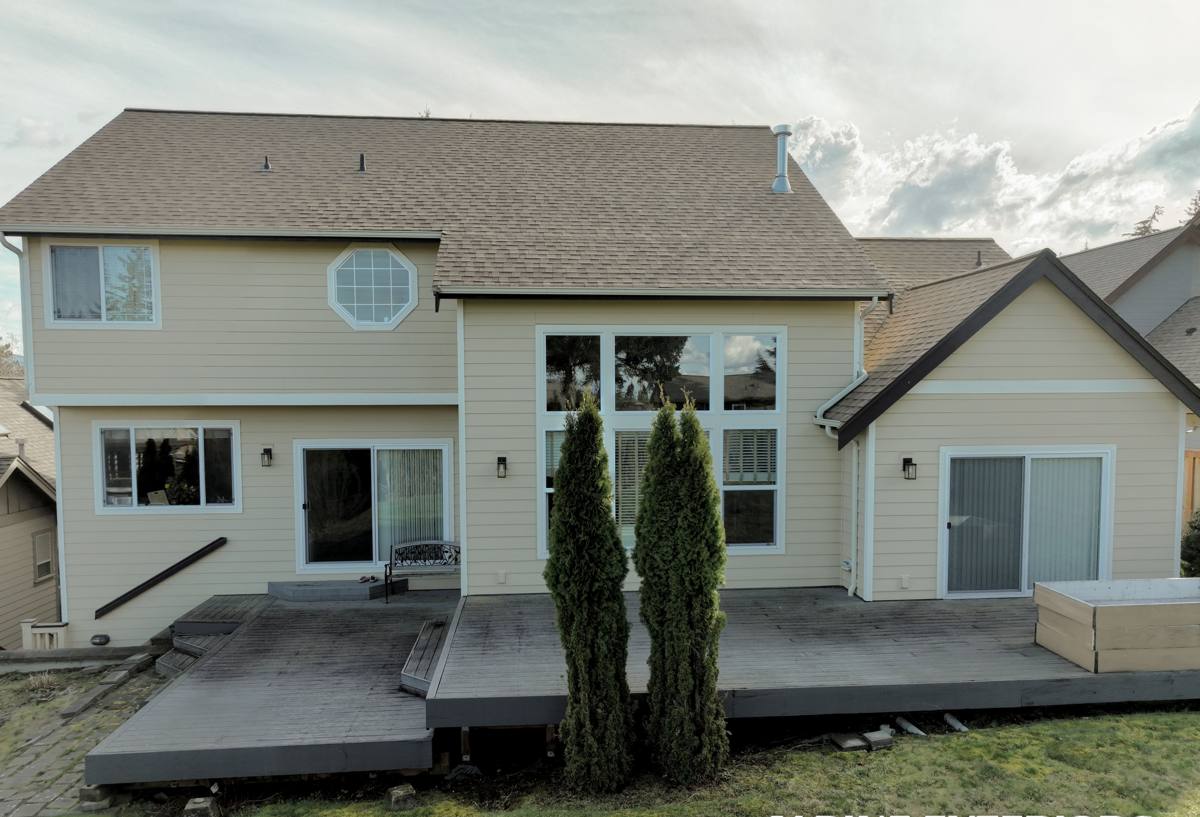
What a Correct Composite Deck Build Actually Involves
Composite decking itself resists rot, doesn't need staining, and won't splinter the way wood does over time. But the board is only one part of the system. A deck that fails near Semiahmoo almost never fails because the composite boards themselves gave out — it fails because something underneath or around them wasn't built for the moisture load.
The Parts That Actually Determine Longevity
- Ledger board flashing and waterproofing where the deck attaches to the house — the single most common source of hidden rot on any deck, wood or composite
- Joist tape or protective wrap on the framing lumber, since composite boards don't rot but the wood structure underneath still can
- Stainless or coated fasteners rated for coastal/marine exposure, not standard exterior-grade hardware that corrodes and streaks the decking
- Proper board spacing and hidden fastener systems that allow water to drain instead of pool
- Ventilation underneath the deck so the substructure can actually dry out between rain events
- Correct drainage slope away from the house, even on a deck that looks level to the eye
Skip any one of these and the composite boards can look fine on the surface while the frame underneath is quietly failing. This is the gap between a deck that's "installed" and a deck that's built correctly for this climate.
Choosing the Right Composite Board for This Environment
Not all composite decking is built the same way, and the differences matter more in a marine climate than a dry inland one. The two biggest decisions are whether the board is fully capped or uncapped, and whether it has a grooved or solid edge.
| Board Type | How It Handles Moisture | Best Fit For |
|---|---|---|
| Capped composite (polymer shell on all sides) | Best resistance to moisture absorption, staining, and mold growth in the cap layer itself | Peace Arch homes with full sun/rain exposure and salt air contact |
| Uncapped or partially capped composite | More prone to surface staining and moisture uptake over time, especially on the exposed core | Covered porches or lower-moisture areas, less ideal fully exposed near the bay |
| Grooved-edge boards (hidden fasteners) | No exposed fastener heads to corrode or streak; slightly more prone to trapping debris in the groove if not cleaned | Most open decks — the standard choice for a clean, low-maintenance surface |
| Solid-edge boards (face-screwed) | Fasteners are exposed to weather directly; needs corrosion-rated screws and periodic inspection | Stair treads and high-traffic areas where extra fastening strength matters |
For most fully-exposed decks in this area, we lean toward capped composite with a hidden fastener system. It costs more upfront than an uncapped board, but it's the difference between a deck that still looks new after five wet winters and one that's showing gray streaking and mildew in the grain texture.
Substructure and Drainage: The Part Nobody Sees
Most homeowners judge a deck by the boards on top. The framing underneath is what actually determines whether that deck is still solid in ten or fifteen years. In a climate with this much sustained moisture, we treat the substructure as the part that can't be shortcut.
That means pressure-treated or naturally durable framing lumber, joist tape on every top edge to keep water from wicking into the wood grain, and enough gap between the bottom of the deck and the ground or grade below for air to actually move. A deck built tight to the ground with no ventilation traps moisture underneath year-round in this climate — that's a recipe for slow substructure rot even if the composite surface never shows a problem.
Drainage matters just as much on multi-level decks or any deck built over living space below. Water needs a clear path off the structure, not just off the individual boards. We check this on every job because it's the single most common thing a rushed installation gets wrong.
How Our Process Works
We keep the process straightforward and we don't skip steps to save time, because the steps we'd be tempted to skip are exactly the ones that matter most in this climate.
- On-site assessment — we look at sun exposure, wind direction, existing structure condition if this is a replacement, and how close the deck sits to salt spray or standing moisture
- Material selection — we walk through board options and hardware grade based on your budget and how exposed the deck actually is, not a one-size-fits-all recommendation
- Framing and waterproofing — ledger flashing, joist protection, and corrosion-rated fasteners go in before a single composite board is laid
- Deck board installation — proper spacing, hidden fastener systems where appropriate, and attention to drainage slope
- Railing, stairs, and trim — matched to the same moisture standards as the decking itself, since railing posts and stair stringers see the same weather
- Final walkthrough — we go over basic care with you before we consider the job done
Maintenance in a Moss and Mildew Climate
Composite decking is genuinely low-maintenance compared to wood, but "low-maintenance" doesn't mean "no maintenance," especially with the amount of moss season this area gets. A little seasonal attention goes a long way toward keeping the surface looking like it did on install day.
- Sweep debris off regularly — leaves and organic matter trapped against the board surface hold moisture and feed algae growth
- Rinse the deck a few times a year, and clean it with a soft-bristle brush and mild soap when green or black staining starts to show
- Check railing posts, stair connections, and any exposed fasteners once a year for corrosion or looseness
- Keep gutters and downspouts near the deck clear so runoff isn't dumping extra water directly onto the structure
- Avoid pressure washing at close range or high pressure — it can wear the cap layer on composite boards over time
What It Typically Costs and Why
Composite decking costs more upfront than pressure-treated wood, but the ongoing maintenance difference over the life of the deck usually closes that gap. Pricing depends heavily on size, board tier, railing choice, and site conditions — here's what tends to move the number.
| Cost Factor | Why It Matters Here |
|---|---|
| Board tier (capped vs. uncapped) | Capped boards cost more per square foot but hold up better against salt air and constant moisture |
| Substructure condition | Replacing rotted framing on an older deck adds cost but is not optional if the frame is compromised |
| Site access and grade | Sloped lots or decks built over living space need extra drainage and support work |
| Railing material | Composite, aluminum, and cable railing all carry different price points and different corrosion resistance |
| Fastener and hardware grade | Marine-grade or coated hardware costs more but is worth it this close to salt water |
We'll always give you an honest range based on your actual deck, not a generic estimate that doesn't account for what your specific site needs.
Why It Matters Hiring a Crew That Already Works Peace Arch
A contractor who mostly works drier, more sheltered lots inland doesn't always think about ledger flashing, hardware grade, or ventilation the same way a crew working the Semiahmoo waterfront does every week. It's not a knowledge gap you'd necessarily notice on install day — it shows up two or three winters later, when the shortcuts start to matter.
Working this area regularly means we've seen which details hold up through repeated wet seasons and which ones don't, on this specific stretch of coastline in Whatcom County. That's not a marketing point — it's the practical reason local experience translates into a deck that's still solid a decade from now instead of one that needs early repairs.
Get a Straight Answer for Your Deck
If you're planning a new composite deck or replacing one that's showing its age near the water, we're happy to take a look and give you an honest assessment — what your site actually needs, what it'll cost, and what tradeoffs are worth making for your budget. Reach out below for a free, no-pressure estimate.