 Semiahmoo Siding
 Why Sumas Siding Wears Differently Than Siding Inland
Sumas sits close enough to the water and the marine air pattern that moves through Whatcom County that its siding takes a different kind of beating than a house forty miles inland. Homes here deal with a combination that's hard on exterior materials: salt-laden air rolling in off the Strait, driving rain that hits siding sideways during winter storms, and a moss season that can stretch from October through May in shaded, north-facing spots. None of these on their own is unusual for the Pacific Northwest. Together, on the same wall, they accelerate problems that a drier, calmer climate would let a homeowner ignore for years.
Salt air is corrosive to fasteners and trim hardware, and it also holds moisture against a wall longer than dry air would. Driving rain finds every gap in flashing, caulk, and butt joints and pushes water where it doesn't belong. And moss doesn't just look bad — it holds water against the siding surface, keeps that surface from drying out between storms, and slowly works its way into any seam or crack it can reach. A siding repair in Sumas isn't just about fixing what's visibly broken; it's about understanding which of these three forces caused the damage, because that determines whether a patch will actually hold.
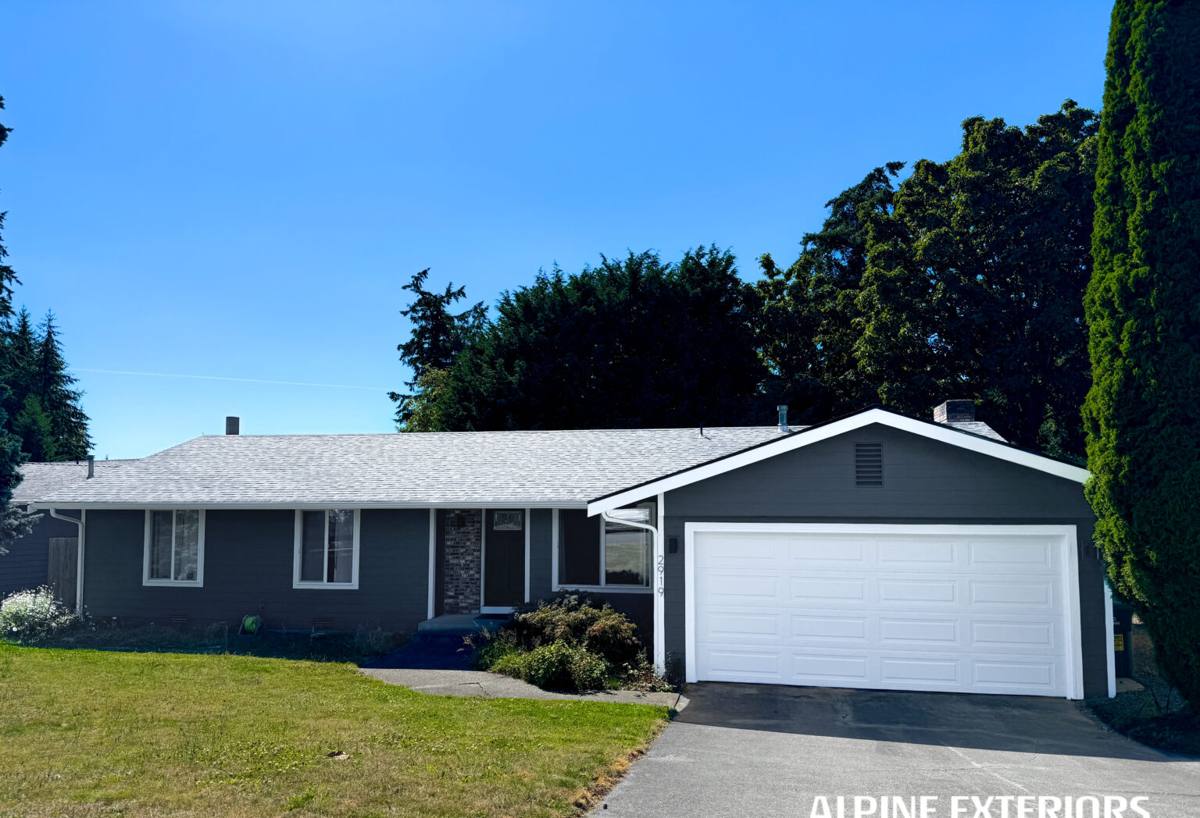
Signs Your Sumas Home Needs a Siding Repair
Most siding problems don't announce themselves with a hole in the wall. They start small and get worse over a wet season or two. Walk your exterior and look for these before you assume everything's fine:
- Soft or spongy spots when you press on the siding, especially near the bottom courses and around window trim
- Visible moss or dark green-black staining that keeps coming back after cleaning
- Cracked, peeling, or missing caulk at joints, corners, and window/door trim
- Bubbling, flaking, or discolored paint that suggests moisture is trapped underneath
- Gaps or separation where siding boards meet trim, especially on the side of the house that takes the most wind-driven rain
- Rust streaks below fasteners or trim hardware
- A musty smell or visible staining on interior walls that share an exterior wall with damaged siding
Any one of these on its own might be minor. Several of them together, especially clustered on one elevation, usually mean water has been getting behind the siding for a while — and that's a different repair than a single cracked board.
What a Correct Repair Actually Involves
A repair that just replaces the damaged board and re-caulks the edge is a patch, not a repair. It looks fine for a season and then fails again, often worse, because it never addressed why the damage happened in the first place. A correct repair in a climate like Whatcom County's starts with figuring out the water path.
Diagnosing the Cause, Not Just the Symptom
Before any board comes off, we look at what's behind it: is the house wrap intact, is flashing at the window or trim doing its job, is there a gap in the weather barrier that let water track down inside the wall instead of running off the surface? Damaged siding is often just the most visible evidence of a failure somewhere upstream — bad flashing, a caulk joint that failed years ago, or a nail pattern that let water track into the panel edge.
Matching Material and Fastening
Repairs also have to match the existing siding's material, profile, and fastening method, or the repaired section will age differently than the rest of the wall — different paint sheen over time, different moisture behavior, a visible patch that never blends in. On a fiber cement wall this matters even more than on vinyl, because fiber cement has specific nailing patterns, gapping requirements, and cut-edge sealing rules that affect how long the repair actually lasts.
Sealing and Finishing to Spec
Every cut edge on fiber cement siding needs to be sealed before it's painted or the ColorPlus finish is touched up. Caulk joints need the right backer rod and joint width, not just a bead squeezed into a gap. Skipping these steps is exactly how a repair fails again in two years instead of holding for twenty.
Repair or Replace: How We Help You Decide
Not every damaged section needs a full re-side, and not every problem is fixable with a patch. The right call depends on how much of the wall is affected and what's causing it.
| Situation | Usually a Repair | Usually Points to Replacement |
|---|---|---|
| Damage location | Isolated to one board, corner, or trim section | Spread across multiple elevations or repeats after prior repairs |
| Cause | Single failure point — a cracked board, a bad caulk joint, impact damage | Systemic moisture intrusion behind the weather barrier |
| Underlying sheathing | Dry and sound once siding is removed | Soft, delaminating, or showing rot |
| Age and material | Newer siding in otherwise good condition | Original siding at or past its expected service life |
| Cost over time | Lower upfront cost, addresses the specific problem | Higher upfront cost, resets the clock on the whole wall |
We'll tell you honestly which side of that table your house falls on. A good contractor doesn't sell a full re-side to a homeowner who needs a corner repaired, and doesn't patch a wall that's failing from the inside out.
Why We Only Repair and Install James Hardie Fiber Cement
We install James Hardie fiber cement exclusively — we don't work with vinyl, LP SmartSide, Cemplank, Allura, or primed wood siding, and that standard shapes how we approach repairs too. In a climate that combines salt air, sustained rain, and heavy moss growth, the material behind the repair matters as much as the workmanship. Fiber cement is non-combustible, holds paint and factory ColorPlus finish far longer than wood-based siding, and doesn't swell, rot, or delaminate the way engineered wood products can when moisture gets past the surface repeatedly.
That doesn't mean fiber cement is maintenance-free — no siding is. It still needs caulk joints maintained, cut edges sealed, and moss kept off the surface. But when we're repairing a Hardie wall, we know exactly how the manufacturer specifies the fix, what the warranty requires to stay intact, and how the product is engineered to perform in exactly the conditions Sumas sees. If your current siding is a product we don't install, we'll still give you a straight answer about your repair options — but our long-term recommendation, when replacement is the right call, is Hardie's HZ5 product line, which is engineered specifically for climates like this one.
Our Repair Process for Sumas Homes
- On-site inspection. We look at the damaged area and the surrounding wall, check for moss buildup, soft spots, and failed caulk joints beyond the obvious problem.
- Diagnose the water path. We identify whether this is surface damage or a sign of moisture getting behind the siding, and check flashing and house wrap where accessible.
- Written scope and honest recommendation. You get a clear explanation of what needs to happen, what it costs, and why — repair or replacement, no upsell.
- Careful removal. Damaged sections come out without disturbing sound siding around them.
- Repair the cause, not just the symptom. Flashing, house wrap, or fastening issues get corrected before new material goes back on.
- Match and finish. New material matches profile and finish, cut edges are sealed, and joints are caulked to spec.
- Final walk-through. We show you what we found and what we did, so you know the condition of the rest of your siding too.
Common Repair Scenarios We See in Sumas
Moss-Driven Deterioration on Shaded Walls
North-facing walls and sections shaded by trees or fences hold moisture longer and grow moss fastest. Left alone, moss keeps the siding surface wet between storms, which accelerates paint failure and, on lower-quality materials, softens the substrate underneath.
Failed Caulk Joints After Years of Driving Rain
Caulk is the first line of defense at trim, corners, and butt joints, and it doesn't last forever — especially where wind-driven rain hits it directly. Once it cracks or pulls away, water gets a direct path behind the siding.
Corrosion at Fastener Points
Salt air speeds up corrosion on exposed or under-driven fasteners and trim hardware. Rust streaks below a nail or screw head are usually a sign it's time to address that section before it gets worse.
Impact and Age Damage
Cracked boards from impact, or siding simply reaching the end of its service life on one section before the rest of the wall, are more straightforward repairs — but still need to be tied in correctly so they don't become the next weak point.
Why It Matters to Hire a Crew That Already Works in Sumas
Siding repair done well requires knowing what a specific climate does to a wall over time, not just how to swap a board. A crew that regularly works Whatcom County homes has already seen how moss builds on shaded elevations here, how far driving rain travels under trim in a coastal storm, and which repair shortcuts fail within a year in this environment versus one that stays dry most of the winter. That local pattern recognition is the difference between a repair that gets diagnosed correctly the first time and one that gets fixed twice.
It also means we're not guessing at code requirements, typical house construction in the area, or how local weather patterns interact with different wall orientations. We show up knowing what to look for.
Maintaining Your Siding After the Repair
A good repair should last, but a little upkeep protects that investment. Rinse moss and debris off siding surfaces at least once a year, more often on shaded walls. Check caulk joints at trim and corners annually, especially after a hard winter. Trim back vegetation and tree limbs that keep a wall shaded and damp. And if you notice a soft spot, new staining, or a caulk joint starting to separate, address it while it's still a small repair — waiting is what turns a one-board fix into a multi-wall project.
If you're seeing any of the warning signs above, or you just want an honest read on the condition of your siding, we're happy to take a look. Fill out the form below for a free, no-pressure estimate — we'll tell you what we actually find, not just what sells a job.