 Semiahmoo Siding
 Siding Replacement in Bellingham: What This Climate Actually Asks Of It
Bellingham sits on Puget Sound in Whatcom County, and that setting shapes what a siding job needs to survive out here more than most homeowners realize until they're standing in front of a bid. Salt-laden air drifts in off the water, storms push rain sideways into walls instead of straight down, and a moss and mildew season that can run most of the year keeps exterior surfaces damp far longer than a drier inland climate would. A siding replacement here isn't just a cosmetic upgrade — it's a chance to correct whatever let the old siding fail in the first place and put something on the wall that's actually built for these conditions.
We focus this page on one job in one area: replacing siding on homes in Bellingham. Not a general overview of every exterior service we offer, not a citywide pitch — just what local homes actually need from a siding replacement, what a correct job looks like from tear-off to finish, and why the details matter more here than they would somewhere with a calmer climate.
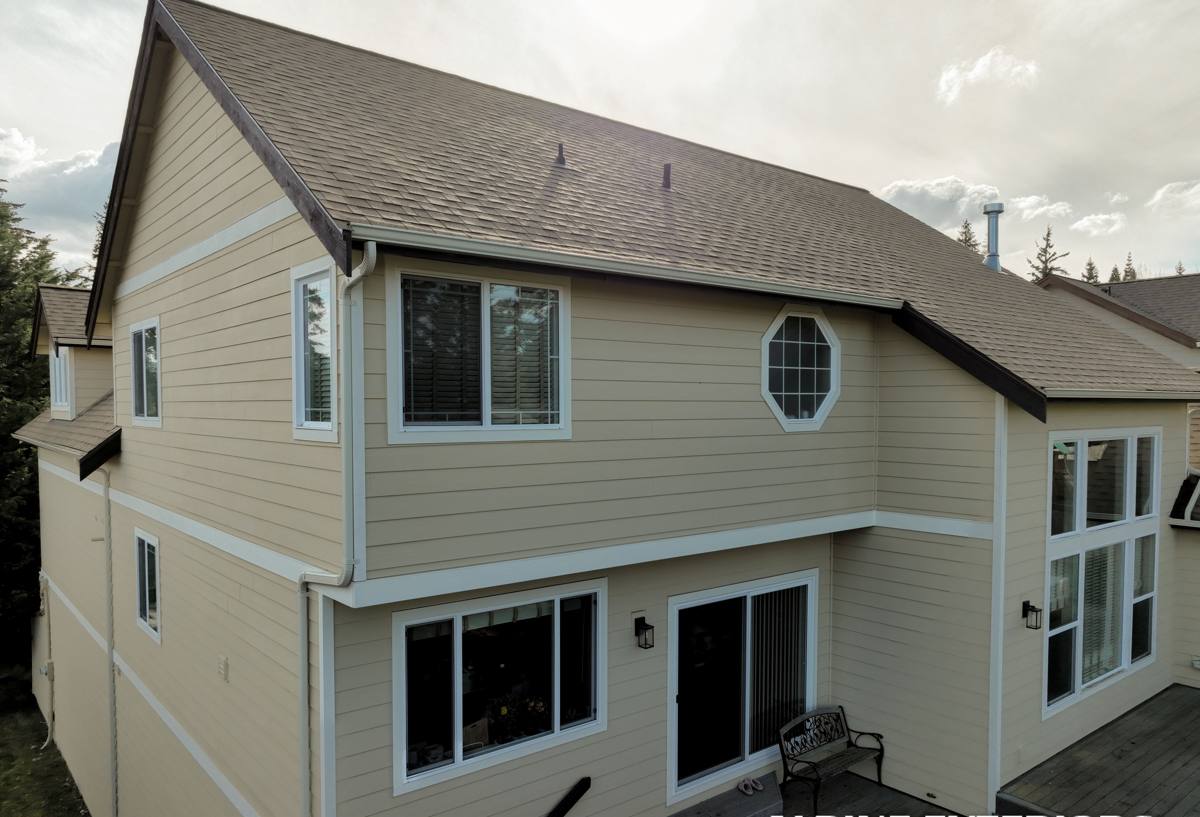
Signs a Bellingham Home Needs Siding Replacement, Not Just a Repair
Not every siding problem calls for a full replacement. But certain signs mean the material or the assembly behind it has reached the point where patching just delays the inevitable and can waste money on a wall that needs to come off anyway. Before we recommend replacement over repair, we look for a combination of these:
- Soft, spongy, or crumbling spots when you press on the siding, especially near the bottom courses and around window and door trim
- Persistent moss, algae, or mildew staining that keeps coming back within a season or two of cleaning
- Visible cupping, warping, or delamination, particularly on wood-based or engineered wood products
- Paint that won't hold — bubbling, peeling, or needing repainting far more often than it should
- Rot or staining on the sheathing or trim visible at corners, seams, or anywhere two materials meet
- Rising energy bills alongside drafts or cold spots, which can point to a water-resistive barrier that's no longer doing its job
Any one of these can sometimes be handled with a targeted repair. Several of them together, especially on a home more than 20 to 25 years old, usually means the wall assembly behind the siding has been taking on moisture for a while and a full replacement is the more honest recommendation.
What a Correct Siding Replacement Actually Involves
The siding itself is the part everyone sees, but most of what determines whether a replacement lasts happens underneath it. A rushed tear-off and reinstall can look identical to a careful one for the first year or two, and then diverge sharply after that.
Tear-Off and Sheathing Inspection
Removing the old siding is also the only chance to see what's really going on behind it. We check the sheathing for soft spots, rot, and staining, and we repair or replace any damaged sections before anything new goes up. Skipping this step and installing new siding over compromised sheathing just hides a problem that will resurface, usually in a worse state than before.
Water-Resistive Barrier and Flashing
A new water-resistive barrier goes on correctly lapped so water sheds downward and outward, never trapped behind a seam. Flashing gets installed and sequenced at every window, door, and roof-to-wall transition — the places where wind-driven rain finds its way in first. In a climate that pushes rain sideways into walls as often as this one does, flashing sequencing isn't a finishing touch; it's most of what keeps water out over the long run.
Fastening and Clearances
Fasteners, spacing, and clearances all need to follow the manufacturer's installation instructions specifically, not a generalized approach used everywhere. That includes keeping proper clearance between the bottom of the siding and grade, decks, roof lines, or anywhere water and debris tend to collect — a detail that matters even more in a region with a long moss season, since trapped moisture is exactly what feeds it.
Material Comparison for Bellingham's Climate
We install James Hardie fiber cement siding and nothing else. That's a standard, not a sales pitch — it comes from years of seeing which materials hold up on the water side of Whatcom County and which ones start showing problems within a few years. Here's an honest look at how the common options stack up against the conditions this climate actually produces:
| Material | Salt Air / Moisture Behavior | Moss & Mildew Resistance | Typical Maintenance |
|---|---|---|---|
| Vinyl siding | Doesn't rot, but can warp or fade under UV and temperature swings; seams can allow water behind the panel | Doesn't feed moss itself, but traps moisture behind it if installed too tight | Low, but limited repair options if damaged or discolored |
| Engineered wood / LP SmartSide | Wood-based core can absorb moisture at cut edges and seams if sealing isn't perfect | More prone to surface growth than fiber cement in persistent damp conditions | Moderate — repainting and edge sealing on a regular cycle |
| Cedar / primed spruce | Natural wood movement with humidity; higher risk of cupping and swelling near the water | Higher susceptibility to moss and mildew without frequent treatment | High — regular refinishing and moisture monitoring |
| James Hardie fiber cement | Cement-based core is dimensionally stable and non-absorptive; not affected by salt corrosion | Factory ColorPlus finish resists surface growth better than porous materials | Low — periodic rinsing, no refinishing cycle required |
Every product on that list has a legitimate place somewhere. Our position is narrower: for homes exposed to this much salt air, wind-driven rain, and sustained dampness, fiber cement gives the wall assembly more margin for error than the alternatives, and that margin is worth more here than it might be in a milder climate.
Our Siding Replacement Process, Step by Step
- On-site assessment. We walk the exterior, check for soft spots and moisture signs, and give you a straight answer on whether repair or full replacement makes sense.
- Tear-off. Old siding comes off completely so we can inspect and repair the sheathing underneath rather than building over a hidden problem.
- Water-resistive barrier and flashing. A new barrier goes on correctly lapped, with flashing sequenced at every window, door, and transition point.
- James Hardie installation. Panels or planks go on to manufacturer spec — correct fastening, spacing, and clearances, sized to your home's exposure.
- Trim and detail work. Corners, trim boards, and joints get finished and sealed so water has nowhere to collect or wick in.
- Final walkthrough. We go over the completed work with you and answer any questions before calling the job done.
What Affects the Cost of a Siding Replacement
Every home is different, so we don't quote a number until we've actually looked at yours, but the same handful of factors drive the cost on nearly every job we bid in Bellingham:
| Factor | Why It Moves the Price |
|---|---|
| Total square footage | More wall area means more material and more labor hours, the most direct driver of cost |
| Condition of the sheathing underneath | Rot or water damage found during tear-off adds repair work that can't be scoped until the old siding is off |
| Trim and architectural detail | Homes with more corners, dormers, or trim work take longer to finish correctly than a simple rectangular wall |
| Height and access | Multi-story sections or homes with tight lot access need more setup time and equipment |
| Color and finish selection | Factory-finished ColorPlus options vary in cost slightly by color and profile, though installation labor stays the same |
A wide, honest range for a full siding replacement typically runs from the mid five figures for a smaller, straightforward home to well into six figures for a large home with significant trim detail or sheathing repair. The only way to know where your home falls is a walk-through estimate.
Why Hiring a Crew That Already Works Bellingham Homes Matters
Siding installation instructions are the same on paper wherever a crew is working. What changes is how much margin a job needs against the local weather, and that only comes from having actually installed and serviced siding in this specific climate. A crew that regularly works Whatcom County's water-adjacent neighborhoods knows to size flashing and drainage details for wind-driven rain rather than the milder, straight-down rainfall assumptions that work fine elsewhere. That local pattern recognition is the difference between a wall assembly that performs the way it's supposed to and one that looks fine for a year or two before problems start.
Local experience also means faster, more accurate estimates. We're not guessing at how a Bellingham lot's exposure, tree cover, or proximity to the water will affect your home — we've already seen the pattern on similar properties nearby.
Living With Your New Siding: Maintenance That Actually Matters
James Hardie fiber cement is low-maintenance, not no-maintenance. A periodic rinse to clear salt residue, pollen, and organic buildup keeps the ColorPlus finish looking the way it's supposed to and prevents moss from getting a foothold in shaded or north-facing areas. Keep an eye on caulking at trim joints and touch it up if it starts to crack or pull away, and clear any vegetation or debris that builds up against the bottom courses — that's exactly the kind of trapped moisture this climate's moss season feeds on. Beyond that, there's no refinishing cycle to plan for and no wood to seal.
If your siding is showing its age, or you just want a straight answer about whether repair or replacement is the right call for your Bellingham home, we're glad to take a look. Reach out below for a free, no-pressure estimate.