 Semiahmoo Siding
 Board & Batten in a Place Where the Weather Doesn't Let Up
Board and batten siding has become one of the most requested looks for homes along the Whatcom County coastline, and Birch Bay is no exception. The vertical lines read as clean, modern farmhouse, or classic beach cottage depending on the trim and color choices around it, and it pairs well with the mix of newer builds and older beach homes you'll find near the water. But Birch Bay is not a forgiving place to hang siding. It sits exposed to wind off the bay, salt-laden air, driving rain that comes in sideways during winter storms, and long stretches of shade and dampness that keep moss and algae growing for most of the year. A board and batten installation that looks right on day one but wasn't built for this environment will show problems within a few seasons — cupping boards, failed caulk joints, moss creeping up from the bottom courses, and paint that fades or chalks faster than it should.
This page is about doing board and batten siding correctly for Birch Bay specifically: what the climate demands, what a correct installation actually involves, and why we only install it in James Hardie fiber cement rather than the wood, engineered wood, or vinyl versions of the same look.
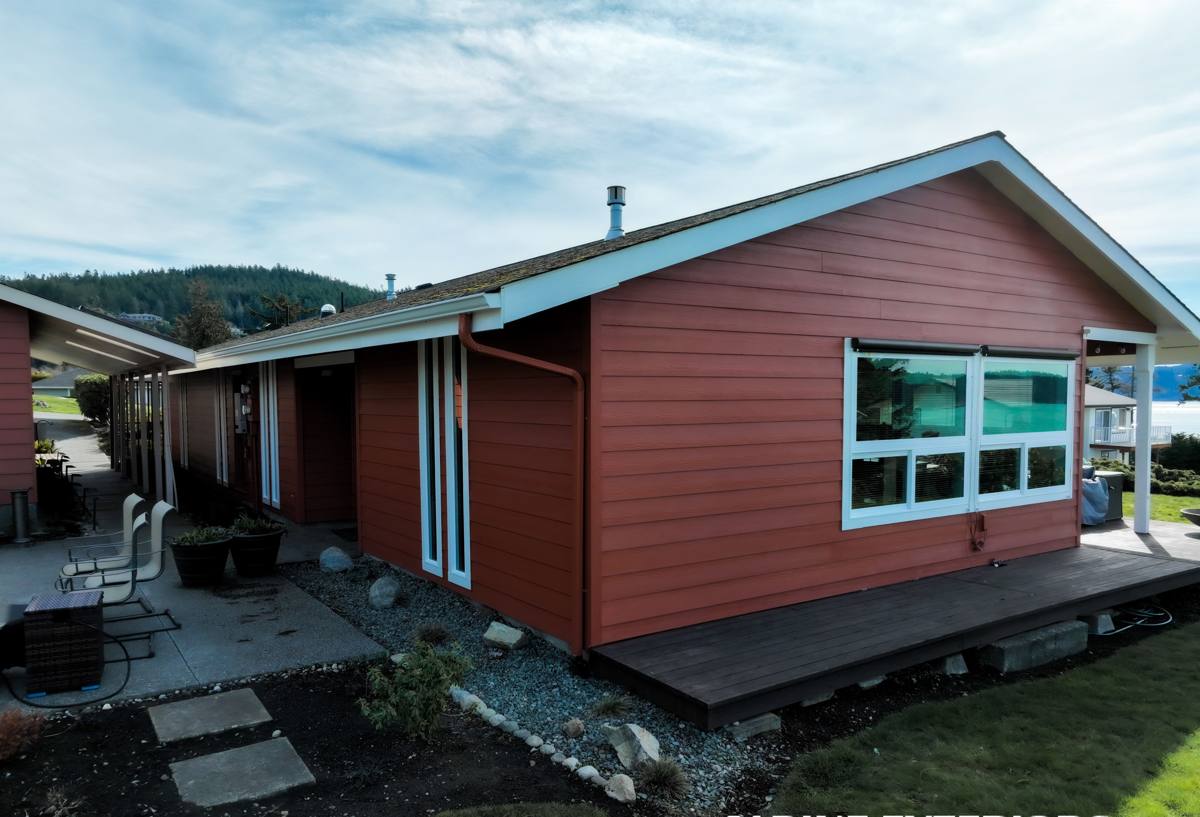
What Birch Bay's Climate Actually Does to Siding
Salt Air
Homes within a mile or two of Semiahmoo Bay and Birch Bay itself are exposed to airborne salt that settles on every exterior surface. Salt accelerates corrosion on fasteners and metal flashing, and it breaks down cheaper paint and coating systems faster than inland exposure would. Any siding material that isn't engineered to resist this — or any fastener that isn't corrosion-resistant — has a shorter service life here than the same product would have thirty miles inland.
Driving Rain
Winter storms off the Strait of Georgia don't fall straight down — they come in at an angle, driven by wind, and they hit vertical siding differently than horizontal lap siding. Board and batten has more vertical seams and butt joints than lap siding, and every one of those seams is a potential entry point for wind-driven moisture if it isn't detailed correctly. This is the single biggest factor separating a board and batten job that lasts from one that fails early.
Moss Season
Shaded, damp conditions persist for much of the fall through spring in this part of Whatcom County. Moss and algae take hold on any siding surface that stays damp and doesn't get direct sun, especially near ground level, under eaves, and on north-facing walls. Some materials resist this better than others, and installation details — like keeping the bottom of the siding off grade and giving water somewhere to drain — matter as much as the material itself.
Why We Install Board & Batten Only in James Hardie Fiber Cement
Board and batten is sold in several materials, and the visual style looks nearly identical in a photo regardless of what's behind it. The material is what determines whether it survives a Birch Bay winter for one decade or three. We standardized on James Hardie fiber cement for this style specifically because it holds up to the three problems above better than the alternatives, without asking the homeowner to take on a maintenance schedule to keep it that way.
Hardie fiber cement is non-combustible, dimensionally stable in wet-dry cycling, and comes with a factory-applied ColorPlus finish baked on under controlled conditions rather than field-painted on site. That factory finish is what resists the fading and chalking that salt air and UV exposure cause faster here than in a drier inland climate. We don't install cedar board and batten, primed spruce, LP SmartSide, or vinyl versions of this look — not because those products don't have a place somewhere, but because we've made a professional call that they carry more maintenance burden, more moisture risk, or more installation sensitivity than we're willing to put our name behind on a Birch Bay home. Cedar looks excellent new but needs regular refinishing to resist moisture and moss in this climate. Engineered wood products can be vulnerable at cut edges and butt joints if those aren't sealed exactly to spec, and vertical siding has a lot of both. Vinyl board and batten is low-maintenance but it's a thin plastic product that can warp in temperature swings and doesn't hold paint if a color change is ever wanted.
What a Correct Board & Batten Installation Involves
The visual result of board and batten is simple — vertical boards with a batten strip covering each seam — but the assembly behind that surface is what determines whether the wall stays dry. For a Birch Bay home, we treat every one of these steps as non-negotiable:
- Rainscreen gap: a drainage cavity behind the siding lets any moisture that does get past the surface drain and dry out instead of sitting against the sheathing.
- Weather-resistive barrier: a continuous water- and air-resistive layer behind the battens, lapped correctly at every seam and penetration.
- Flashing at every horizontal transition: window heads, trim boards, and the base of the wall all need proper flashing detail, not just caulk.
- Corrosion-resistant fastening: stainless or hot-dip galvanized fasteners sized and spaced to Hardie's published fastening schedule, not shortcut nail patterns.
- Correct board spacing and batten reveal: gaps sized to allow for expansion so boards don't buckle or crack the caulk joint over time.
- Bottom clearance off grade: keeping the lowest course of siding the proper distance above grade, decks, and roof lines so it isn't sitting in standing water or splashback.
- Factory-primed cut edges sealed on site: every field cut gets sealed before installation, since a raw cut edge is the fastest way moisture gets into fiber cement.
Skip any one of these and the siding can still look fine for a year or two. In a climate that throws salt air and driving rain at a wall for most of the year, the shortcuts show up as callbacks — not immediately, but reliably.
Board & Batten Material Comparison for Birch Bay Conditions
| Material | Salt Air Resistance | Moisture Behavior | Maintenance | Finish Longevity |
|---|---|---|---|---|
| James Hardie Fiber Cement | Strong — non-combustible, engineered for coastal exposure | Dimensionally stable, low expansion/contraction | Occasional wash; no refinishing needed | Factory ColorPlus finish, long warranty |
| Cedar | Moderate — needs sealing to resist salt and moss | Prone to cupping and checking if moisture gets behind the finish | Refinish or reseal every few years | Field-applied stain/paint fades faster |
| LP SmartSide (engineered wood) | Moderate — sensitive at cut edges and joints | Wood-based core can swell if seams aren't sealed exactly to spec | Inspect and re-seal joints periodically | Field or factory finish, moderate lifespan |
| Vinyl | Good — won't corrode or rot | Can warp or distort in temperature swings; not repairable if damaged | Low, but color can't be changed by painting | Color molded in, fades over time, brittle with age |
Our Process, Start to Finish
Estimate and Inspection
We walk the exterior with you, look at exposure on every elevation — which walls take the most wind-driven rain, which stay shaded and damp longest, where moss or staining is already showing — and talk through board width, reveal spacing, and trim details that fit the home.
Prep and Moisture Barrier
Existing siding is removed where needed, sheathing is inspected for hidden damage, and the weather-resistive barrier and rainscreen system go on before a single board is hung.
Installation
Boards and battens go up to Hardie's fastening and clearance specifications, with every cut edge sealed and every horizontal transition properly flashed.
Final Detail and Walkthrough
Caulking, trim, and touch-up are finished, and we walk the job with you before calling it done.
Why a Crew That Already Works Birch Bay Matters
General fiber cement installation experience isn't quite the same as experience installing it on a bay-exposed wall in Whatcom County. Crews who work this area regularly know which elevations on a Birch Bay home typically take the worst of the winter wind, how much clearance the local moss and moisture conditions really require at grade level, and how salt exposure changes fastener and flashing choices compared to an inland job. That local pattern recognition is what keeps small details from getting missed — and on vertical siding with this many seams, the details are what determine whether the wall performs for twenty-plus years or needs attention in five.
Maintenance and What to Expect Over Time
A correctly installed James Hardie board and batten wall in Birch Bay is genuinely low-maintenance, not maintenance-free. Expect to rinse road film, salt residue, and organic buildup off the siding periodically, keep gutters and downspouts clear so water isn't dumping against a wall, and trim back vegetation that shades a wall and keeps it damp longer than it needs to be. Beyond that, the factory finish and fiber cement core are built to hold up to this coastline without a repainting cycle.
If you're considering board and batten siding for a home in Birch Bay, we're happy to walk the exterior with you and give a straight, no-pressure estimate — including which elevations need the most attention and why. There's a short form below to get started.