 Semiahmoo Siding
 Why Marietta Decks Wear Out Faster Than Homes Inland
If you own a home in Marietta or anywhere along Drayton Harbor and Semiahmoo Bay, you already know your deck doesn't age the same way a deck fifteen miles inland does. The combination of salt-laden air off the water, long stretches of driving rain through fall and winter, and a moss season that can run six months or more puts extra strain on every joint, fastener, and board. Whatcom County's marine climate is mild compared to a lot of the country, but "mild" doesn't mean gentle on wood and hardware. It means near-constant moisture cycling — wet, damp, wet again — with very little hot, dry weather to let structures fully dry out between storms.
We've replaced enough decks in this specific pocket of Whatcom County to know the failure patterns aren't hypothetical. Salt air accelerates corrosion on fasteners and metal connectors long before the visible decking looks bad. Moss and algae hold moisture against wood surfaces and inside joints, which speeds up rot from the inside out. And driving rain — the kind that comes in sideways off the water rather than falling straight down — gets up under boards and into ledger connections in ways a lot of standard deck-building assumes won't happen. A deck built to a generic spec sheet, without accounting for this environment, is often working against itself from day one.
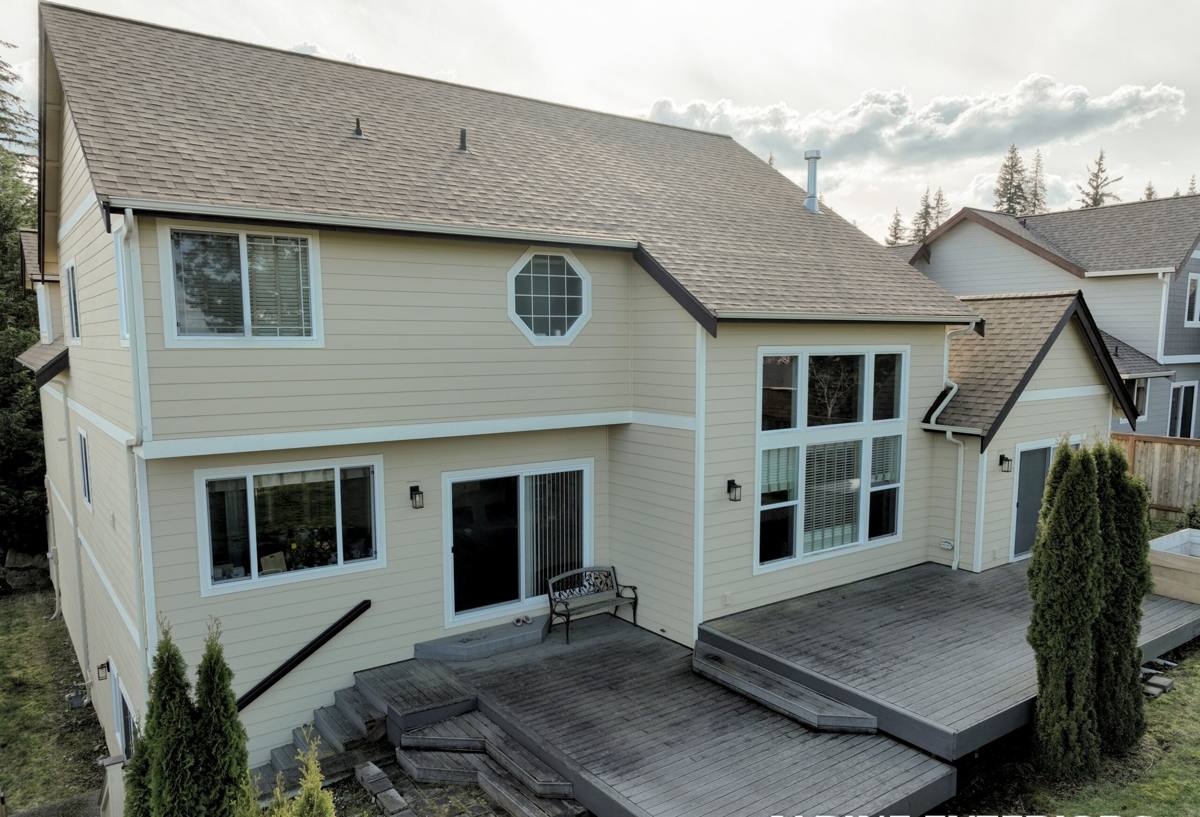
Signs Your Marietta Deck Needs Replacement, Not Just Repair
Not every tired-looking deck needs a full teardown. Sometimes a few boards, a repainted railing, or new fasteners buy several more years. But there's a point where patching becomes a losing game — you're spending money to delay the inevitable rather than to fix the problem. Here's how we tell the difference on a typical visit.
- Soft or spongy spots underfoot, especially near the house or along the perimeter, usually mean rot in the decking or the framing beneath it.
- Rust streaks running down from screws, joist hangers, or ledger bolts point to fastener corrosion, which is common near the water and often more advanced than it looks from the surface.
- A ledger board pulling away from the house, even slightly, is a structural safety issue and not something to leave for "next season."
- Persistent green or black staining that returns within weeks of cleaning tells us the wood has been holding moisture long enough for moss and algae to take root in the grain itself, not just sit on top of it.
- Wobble in the railing posts or stairs, especially after wet weather, often signals post-base rot that isn't visible from above.
- A deck more than 15-20 years old built with older fastening methods or undersized footings for today's code may not be worth chasing repairs on at all.
When we see two or three of these at once, replacement is almost always the more honest recommendation — and the more cost-effective one over a five- or ten-year horizon.
What a Correct Deck Replacement Actually Involves
A deck replacement done right is a structural project, not a cosmetic one. The decking boards on top are what you see, but the work that determines whether the deck lasts happens underneath.
Footings and Posts
In this soil and moisture environment, footings need to be sized and set below frost depth with proper drainage around them, not just poured to the minimum. Post bases should sit clear of standing water and use connectors rated for exterior, corrosion-prone environments — not the general-purpose hardware that's fine for a dry inland lot but starts rusting within a few seasons this close to the bay.
Ledger Attachment
The ledger board — where the deck ties into the house — is the single most common failure point we find on old decks in this area, and it's also the most safety-critical connection on the whole structure. Correct attachment means proper flashing to keep water from tracking behind the ledger and into the house's rim joist, lag bolts or through-bolts sized to code (not just nails), and a gap or flashing detail that lets water drain away instead of pooling against the house.
Framing and Joist Spacing
Joist spacing and beam sizing need to match the decking material you're installing and the loads the deck will actually see — furniture, hot tubs, gatherings. Tighter joist spacing under composite decking, for example, prevents the bounce and long-term sag that shows up a few years in in undersized framing.
Fasteners and Hardware
This is where a lot of corners get cut on budget decks, and it's the corner that costs the most in this climate specifically. We use hot-dip galvanized or stainless connectors and coated or stainless fasteners rated for coastal, high-moisture exposure. Standard electro-galvanized screws and clips look fine going in, but they're often visibly rusting within two or three winters of salt air exposure.
Decking Material Choices for Salt Air and Moss Season
There's no single "best" decking material — there's a best fit for how you use the deck, your maintenance appetite, and your budget. What changes near Semiahmoo Bay is how much each option is stressed by the environment.
| Material | Moisture & Salt Air Behavior | Maintenance | Typical Lifespan Here |
|---|---|---|---|
| Pressure-treated wood | Resists rot reasonably well if sealed and maintained; end grain and cut edges are vulnerable if not re-treated | Annual cleaning, periodic sealing/staining | 10-15 years with upkeep |
| Cedar | Naturally rot- and insect-resistant, but softer and can gray or cup faster under constant damp/moss exposure without upkeep | Regular cleaning, sealing every 1-2 years | 12-18 years with upkeep |
| Composite decking | Doesn't rot; some boards can hold surface moisture longer, which favors algae/moss growth on the surface if not cleaned | Periodic washing; no staining or sealing | 20-30 years, varies by brand and warranty |
| PVC/cellular decking | Fully moisture-resistant, no wood fibers to rot; performs consistently in wet, salt-air conditions | Low — occasional washing | 25+ years, brand-dependent |
We're upfront with homeowners about trade-offs rather than pushing one product. Wood costs less up front and looks great, but it asks for a real annual maintenance commitment in a climate that doesn't give you many fully dry weeks to do that maintenance in. Composite and PVC cost more initially but shift the long-term burden away from sealing and staining — the trade-off there is mainly upfront cost and, on some composite products, staying on top of surface cleaning so moss and algae don't get a foothold in the texture. We'll walk through what fits your budget and how much deck maintenance you actually want to be doing.
Our Deck Replacement Process
We keep the process straightforward because a deck replacement shouldn't feel like a mystery to the homeowner paying for it.
- On-site assessment. We inspect the existing deck's framing, ledger, footings, and hardware — not just the surface boards — to confirm replacement is the right call and to catch any hidden rot or structural issues before we quote.
- Honest scope and options. You get a clear rundown of what's failing, what decking materials fit your budget and maintenance preference, and a straightforward estimate with no vague allowances.
- Permitting. Whatcom County and local jurisdictions require permits for most deck replacements, especially where structural framing or footings are involved. We handle that process so it isn't on you to navigate.
- Demolition and disposal. Full removal of the old structure, checking the rim joist and house connection point for hidden water damage while everything is exposed.
- Rebuild from the ground up. Correctly sized footings, corrosion-rated hardware, proper ledger flashing, and framing matched to your chosen decking material and expected use.
- Decking, railing, and finish work. Installed to the manufacturer's specifications, with attention to drainage and gaps that matter in a climate with this much rainfall.
- Final walkthrough. We go over the finished deck with you, including what maintenance (if any) it needs going forward.
Permits and Code Considerations Near Semiahmoo Bay
Deck replacements that involve structural framing, footings, or a change in size typically require a permit in Whatcom County, and inspections are part of that process. Skipping permitting on a "just replace what's there" job might seem faster, but it leaves you exposed if there's ever an insurance claim, a sale inspection, or a problem down the road — an unpermitted structural deck can become a real headache during a home sale. We pull the appropriate permits and build to current code, including footing depth, guardrail height, and stair requirements, so the deck is documented and defensible, not just built.
Why a Crew That Already Works Marietta Matters
A deck replacement quote from a contractor who's never worked this stretch of coastline can look identical on paper to one from a crew that has — same materials listed, same rough dimensions — and still result in a very different deck five years out. The difference shows up in details that don't make it onto a generic estimate: which hardware grade actually holds up against salt air here, how ledger flashing needs to be detailed for the amount of driving rain this area gets, and which decking products handle a long moss season without turning into a slip hazard by their second winter.
We work on homes throughout Semiahmoo and the surrounding Whatcom County communities, including Marietta, and we bring that specific experience to every deck we quote — not assumptions carried over from drier, inland jobs. That local knowledge is part of what you're paying for, even though it doesn't show up as a line item.
Protecting a New Deck Once It's Built
Whatever material you choose, a little seasonal attention goes a long way in this climate. Here's what we recommend to homeowners after a replacement.
- Clear leaves and debris from between boards and off the surface regularly through fall — trapped organic matter is what feeds moss and holds moisture longest.
- Wash the deck surface at least once or twice a year to knock back algae and moss before it gets a grip, especially on shaded or north-facing sections.
- Check railing posts and stair connections annually for any looseness, particularly after a hard winter.
- If you chose wood, plan on resealing or restaining on the schedule your product calls for — skipping a cycle in this climate shortens lifespan noticeably.
- Keep gutters and downspouts near the deck clear so runoff isn't dumping extra water onto or under the structure.
- Have any soft spots, rust streaks, or new gaps checked promptly rather than waiting for the next scheduled inspection.
Getting an Honest Estimate
Every deck and every property near Semiahmoo Bay is a little different — sun exposure, wind direction, how sheltered or exposed the lot is, and how the existing structure was originally built all factor into what a replacement should look like. We'd rather look at your specific deck than quote off a phone description. If you're seeing soft spots, rust, persistent moss, or just know your deck is past its useful life, we're happy to come take a look and give you a straightforward, no-pressure estimate using the form below.