 Semiahmoo Siding
 Why Windows Take a Beating at Semiahmoo Resort
Homes on the Semiahmoo spit and the surrounding resort community sit about as exposed to the elements as a house in Whatcom County can get. You've got open water on more than one side, wind that funnels down the Strait with nothing to slow it, and a marine layer that keeps everything damp for long stretches of the year. That combination is hard on windows in ways that homes ten miles inland simply don't deal with.
Three things do most of the damage. Salt air corrodes hardware, fasteners, and lower-grade metal components faster than people expect — even components rated for "coastal use" if they're not installed and sealed correctly. Wind-driven rain doesn't just hit glass, it gets pushed sideways into gaps around frames that would stay dry on a calmer site. And our long moss season — reliable rain from fall through spring — keeps north- and shade-facing walls wet long enough for algae and moss to take hold on sills, trim, and cladding if drainage isn't handled right.
None of this means windows can't perform well here. It means the material choices, the glass package, and the installation details all need to account for the site, not just the house.
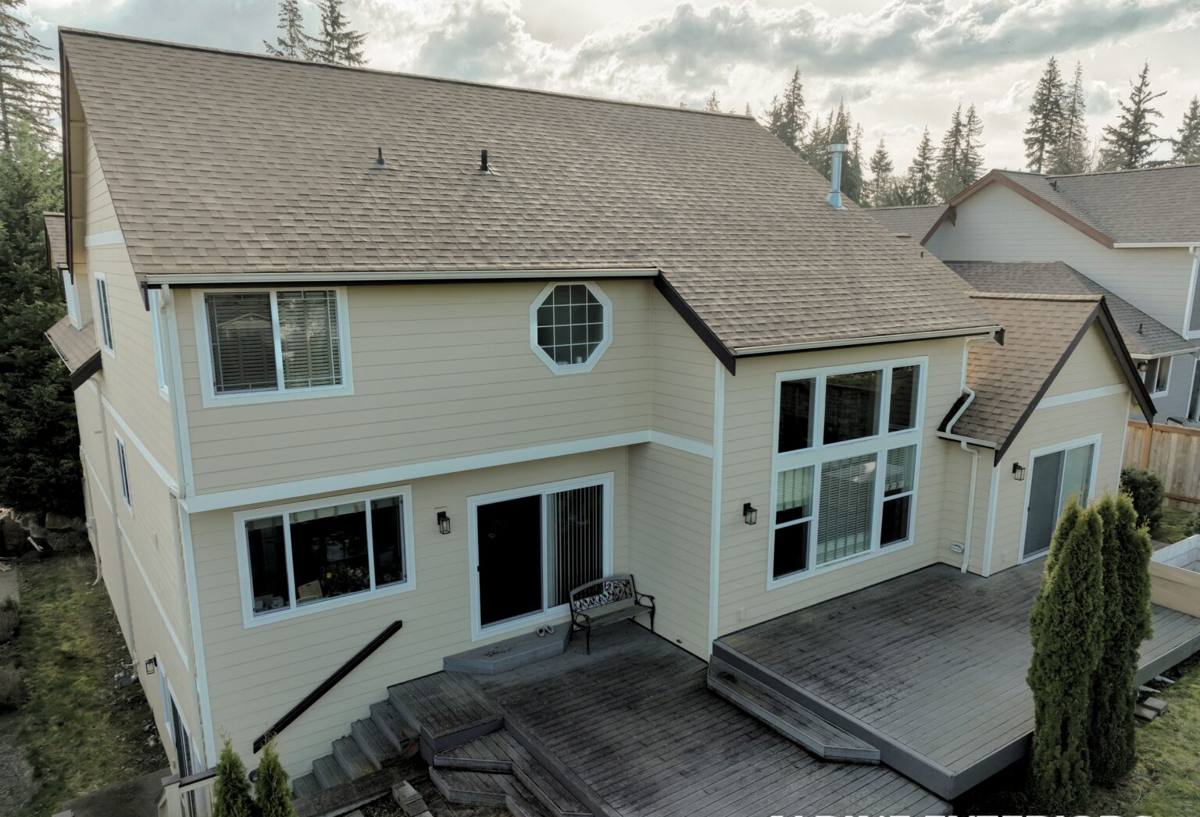
What "Energy-Efficient" Should Actually Mean at This Site
Energy efficiency gets sold as a single number, but at Semiahmoo it's really two separate jobs: keeping conditioned air in, and keeping wind-driven moisture out. A window can have excellent U-factor and SHGC ratings on paper and still underperform if it's not sealed and flashed for a site that takes rain from multiple directions.
The two ratings that matter most here
- U-factor — how well the window resists heat loss. Lower is better for our cool, wet winters. This is the number that most directly affects heating bills.
- SHGC (Solar Heat Gain Coefficient) — how much solar heat passes through the glass. Waterfront homes often get more reflected light off the water, so this matters more here than on a shaded inland lot.
For most Semiahmoo Resort homes, we're looking for a moderate-to-low U-factor paired with an SHGC that's balanced rather than extreme in either direction — you want to hold onto heat in winter without turning a water-facing room into a greenhouse on the clear days we do get.
Frame Material: What Holds Up to Salt Air and What Doesn't
Frame material is where a lot of window jobs succeed or fail long-term in this location. Every material has trade-offs, and honest trade-offs are what we walk homeowners through rather than pushing one product as a cure-all.
| Frame Material | Salt Air / Coastal Behavior | Maintenance |
|---|---|---|
| Vinyl | Good corrosion resistance since there's no bare metal to pit; quality varies a lot by manufacturer | Low — occasional rinse to clear salt residue and grime |
| Fiberglass | Very stable in temperature swings and resists corrosion well; a common upgrade choice for exposed sites | Low — durable finish, minor cleaning |
| Aluminum | Strong but prone to corrosion and pitting near salt water unless it's a marine-grade finish, and it conducts heat/cold | Higher — needs monitoring for finish breakdown over time |
| Wood / wood-clad | Handsome, but bare or poorly maintained wood is the most vulnerable to moisture and rot in this climate | Highest — regular painting/sealing, more failure points at joints |
We don't install bare wood frames on directly exposed elevations at Semiahmoo Resort as a matter of our own standard — not because wood is a bad material everywhere, but because the maintenance burden and moisture risk on an unprotected, water-facing wall here is more than most owners want to sign up for. Vinyl and fiberglass cover the large majority of what we recommend for this site.
Hardware and fasteners
This is the detail that gets skipped by crews unfamiliar with coastal installs. Standard steel screws and hinges corrode fast in salt air, even hidden inside a frame. We spec stainless or coated corrosion-resistant hardware on Semiahmoo Resort jobs so the fasteners don't become the first failure point behind an otherwise good window.
Glass Packages for a Wet, Windy Marine Climate
Whatcom County's marine climate is mild in temperature but relentless in moisture, which changes the glass conversation compared to a colder, drier climate where triple-pane is an easy default.
- Double-pane with a quality low-E coating and argon fill — the workhorse choice for most homes here. It handles our temperature range well and is significantly more affordable than triple-pane, with a solid return on the energy savings.
- Triple-pane — worth considering on rooms with heavy wind exposure, large glass areas facing open water, or where sound reduction from wind and waves is a priority. It adds cost and weight (which affects frame and hardware sizing) for a smaller efficiency gain than the jump from single- to double-pane ever delivered.
- Low-E coating selection — matters more on water-facing glass because of reflected light and heat gain. We match coating type to orientation rather than using one spec on every elevation of the house.
Condensation resistance is also worth a mention: homes that stay closed up through our wet season can develop interior condensation on older, poorly sealed windows. A correctly installed, properly rated window package reduces that, but it works best alongside reasonable ventilation — new windows aren't a substitute for a bathroom fan that actually vents outside.
Installation Details That Matter More Here Than Almost Anywhere Else
A high-end window installed with generic technique will underperform a mid-range window installed correctly for wind-driven rain. This is the part of the job that doesn't show up in a brochure but shows up in five years.
What a correct installation includes
- A sloped sill pan under every unit so any water that does get past the exterior seal drains back out instead of sitting against the framing.
- Proper flashing sequencing — house wrap, flashing tape, and window flange layered so water always sheds downward and outward, never trapped behind a layer.
- Backer rod and exterior-grade sealant rated for UV and salt exposure, not a generic caulk that chalks and cracks within a couple seasons.
- Shimming and squaring so the sash operates smoothly and the seal isn't stressed unevenly by a slightly racked frame.
- Insulation in the gap between frame and rough opening — an often-skipped step that directly affects both energy performance and condensation risk.
On wind-exposed elevations facing the water, we pay particular attention to how the flashing integrates with the existing siding or trim, since that's usually where driving rain finds a way in on older installations.
Our Process, Start to Finish
- On-site assessment — we look at each elevation's exposure separately, since a wall facing open water needs different attention than a sheltered side yard.
- Product recommendation — we walk through frame material, glass package, and cost trade-offs specific to what we found, not a one-size answer.
- Written estimate — clear scope, materials, and pricing before any work starts.
- Removal and prep — old units come out, rough openings get inspected for hidden rot or water damage before anything new goes in.
- Installation — sill pan, flashing, insulation, and sealant sequence as described above, on every unit, every time.
- Final check — operation, seal, and cleanup review with the homeowner before we consider the job done.
What Windows Cost to Replace Here — and What Actually Drives the Price
We won't quote a number without seeing the house, but the factors that move price at Semiahmoo Resort specifically are worth knowing up front.
| Cost Factor | Why It Matters at This Site |
|---|---|
| Frame material | Fiberglass generally costs more than vinyl upfront but needs less long-term maintenance in salt air |
| Glass package | Triple-pane and specialty coatings add cost; often only worth it on the most exposed, water-facing rooms |
| Elevation exposure | Wind- and water-facing sides may need extra flashing detail and labor time compared to sheltered sides |
| Rough opening condition | Hidden rot or water damage found during removal — common on older coastal homes — adds repair scope |
| Number and size of openings | Large view windows toward the water cost more per unit and may need reinforced framing |
Living With Windows in a Moss-Prone, Salt-Air Environment
Even a well-installed window benefits from a little upkeep in this climate. A short seasonal routine keeps the system — glass, frame, seals, and drainage — working the way it's supposed to.
- Rinse frames and glass periodically to clear salt residue, especially on directly water-facing elevations.
- Keep weep holes at the base of the frame clear of debris, moss, and dirt so water can drain out instead of backing up.
- Check exterior caulking annually for cracking or gaps, particularly after a hard winter of wind and rain.
- Trim back vegetation or clean shaded sills that stay damp long enough for moss and algae to establish.
- Test operation of moving sashes each season — hardware that's starting to bind or stick is often the first sign of a developing issue, not just an inconvenience.
Why It Matters That We Already Work This Neighborhood
Semiahmoo Resort isn't a typical Whatcom County lot. A crew that mostly installs windows on sheltered, inland homes and treats this job the same way is going to miss things — the flashing sequence that matters more here, the hardware spec that avoids early corrosion, the sill pan detail that keeps driving rain from becoming a hidden leak two years later. We've done the work of understanding what this specific exposure demands, and we build every installation around it rather than a generic checklist.
If you're weighing whether it's time to replace windows on a Semiahmoo Resort home, we're happy to take a look and walk you through what we're seeing — no pressure, no obligation. Reach out for a free estimate using the form below.