 Semiahmoo Siding
 Fiber Cement Siding for a Whatcom County Peninsula That Sits Apart
Point Roberts occupies a strange spot on the map: a small peninsula that's part of Washington and Whatcom County, but cut off from the rest of the state by water and by Canada. Reaching it from anywhere else in the U.S. means crossing into British Columbia and back across the border again, since there's no direct American road connection. That isolation shapes more than grocery runs and mail delivery — it also means the peninsula sits fully exposed to marine weather coming off Boundary Bay and the Strait of Georgia, with very little terrain or development between the open water and the houses to slow it down.
We're based in Semiahmoo, and Point Roberts is regular territory for our crew, border crossing included. On siding, we install James Hardie fiber cement exclusively — a professional standard we hold to everywhere we work, and one that matters even more on a peninsula this exposed to salt air, driving rain, and a moss season that barely lets up. This page covers what a Point Roberts home actually needs from its siding, what a correct installation involves, and why a crew that already works this stretch of Whatcom County is worth choosing over one that doesn't.
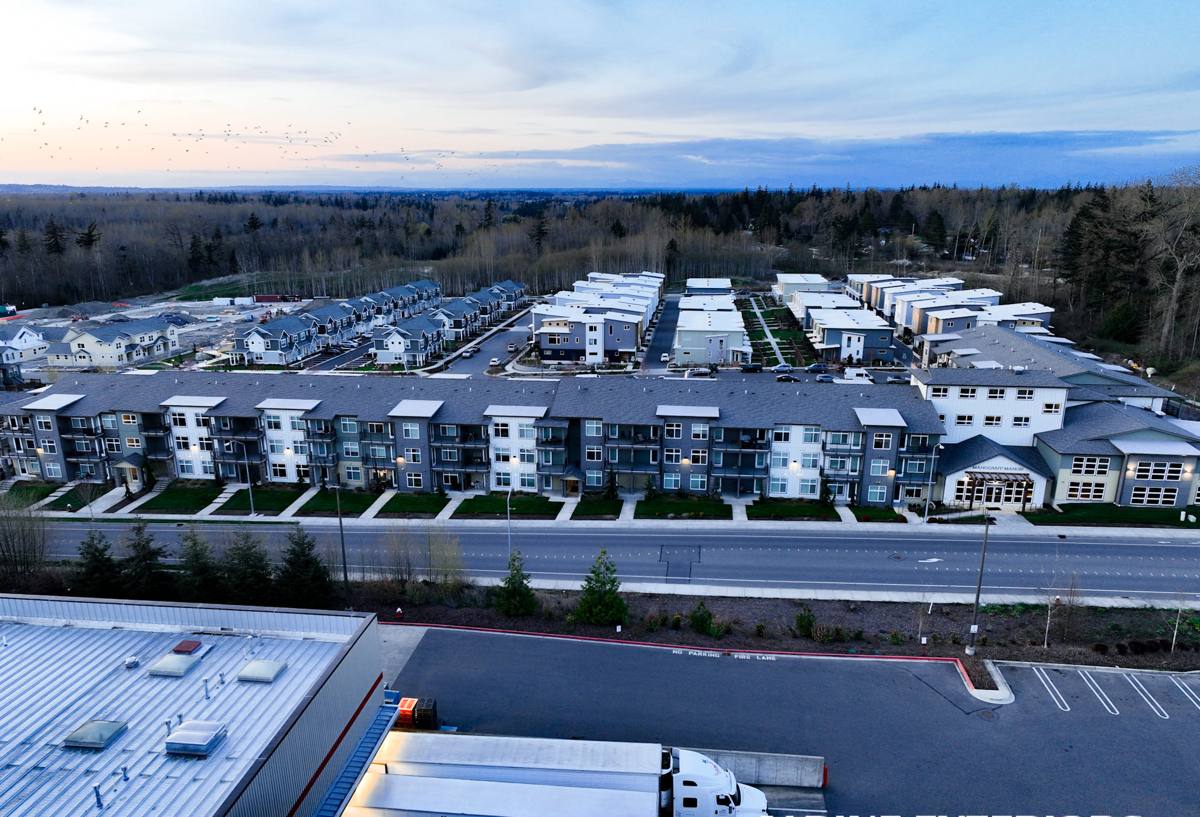
What Point Roberts' Climate Does to Siding
Salt Air From Nearly Every Direction
Most Whatcom County towns face salt air from one side — off a bay, a harbor, a stretch of shoreline. Point Roberts is a peninsula with water on three sides, so homes here take salt-laden air more consistently and from more angles than houses set further inland or tucked behind higher ground. Salt accelerates corrosion in fasteners, flashing, and any exposed metal trim, and it wears down lower-grade paints and coatings faster than they'd fail in a drier climate. On a site this exposed, material and hardware choices carry more weight than they would somewhere more sheltered.
Driving Rain With Nothing to Break It Up
Storms moving through the Strait of Georgia and Boundary Bay reach Point Roberts with little higher terrain or dense development to slow wind and rain before they hit a house. That means driving rain gets pushed sideways into wall assemblies, window flashing, and roof-to-wall transitions harder and more often than it would somewhere more sheltered. Sideways-driven moisture is exactly the kind that finds gaps a careless installation leaves behind, and on an open peninsula, there are simply more days a year when conditions push water where it isn't supposed to go.
A Moss Season That Rarely Fully Stops
Mild temperatures and near-constant moisture give moss a long growing season across Whatcom County, and Point Roberts' marine exposure keeps humidity high enough that shaded or north-facing walls rarely get a real dry stretch. Any siding material with even a little surface porosity becomes a foothold for moss and mildew over time, and once it takes hold on a wall that stays damp, it comes back faster than routine washing can keep up with.
Why James Hardie Is the Only Siding We Install Here
We didn't start out installing only one siding product. The decision came from what we found doing service calls and tear-offs on coastal, high-moisture properties across the county, Point Roberts included — not from a supplier relationship or a sales angle.
- Non-combustible core: Fiber cement doesn't feed a fire the way wood-based siding products can, which matters for both safety and insurance considerations.
- Factory-applied ColorPlus finish: The color is baked on under controlled factory conditions instead of brushed on in the field, so it holds up longer against fading, chalking, and the kind of constant moisture exposure a peninsula like this sees.
- Climate-engineered HZ5 formulation: Hardie's HZ5 product line is built for regions with sustained moisture and freeze-thaw cycling, which describes coastal Whatcom County — and Point Roberts specifically — well.
- Dimensional stability: Fiber cement doesn't swell, cup, or warp the way engineered wood products can after repeated wetting on an exposed site.
- Strong transferable warranty: Hardie backs the product with one of the stronger warranty structures in the industry, provided installation follows their spec — which matters on second homes and rental properties that change hands more often than a typical primary residence.
We won't install LP SmartSide, vinyl siding, Cemplank, Allura, primed spruce, or cedar. Each has a place in the market, and plenty of homeowners are satisfied with them in milder settings. But on a peninsula that takes salt air and driving rain from nearly every direction, we've made a professional call to install one system we fully stand behind rather than offer something cheaper that quietly shifts maintenance risk onto the homeowner over time.
What a Correct Installation Involves on a Point Roberts Home
Hardie siding performs the way it's engineered to only when the installation follows spec, and on an exposed peninsula like this, the details matter more than they would in a calmer inland setting. A few of the basics we won't skip:
- Rain screen gap: A small drainage cavity behind the siding lets any moisture that gets past the exterior surface drain and evaporate instead of sitting against the wall sheathing.
- Correct fastener type and spacing: Hardie specifies corrosion-resistant fastener types and placement for a reason; loose spacing or the wrong fastener is one of the more common causes of early siding failure we find on tear-offs in salt-air locations.
- Properly lapped house wrap and flashing: Every seam and penetration needs to shed water downward and outward, especially on walls that catch wind-driven rain with no terrain to soften it first.
- Sealed butt joints and trim transitions: Open or poorly sealed joints are where salt-laden moisture finds its way behind the siding first, and on a fully exposed site that happens faster than it would somewhere sheltered.
- Careful corner and penetration detailing: Every outlet, vent, and fixture through the siding is a place water can get behind the wall if it isn't flashed and sealed correctly the first time.
None of this is exotic. It's the manufacturer's own installation spec, followed consistently rather than shortcut on the parts that are hardest to see once the job wraps up.
Choosing the Right Hardie Product Line
James Hardie makes several siding profiles, and the right one for a Point Roberts home usually comes down to the style of the house and how much of the peninsula's weather a given wall actually takes on.
| Product Line | Look | Best Suited For |
|---|---|---|
| HardiePlank lap siding | Traditional horizontal lap, smooth or woodgrain texture | Most home styles; the most common choice across the county |
| HardiePanel vertical siding | Clean vertical lines, often paired with batten strips | Modern or board-and-batten style homes |
| HardieShingle | Staggered or straight-edge shingle profile | Craftsman or cottage-style homes wanting a shingle look without cedar's upkeep |
| HardieTrim boards | Smooth trim for corners, fascia, and window surrounds | Finishing detail on any of the above, matched or contrasted with the field color |
ColorPlus finishes come in a range of colors developed to hold up under real weather rather than fade quickly, and most homeowners on the peninsula lean toward tones that read well against the gray, marine-influenced light common here — deeper grays, muted blues and greens, and warm neutrals all show up often. Field-painted color is also available for homeowners who want a shade outside the ColorPlus lineup, though it won't carry the same factory finish warranty.
Cost Factors for Fiber Cement Siding in Point Roberts
| Factor | What Drives It | Point Roberts Consideration |
|---|---|---|
| Home size & layout | Total wall area, number of stories, roofline complexity | Same drivers as anywhere else in the county |
| Tear-off vs. overlay | Whether old siding and any water-damaged sheathing needs removal first | More common here given the peninsula's sustained moisture exposure over time |
| Trim & detail work | Corner boards, window and door trim, accent siding profiles | Adds labor time but also adds to how well the house sheds wind-driven rain |
| Material & crew logistics | Scheduling deliveries and crew travel | Requires routing materials and crew through the border, which not every contractor is set up to do efficiently |
These are general drivers, not a quote. Every home on the peninsula sits at a slightly different distance from open water and under different tree cover, so we walk the property before putting a real number on the work — and on a job here, that visit also means confirming the delivery and crew schedule works around the crossing.
Why the Border Crossing Matters for Your Project
Point Roberts is part of Washington, but reaching it means crossing into Canada and back — there's no direct U.S. road connection. That single fact keeps a number of contractors from taking on regular work here. It complicates material deliveries, adds time to every crew trip, and means a contractor unfamiliar with the crossing can end up costing a homeowner real project delays without ever meaning to.
Working this peninsula regularly means we've already worked out the parts that trip up a first-timer: how to time material orders so a truckload of siding isn't sitting at the border longer than it needs to, how to schedule crew days so wait times don't eat into the workday, and what timing considerations come up around larger deliveries. None of that shows up in a sales pitch, but it shows up in whether a project stays on schedule once work actually starts.
A number of homes on the peninsula are seasonal or part-time residences, which adds another layer: coordinating around an owner who isn't on-site full time, and being someone that owner can trust to manage a project and communicate clearly without daily in-person check-ins. That's a different working relationship than a typical full-time-resident job, and it's one we're used to.
Signs a Point Roberts Home Needs Attention
- Moss or dark staining on siding that returns quickly after cleaning
- Soft or spongy siding, especially low on the wall or around window trim
- Rust staining or visibly corroded fasteners and trim
- Peeling paint or warping on shaded, north-facing walls
- Gaps opening up at butt joints, corners, or trim transitions
- Water staining on interior walls near exterior corners — a sign moisture has already gotten behind the siding
How Our Process Works for a Point Roberts Project
We start with a site visit to look at the home's actual exposure — how much open water it faces, tree cover, existing siding condition, and any signs moisture has already gotten behind the wall. From there we go over product line and color options and put together a scope that accounts for tear-off needs if the old siding or sheathing underneath needs replacing rather than just covering over.
Once a project is scheduled, we plan material delivery and crew days around the border crossing up front, rather than treating it as a surprise mid-project. Installation follows Hardie's spec from the framing out — rain screen, flashing, fastening, and sealed joints — the same standard we hold to everywhere we work, adjusted for how much weather a given wall on the property actually takes. We finish with a walkthrough covering what the finished siding needs from the homeowner going forward, which for correctly installed Hardie siding is minimal.
If your Point Roberts home needs new siding, or you'd like a straight answer about whether your current siding is holding up the way it should, we're glad to take a look. Reach out using the form below to schedule a free, no-pressure estimate — we already make the trip out to the peninsula regularly, so getting a crew out to look at your home isn't a hurdle.