 Semiahmoo Siding
 Why Roofs in Lynden Wear on Their Own Schedule
Lynden sits inland from the water, but the weather that moves through Whatcom County doesn't stop at the coastline. The same Pacific systems that soak Semiahmoo and the rest of the county push damp, marine-influenced air across the farmland and residential streets around Lynden for months at a time. Add heavy tree cover on many older lots, long stretches of overcast days, and a rainy season that can run from fall into spring, and you get a roof that ages differently than one in a drier climate. A roof replacement here isn't just about swapping old shingles for new ones — it's about building a system that can shed water fast, resist moss, and hold up to fasteners and flashing slowly working loose from years of damp-dry cycling.
Salt Air Reaches Farther Than People Expect
Homes right on the water deal with direct salt spray, but Whatcom County's marine air carries fine salt content well inland on strong weather systems, especially during fall and winter storms. On a roof, that shows up less as visible corrosion and more as accelerated wear on exposed metal — nail heads, flashing edges, and vent stacks — years before a homeowner would otherwise expect it. It's a slow effect, but it's real, and it's one more reason to spec better metal and fastener quality than a big-box minimum.
Driving Rain Finds Every Weak Point
Wind-driven rain in this part of Washington doesn't just fall straight down — it gets pushed sideways under eaves, into valleys, and around chimneys and skylights. A roof that's only "good enough" in calm weather will leak the first time a real system rolls through. Correct flashing detail and underlayment matter more here than in milder climates.
Moss Season Runs Long
Shaded roof planes, north-facing slopes, and lots with mature trees hold moisture longer, and moss doesn't need much encouragement to take hold. Once it does, it lifts shingle edges, holds water against the roof deck, and shortens the life of even a well-installed roof. Any replacement plan for a Lynden home should account for moss from day one, not treat it as an afterthought once it's already a problem.
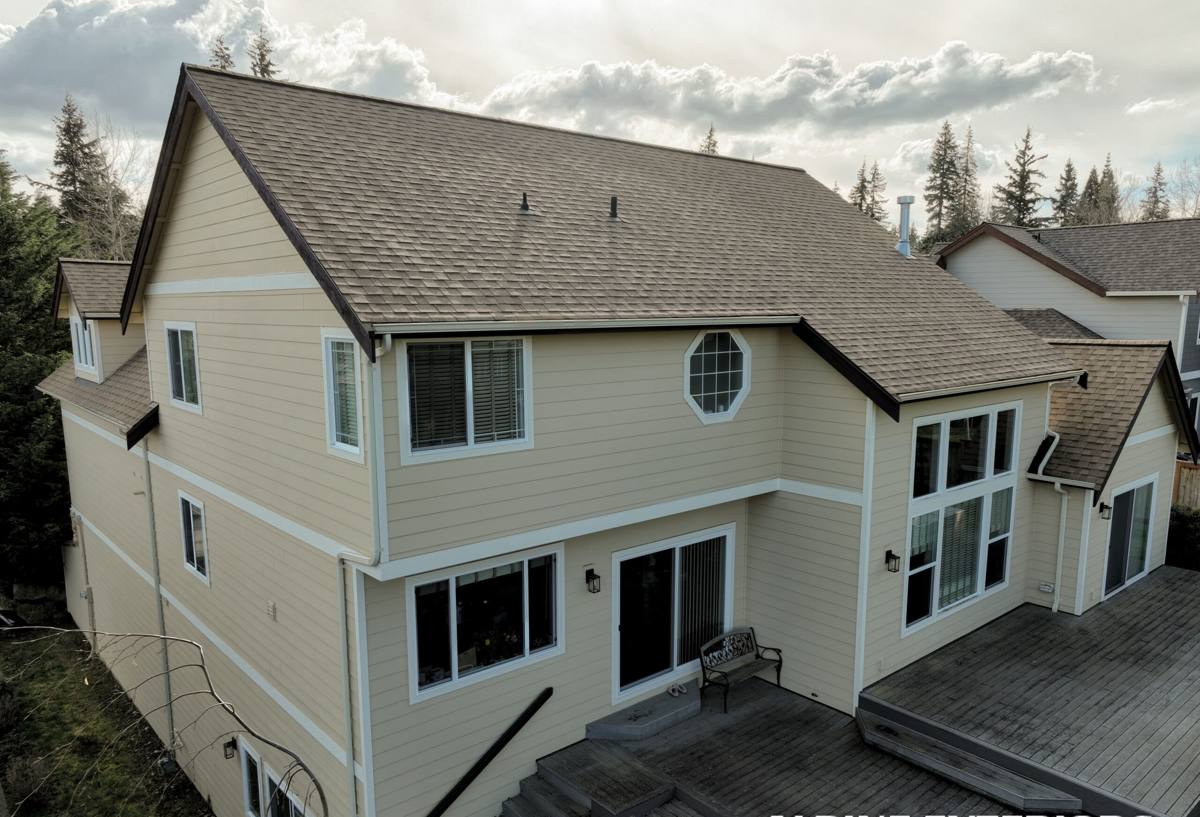
Signs a Lynden Roof Needs Replacement, Not Just Repair
Not every roof problem calls for a full replacement. But there's a point where patching becomes a way of spending money without solving anything. Some of the clearer signals we look for:
- Granule loss heavy enough that shingles look bald or the gutters are consistently full of grit
- Shingles that are cupping, curling, or cracking across multiple roof planes, not just one isolated spot
- Soft or spongy decking felt underfoot during an inspection, which usually means moisture has already gotten in
- Persistent moss or algae staining that keeps coming back after cleaning
- Daylight visible through the roof deck from inside the attic
- A roof that's already had multiple patch repairs in the same area over a few years
- Flashing around chimneys, skylights, or vent stacks that's rusted, lifted, or was never sealed correctly to begin with
- A roof approaching or past the manufacturer's expected service life for its material and local exposure
If a roof is showing one or two of these on an otherwise sound structure, targeted repair can still make sense. When several show up together, replacement is usually the more honest recommendation, since repeated repairs on a failing roof rarely pencil out over time.
What a Correct Roof Replacement Actually Involves
A roof replacement is more than removing old material and nailing down new shingles. Done right, it's a layered system, and skipping steps is exactly how a new-looking roof ends up leaking within a few years.
Tear-Off and Deck Inspection
We remove the existing roofing down to bare decking rather than layering over it. That's the only way to actually see the condition of the plywood or plank decking underneath. Any soft, delaminated, or water-damaged sections get cut out and replaced before anything new goes down — a step that's easy to skip and impossible to catch later once the roof is closed up.
Underlayment and Moisture Barriers
Given the amount of driving rain the region sees, underlayment choice matters. Self-adhered ice-and-water membrane goes in along eaves, valleys, and around penetrations — the spots most likely to see wind-driven water get forced up under the shingle line. The rest of the deck gets a synthetic underlayment layer that resists tearing during install and holds up better than old-style felt paper if weather delays the job partway through.
Flashing Details
Flashing is where most roof leaks actually originate, not in the field of the shingles themselves. Step flashing at walls, counterflashing at chimneys, and proper valley metal all get installed or replaced as part of the job, not just re-sealed with roofing cement over whatever was there before.
Ventilation
An under-ventilated attic traps moisture, which speeds up deck rot from the inside and can encourage moss growth from underneath as well as above. We check intake at the soffits and exhaust at the ridge or roof vents, and correct the balance where it's off — a detail that gets overlooked constantly on quick re-roof jobs.
Choosing a Roofing Material for This Climate
There's no single "best" roofing material — the right choice depends on the home, the budget, and how much of the moss-and-moisture problem the homeowner wants to actively manage versus build out of the equation. Here's how the common options stack up for a Lynden-area roof specifically:
| Material | Moss Resistance | Wind/Rain Performance | Typical Lifespan Here |
|---|---|---|---|
| Standard 3-tab asphalt | Low — needs regular cleaning | Adequate if installed correctly | 15–20 years |
| Architectural (dimensional) asphalt | Moderate | Good, better wind rating | 20–30 years |
| Algae-resistant (copper/zinc-granule) asphalt | Higher, granules actively discourage growth | Good | 20–30 years |
| Standing seam metal | High — little for moss to grip | Excellent, sheds water fast | 40–50+ years |
| Synthetic/composite shake or slate | Moderate to high | Good | 30–50 years |
Metal roofing tends to perform best against moss simply because there's little for it to take hold on, and it sheds driving rain efficiently. It costs more upfront and has its own installation sensitivities around fastener type and thermal movement, so it's not automatically the right call for every home. Algae-resistant asphalt shingles are a reasonable middle ground for homeowners who want better moss resistance without the jump to metal pricing. We'll walk through the real trade-offs for your specific roof rather than push one product across the board.
What Actually Drives the Cost of a Roof Replacement
Broad ranges only, since every roof is different, but the factors that move the number the most are consistent:
| Factor | Why It Matters |
|---|---|
| Roof size and pitch | Steeper roofs take longer, need more safety setup, and use more material per square |
| Number of existing layers | Tearing off two layers of old shingles takes more labor and disposal cost than one |
| Decking condition | Rot or soft sheathing found during tear-off means plywood replacement, which isn't knowable until the old roof is off |
| Material selection | Standard asphalt, algae-resistant asphalt, and metal sit at very different price points per square |
| Roof complexity | Valleys, dormers, skylights, and multiple penetrations all add flashing labor |
| Ventilation upgrades | Adding or correcting intake/exhaust venting is a smaller add-on cost that pays for itself in roof life |
We give a written estimate that spells out scope and material, not just a bottom-line number, so there's no guessing at what's actually included.
How Our Roof Replacement Process Works
- Inspection and estimate — we get on the roof (or in the attic, weather and access permitting) to assess decking, flashing, and ventilation before quoting, not after the contract is signed
- Material selection — we walk through the realistic options for the home and budget, including trade-offs, not just the highest-margin product
- Scheduling around weather — given how much of the year sees active rain here, we plan tear-off days around forecasts and stage material to minimize how long a roof sits open
- Tear-off and deck repair — full removal down to the deck, with any damaged sheathing replaced and documented, not covered over
- Underlayment, flashing, and roofing installation — installed in the sequence and detail described above, not shortcut to save a day
- Ventilation check — intake and exhaust balance confirmed or corrected as part of the same job
- Cleanup and magnetic nail sweep — yard, driveway, and landscaping cleared of debris and stray fasteners
- Final walkthrough — we go over the finished roof and warranty paperwork together before calling the job done
Keeping Moss From Taking Over After the New Roof Is On
A new roof still needs some basic upkeep in this climate, especially on shaded lots. None of this is complicated, but skipping it shortens the life of even a well-installed roof:
- Keep gutters clear so water isn't backing up under the eaves during heavy rain
- Trim back overhanging branches where practical to cut down on shade and debris buildup
- Rinse or treat moss-prone areas before it gets established rather than after it's visibly spread
- Have the roof looked at every couple of years, particularly after a rough winter
- Address any small flashing or sealant issues early, before a minor gap becomes a deck-level leak
Why It Matters to Hire a Crew That Already Works in Lynden
Roofing crews who work regularly across Whatcom County build a working knowledge of how homes in this specific area actually fail — which roof orientations hold moss the longest, which older neighborhoods tend to have thinner original decking, and how local permitting and inspection processes typically run. That's different from a crew that's used to a drier climate showing up to quote a job the same way they would anywhere else. It also means faster response if a problem shows up after the job's done, since we're not driving in from out of the area to deal with it. For a homeowner, that local familiarity translates into fewer surprises during the job and a roof that's actually specified for the weather it has to survive, not a generic install.
If your roof is showing its age or you just want an honest read on whether repair or replacement makes more sense, we're happy to take a look. Reach out below for a free, no-pressure estimate — we'll tell you what we actually see, not just what's easiest to sell.