 Semiahmoo Siding
 Why Point Roberts Wears Out Siding Faster Than Most Homes
Point Roberts sits on a small peninsula exposed to open water on more than one side, which means homes here take a steadier beating than siding was ever designed to absorb. Salt-laden air corrodes fasteners, breaks down caulking, and chalks out cheaper paint finishes years before their time. Driving rain off the water doesn't just wet the surface of a wall — wind pressure drives it sideways and upward, finding every seam, lap joint, and penetration that wasn't flashed correctly the first time. And because so many lots here carry mature tree cover and shaded north walls, moss and algae get a long, uninterrupted growing season to work into siding joints and hold moisture against the wall long after a storm has passed.
None of this is unique to any one house — it's the baseline condition for siding anywhere on this stretch of Whatcom County coastline. What it means practically is that a siding system built for a drier, inland climate simply won't hold up here the way it would somewhere else in the state.
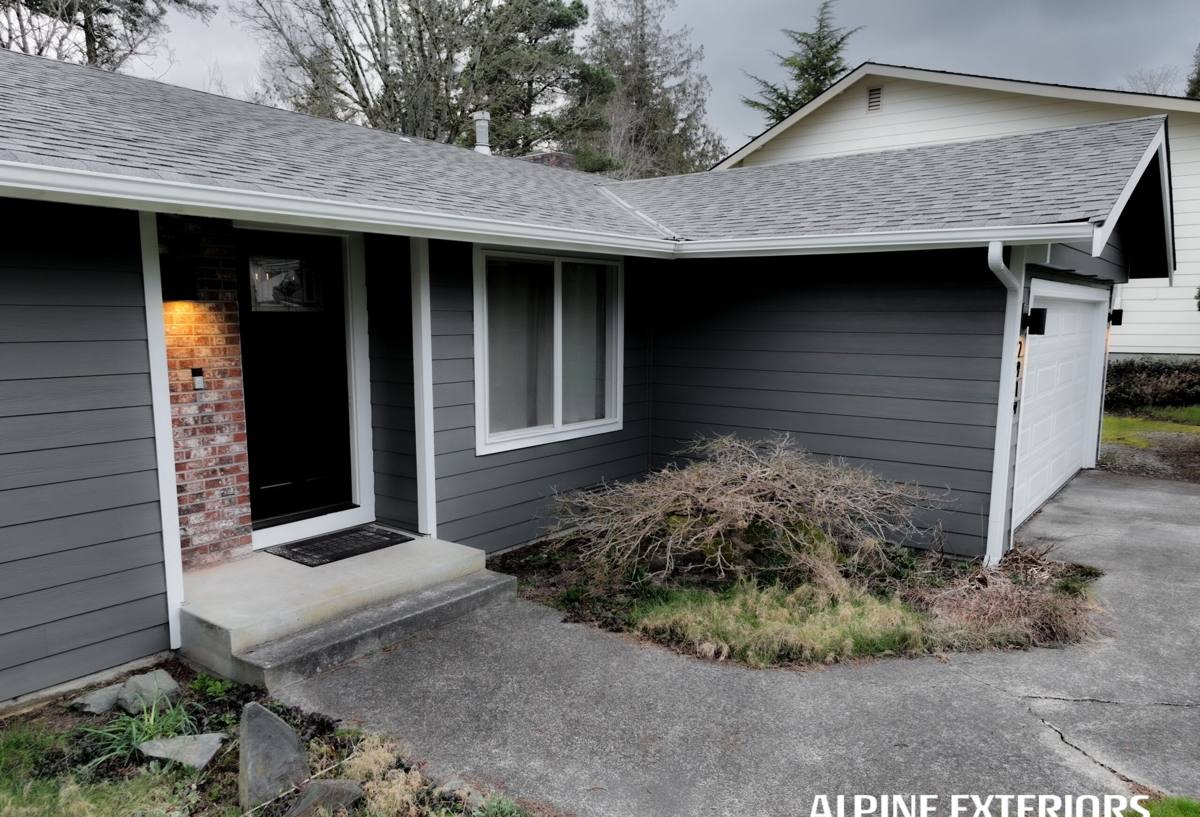
What a Correct Siding Replacement Actually Involves
Replacing siding is not just pulling off old boards and nailing up new ones. In a climate like this, the parts you don't see after the job is done matter more than the parts you do.
Water-resistive barrier and flashing
Every wall gets a continuous water-resistive barrier behind the siding, lapped correctly from bottom to top so water sheds outward instead of working its way in. Windows, doors, and any wall penetration get properly integrated flashing — this is the single most common failure point we find when we tear off old siding on homes exposed to wind-driven rain. Skipping or shortcutting flashing is invisible on install day and expensive five years later.
Fastening for wind and moisture cycling
Fasteners have to be corrosion-resistant and driven to the manufacturer's spec — not too deep, not too shallow — so the siding can expand and contract with moisture and temperature without cracking or popping loose. In salt air, the wrong fastener can start rusting and staining the face of the siding within a couple of seasons.
Proper clearances and drainage
Siding needs a gap at grade, at decks, and at roof lines so water has somewhere to go instead of wicking up into the bottom edge of the material. This is one of the most commonly ignored details on older installs and a major reason siding rots from the bottom up.
Signs Your Siding Has Reached the End of Its Service Life
- Soft or spongy spots when you press on the siding, especially near the bottom courses or under windows
- Paint that's peeling, bubbling, or needs repainting more often than it used to
- Persistent moss or algae staining that comes back within a season of cleaning
- Visible warping, cupping, or gaps opening up at seams and corners
- Rust streaking below fasteners or trim hardware
- Rising energy bills with no other explanation — a sign the wall assembly behind the siding is no longer doing its job
- Interior signs like musty smells, peeling interior paint, or damp drywall on exterior walls
Material Performance in a Salt-Air, High-Moss Climate
Not every siding material handles this environment the same way. Here's how the common options actually perform under sustained salt exposure, wind-driven rain, and moss pressure:
| Material | Salt air / corrosion resistance | Moisture behavior | Moss and algae resistance |
|---|---|---|---|
| Vinyl siding | Doesn't corrode, but can warp, fade, and become brittle | Not water-permeable itself, but seams and J-channels can trap moisture behind panels | Moss and algae readily attach to the surface texture |
| Cedar / wood siding | No metal corrosion issue, but the wood itself weathers and checks | Absorbs moisture; prone to rot without diligent maintenance | Highly susceptible without regular treatment |
| Primed spruce / engineered wood panels | Fasteners can corrode; panel edges are moisture-sensitive | Edge swelling is a known failure mode if the factory seal is compromised | Moderate to high, depending on finish maintenance |
| James Hardie fiber cement | Non-combustible, dimensionally stable material; correct fasteners resist corrosion | Engineered specifically for moisture-prone climates in the HZ10 product line | ColorPlus factory finish resists moss adhesion better than bare or field-painted surfaces |
Why We Install Only James Hardie Fiber Cement
We made the decision years ago to standardize on James Hardie and stop installing everything else — not because every alternative is worthless, but because we got tired of doing the same repairs and replacements on the same failure points, over and over, on homes exposed to exactly the conditions Point Roberts sees every year. Vinyl handles rain fine but shows every flaw in a straight, low-glare coastal light and doesn't hold up structurally to wind the way a heavier material does. Cedar looks great on day one but demands a maintenance schedule most homeowners don't keep up with once the novelty wears off. Primed spruce and similar engineered panels are sensitive to any break in the factory seal, and a break is exactly what driving rain and freeze-thaw cycling are good at finding.
Hardie's fiber cement is non-combustible, doesn't feed moss the way some surfaces do, and the ColorPlus factory finish is baked on under controlled conditions rather than applied on site — which matters a lot in a climate where a field-applied finish gets tested by weather within days of going up. The HZ10 engineering variant is built specifically for moisture-heavy climates like ours, and the warranty backing it is transferable, which matters if you ever sell. We're not going to tell you every other product is garbage. We are going to tell you that after years of tear-offs, this is the one we're willing to put our name behind on a Point Roberts wall.
Our Point Roberts Siding Replacement Process
- On-site assessment of your current siding, wall assembly, and any moisture or rot damage already present
- Written estimate covering material, labor, disposal, and any repair work the tear-off reveals
- Material ordering and scheduling, timed around weather windows and border logistics (more on that below)
- Full tear-off, with inspection of sheathing and framing before anything new goes up
- Water-resistive barrier installation and flashing at every window, door, and penetration
- James Hardie panel or lap installation to manufacturer fastening spec
- Final walkthrough and cleanup, including haul-away of old material and job-site debris
What It Costs and What Moves the Number
Every home is different, but the same handful of factors drive most of the variation we see in Point Roberts estimates:
| Factor | Why it matters |
|---|---|
| Home size and wall complexity | More corners, dormers, and trim details mean more labor and material waste |
| Condition of existing sheathing | Rot found during tear-off has to be repaired before new siding goes on, which adds cost but is not optional |
| Siding profile and accessories | Lap siding, panel siding, trim boards, and soffit work are priced differently |
| Access and staging | Tight lots, water-side elevations, and limited equipment access can add labor time |
| Scheduling window | Material delivery and crew logistics for Point Roberts take more lead time than a mainland job, which we build into the schedule up front |
Why It Matters That Your Crew Already Works in Point Roberts
Point Roberts is a U.S. exclave — the only way to drive here is through Canada, and that single fact changes how a siding project actually runs. Material deliveries, dump trailers, and crew scheduling all have to account for a border crossing that a mainland Whatcom County job never has to think about. A contractor who hasn't done this before will either underestimate the lead time or pass the friction on to you in the form of delays. We've built our scheduling and supply routines around this reality because we work this area regularly, not as an occasional trip.
There's a second, quieter reason it matters: a lot of homes out here are used seasonally, which means a slow leak or a failing seam can go unnoticed for months between visits. A crew that knows the area tends to catch those problems earlier, because we've seen how quickly moisture damage compounds on a home that isn't occupied every day.
Maintaining New Siding Through the Wet Season
Even the right material benefits from basic upkeep. A yearly rinse-down helps keep salt residue and early moss growth from building up, especially on shaded or north-facing walls. Keep gutters clear so water isn't sheeting down the face of the siding, and trim back vegetation that's holding moisture against the wall. Walk the exterior once a year and look at caulking around windows and trim — it's the first thing to fail and the cheapest thing to catch early. None of this is heavy maintenance; it's the kind of five-minute check that keeps a correctly installed system performing the way it's supposed to for decades.
If your siding is showing its age, or you just want an honest read on how many years it's got left, we'll come take a look and give you a straightforward, no-pressure estimate — no hard sell, just what we'd actually recommend for your home.