 Semiahmoo Siding
 Blaine Harbor's Climate Puts Real Demands on Siding
Blaine Harbor sits right where Semiahmoo Bay meets the rest of Whatcom County's marine climate, and that location shapes what a house needs from its exterior. Homes here don't just deal with rain — they deal with salt-laden air off the water, wind-driven rain that hits walls sideways instead of falling straight down, and a moss and lichen season that can run most of the year on shaded, north-facing elevations. Siding that would hold up fine forty miles inland can fail early here if it wasn't chosen and installed with this specific exposure in mind.
Salt Air and Corrosion
Airborne salt from the harbor settles on siding, trim, and especially fasteners. Over years, that accelerates corrosion in anything not rated for coastal exposure — cheap staples, exposed nail heads, and unprotected metal flashing are usually the first things to show it. It also breaks down certain paint films and finishes faster than a standard inland forecast would predict.
Driving Rain Off the Water
Wind off Semiahmoo Bay doesn't just bring rain — it drives it horizontally into wall assemblies, into laps, and into any gap around trim or penetrations. A siding system depends on the water-resistive barrier and flashing behind it as much as the visible cladding itself, and Blaine Harbor's wind exposure asks more of that hidden layer than a sheltered inland lot would.
A Long Moss Season
Shaded walls, roof overhangs with limited sun, and the Pacific Northwest's long wet season combine to make moss and algae growth a near year-round concern rather than a seasonal one. Siding material, surface texture, and even color choice all affect how much moss takes hold and how easily it washes off.
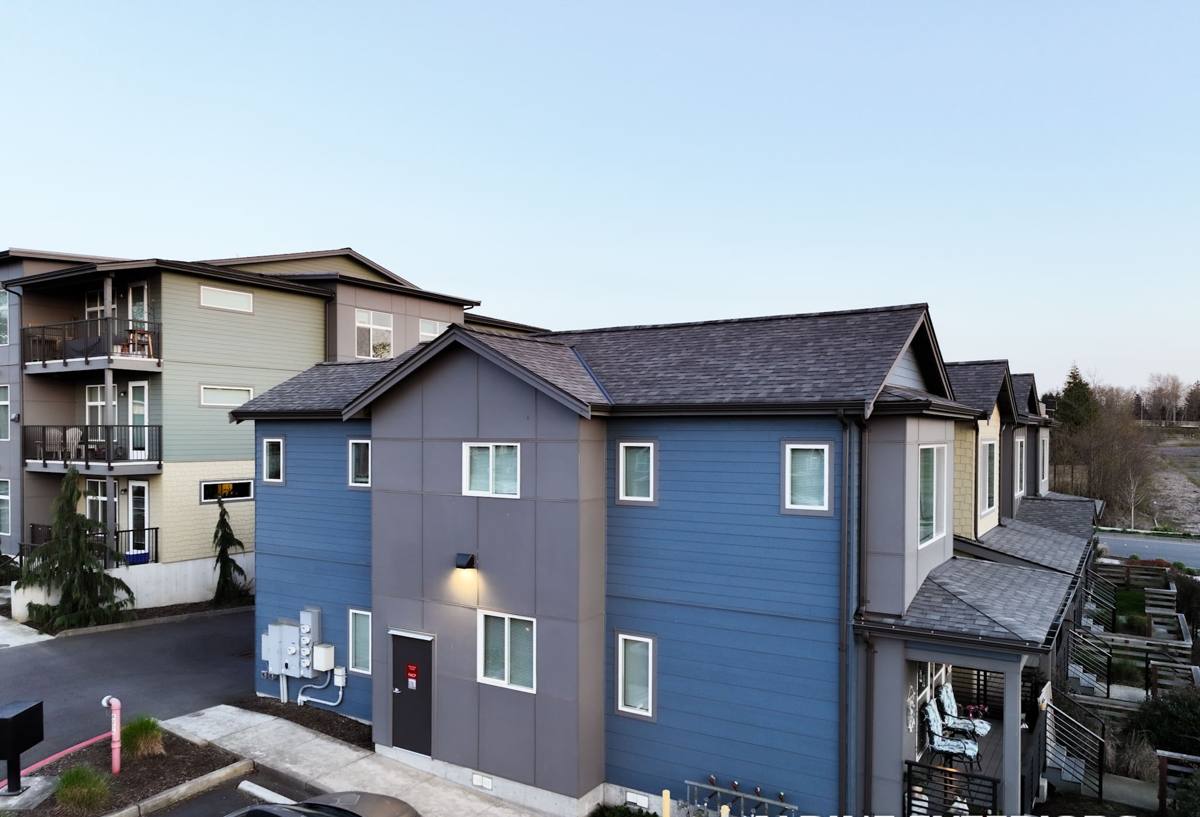
What Correct Siding Installation Actually Involves
Siding is a system, not a single product nailed to the wall. In an exposure like Blaine Harbor's, getting the system right matters more than the brand name on the plank.
Water Management Behind the Cladding
Before a single piece of siding goes up, the wall needs a continuous, properly lapped weather-resistive barrier, correctly integrated flashing at every window, door, and penetration, and a drainage plane that lets any moisture that does get behind the siding find its way back out instead of sitting against the sheathing.
Fastening and Clearances
Fastener type, spacing, and depth all affect how siding performs over time — especially in a salt-air environment where the wrong fastener corrodes years before the siding itself would fail. Ground clearance and clearance from decks, patios, and roof lines also matter, since those are the spots where standing water and splash-back do the most damage.
Sealants and Trim Details
Where caulking is appropriate versus where a design should rely on flashing and overlap instead is a judgment call that separates a durable installation from one that will need re-caulking every couple of years. Trim details around windows, corners, and utility penetrations are where most premature siding failures actually start.
Why We Install Only James Hardie Fiber Cement
We install one siding product: James Hardie fiber cement. That's not a marketing preference — it's a standard we settled on after weighing what different products actually do over a full lifespan in a climate like this one, and we think homeowners deserve the honest reasoning, not just a recommendation.
Fiber cement is non-combustible, which matters in any wildfire-adjacent region and is simply a sound long-term choice regardless. James Hardie's ColorPlus factory finish is baked on under controlled conditions rather than field-applied, which gives it more consistent adhesion and fade resistance than site-painted alternatives — a real advantage in an environment where UV, salt, and moisture all work against a finish at once. James Hardie also engineers specific product formulations for different climate zones, accounting for the moisture and temperature patterns a region actually sees rather than using one blend everywhere. And the warranty is transferable to a new owner, which matters to resale in a market like this one.
We don't install vinyl siding, LP SmartSide, Cemplank, Allura, primed spruce, or cedar. Each of those products has legitimate uses and each has honest customers. Our decision not to install them comes down to trade-offs we're not willing to build a business on: vinyl's expansion and impact vulnerability, engineered wood's dependence on perfect field sealing to avoid moisture intake, cedar's ongoing maintenance burden, and inconsistent quality control we've seen in some fiber cement competitors to Hardie. We'd rather install one product correctly than several products with compromises we'd have to explain away later.
Our Installation Process for Blaine Harbor Homes
Site Assessment and Moisture Check
We start by looking at the wall assembly itself, not just the old siding. That means checking for hidden moisture damage, evaluating sheathing condition, and noting exposure — waterfront-facing walls, shaded north sides, and areas near grade all get treated differently because they take different amounts of weather.
Prep, Weather Barrier, and Flashing
Old siding comes off, damaged sheathing gets repaired rather than covered over, and a new weather-resistive barrier goes on with proper lapping and integrated flashing at every opening. This is the step that determines whether the house stays dry for the next few decades, and it's the step that's easiest to shortcut if a crew is in a hurry.
Installing to Manufacturer Spec
James Hardie publishes specific fastening patterns, clearances, and joint treatment requirements, and following them exactly is what keeps the manufacturer's warranty valid. We follow that spec on every job, including the fastener corrosion-resistance requirements that matter more here than they would inland.
Final Inspection and Cleanup
Before we call a job finished, we walk the whole exterior checking laps, caulk lines, trim, and touch-up paint, and we clear the site of debris and old material.
Cost Factors for Siding Installation in Blaine Harbor
Every home is different, but the same handful of factors drive most of the cost variation we see on siding jobs in this area.
| Factor | Why It Matters Here |
|---|---|
| Home size and wall complexity | More square footage and more corners, gables, and dormers mean more material and more labor-intensive detail work |
| Tear-off and disposal | Removing old siding, especially if it's layered over a prior product, adds time and disposal cost |
| Hidden moisture or sheathing damage | Common on older waterfront-exposed walls; repair costs aren't known until the old siding comes off |
| Exposure level | Walls facing the water or prevailing wind need more attention to flashing and fastener spec, which affects labor time |
| Trim and detail complexity | Custom trim, multiple siding profiles, or extensive window and door surrounds add cost |
| Siding profile and color | Lap width, shingle-style accents, and ColorPlus color selection all have different material costs |
Signs It's Time to Replace Your Siding
Homeowners in Blaine Harbor often wait until a problem is visible from the street, but several warning signs show up earlier if you know where to look.
- Soft spots, bubbling, or visible warping, especially near the ground or under windows
- Persistent moss or algae staining that returns quickly after cleaning
- Paint that's peeling or chalking faster than expected for its age
- Visible gaps at seams, corners, or trim where caulking has failed
- Rust streaking from fasteners or metal flashing
- Interior signs like musty smells or discoloration on walls that back up to exterior siding
Choosing a Siding Contractor Who Knows Blaine Harbor
A crew that's only worked drier, inland jobs can miss details that matter on a waterfront-exposed home. Before hiring anyone for siding work in this area, it's worth checking a few things.
- Do they carry current licensing and liability insurance, and will they show proof without being asked twice?
- Are they certified or trained specifically on the manufacturer's installation spec for the product they're proposing?
- Can they explain, specifically, how they'll handle flashing and water management around windows and doors — not just "we'll caulk it"?
- Do they have experience with homes in this specific exposure — near water, wind-driven rain, salt air — rather than general regional experience only?
- Is the warranty (both manufacturer and workmanship) explained in writing, and is it transferable if you sell the home?
- Will they give you a written scope of work before starting, not just a total price?
Caring for Your New Siding
James Hardie siding is low-maintenance, but low-maintenance isn't no-maintenance, especially in this climate. A periodic rinse to keep salt residue and organic growth from building up, prompt attention to any caulking that starts to fail at trim joints, and keeping gutters and downspouts clear so water isn't dumping directly onto a wall section will all extend the life of the installation well beyond the baseline warranty period.
Ready to Talk About Your Home
If your siding is showing its age, or you're planning ahead before it becomes an urgent repair, we're happy to take a look and walk you through what we'd actually recommend for your home's specific exposure. There's no pressure and no obligation — just a straight assessment from a crew that installs one product and knows this stretch of Whatcom County's coastline. Request a free estimate using the form below.